EnPro Industries (NPO): Supplier relationships, constraints, and what investors should price in
EnPro Industries designs, manufactures and services engineered industrial components—selling through OEM and aftermarket channels across multiple specialty segments—and monetizes by combining product sales, aftermarket service contracts and targeted M&A to expand addressable markets. Revenue is product-led, margins are driven by engineered solutions and aftermarket servicing, and growth is augmented through acquisitions and distribution partnerships that embed EnPro deeper into customers’ supply chains. For an at-a-glance gateway into supplier intelligence for EnPro, visit https://nullexposure.com/.
Why supplier relationships matter for an industrial consolidator like EnPro
EnPro’s business model leverages scale in engineered components and aftermarket services; that model both reduces and creates supplier risk. On one hand, broad product lines and aftermarket revenues dilute single-order volatility; on the other, highly engineered components—especially in safety-critical areas like braking—create points of structural dependence on specific component technologies and supply partners. According to company disclosures, “We source a wide variety of materials and components from a network of global suppliers,” which is a clear corporate signal that EnPro runs a global sourcing network and organizes procurement to support multiple product platforms.
Operationally, investor-relevant characteristics include:
- Contracting posture: Evidence of structured distribution agreements and acquisitions indicates EnPro pursues formal partner arrangements that lock in routes to market for specific product families.
- Concentration: The company’s explicit global sourcing stance suggests geographic diversification of vendors; however, product-level concentration can persist where unique materials or technologies are required.
- Criticality: Friction and brake-related products are safety-critical; any supplier relationship in that space is higher priority for procurement and risk mitigation.
- Maturity: EnPro operates as an established industrial consolidator with publicly reported revenue of $1.1433B TTM and EBITDA of $275M, implying scale sufficient to negotiate and integrate supplier relationships, though valuation multiples (EV/EBITDA ~29.16) reflect market expectations of margin durability and growth.
The supplier relationships in the public record
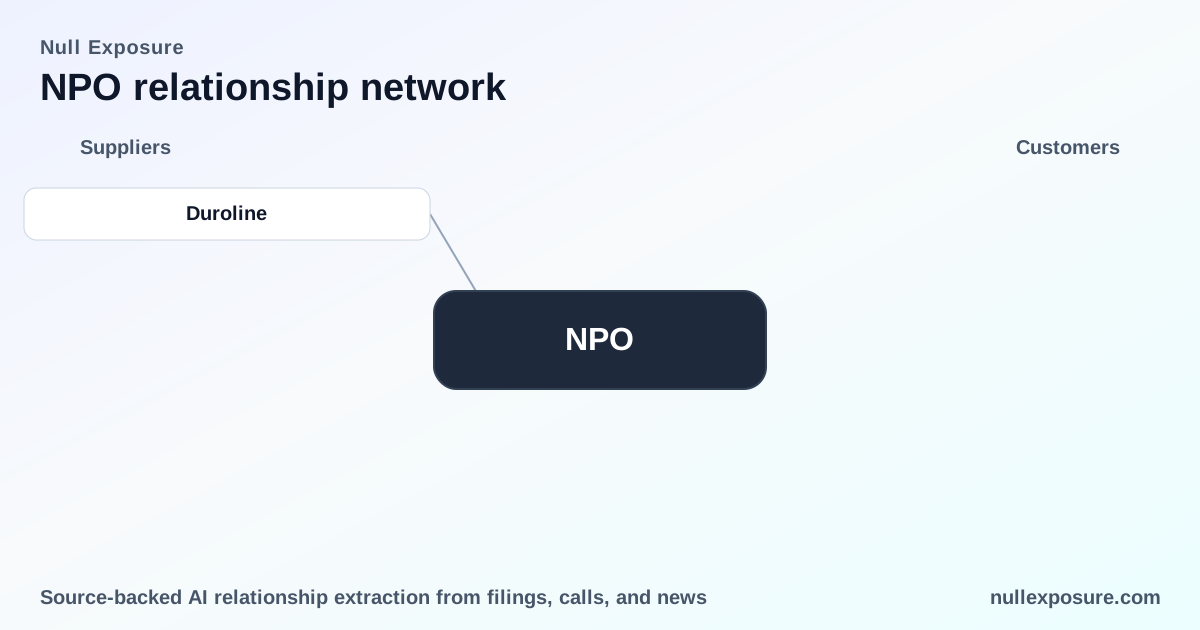
The database returns a single, material supplier relationship for the supplier scope on NPO; I cover it here without omission.
- Duroline — EnPro added friction products to its North American offering via a distribution agreement with Duroline, a Brazilian brake linings manufacturer, and the business will be integrated into Stemco’s brake products group, an EnPro company. According to TruckingInfo reporting on March 10, 2026, the arrangement expands Stemco’s friction portfolio through North American distribution rights with Duroline. (Source: TruckingInfo, news report, 2026-03-10.)
What that Duroline relationship means in plain English
The Duroline agreement is not a casual resale arrangement: it establishes a formal distribution channel into North America and folds product responsibility into Stemco’s brake products group, which positions EnPro to capture both margin on distribution and aftermarket service revenues tied to friction product replacement cycles. TruckingInfo’s March 2026 coverage frames this as an integration of new friction product lines into Stemco, signaling a deliberate product-line expansion rather than a one-off purchase. (Source: TruckingInfo, 2026-03-10.)
How to translate supplier signals into investment implications
Use the Duroline relationship and the company-level sourcing statement to draw operational conclusions:
- Strategic integration: The distribution agreement implies EnPro is comfortable embedding third-party manufactured components into its branded product portfolios, using distribution and aftermarket service to capture economics beyond simple resale.
- Negotiating leverage: With TTM revenue of $1.143B and EBITDA of $275M, EnPro operates at a scale that gives it purchasing leverage in supplier negotiations; that said, the premium valuation (EV/EBITDA ~29.16) prices in confidence that these supplier relationships will sustain margins and aftermarket capture.
- Supplier risk profile: A global supplier footprint reduces single-country disruption risk, but products that are safety-critical (brake friction materials) elevate the need for dual sourcing, inventory buffers, and regulatory oversight. The Duroline North American distribution agreement reduces lead-time risk for Stemco’s North American customers while concentrating product provenance in a named manufacturer.
- M&A and distribution as growth levers: The Duroline example illustrates EnPro’s playbook—acquire or partner to add product families and route-to-market—which supports recurring revenue via aftermarket cycles and justifies a willingness to pay for strategic distribution arrangements.
For more granular supplier analytics and to track follow-on disclosures, check tools hosted at https://nullexposure.com/.
Operational and risk considerations procurement teams and analysts should watch
- Single-supplier dependency in specialized product lines: Even if EnPro sources globally, single-source technologies for friction materials can create outsized disruption risk; confirm whether Duroline supplies are single-source for particular SKUs.
- Regulatory and quality oversight: Brake materials are safety-regulated; supplier QC processes and traceability are critical. Investors should confirm quality audit cadence and recall exposure.
- Currency and logistics exposure: A Brazilian manufacturing base supplying North America introduces FX and freight cost exposure—factors that affect gross margins in the near term and inventory strategy long-term.
- Integration execution risk: Turning a distribution agreement into recurring aftermarket revenue requires channel management, warranty provisions, and aftermarket parts inventory—areas where execution determines margin realization.
Actionable takeaways for investors and operators
- Confirm the commercial terms: Evaluate exclusivity, pricing floors, and minimum purchase commitments in the Duroline distribution agreement to assess revenue visibility and margin capture.
- Assess supply redundancy: For safety-critical product families, validate whether EnPro maintains second-source options or inventory buffers to limit outage risk.
- Monitor integration KPIs: Watch Stemco’s aftermarket attach rates and replacement-cycle penetration for early signs that the Duroline line is converting to recurring revenue.
For a consolidated view of supplier relationships and to subscribe to updates on EnPro and peer exposures, visit https://nullexposure.com/.
Bottom line
EnPro runs a global supplier network and uses targeted distribution agreements and acquisitions—exemplified by the Duroline friction-product deal—to grow product portfolios and aftermarket revenue streams. The Duroline relationship is strategically consistent with EnPro’s model: integrate third-party manufacturing where it accelerates market access and aftermarket capture, while relying on scale to preserve margin. Investors should focus diligence on contractual terms, sourcing redundancy, and integration execution to determine whether current valuation multiples reflect sustained structural advantages.
If you want continuous tracking of supplier disclosures and partnership movements for EnPro, explore the service at https://nullexposure.com/ and set up alerts for any material supplier changes.