NPT supplier relationships: what investors need to know
NPT operates as a commercial supplier that outsources capital markets and investor-communications functions to third-party boutique providers and monetizes through transaction fees and retained services tied to capital raises and corporate communications. The visible supplier footprint is narrow and transaction-focused: capital markets execution and investor relations are handled by external specialists, which implies a lean in-house model and fee-based monetization aligned to discrete financing events. If you are evaluating NPT as a counterparty or as part of vendor-risk due diligence, the supplier list below signals a tactical, event-driven vendor posture rather than a broad, multi-provider ecosystem. For a consolidated view of NPT’s supplier signals and disclosures, see https://nullexposure.com/.
What the public reporting reveals about NPT’s vendor strategy
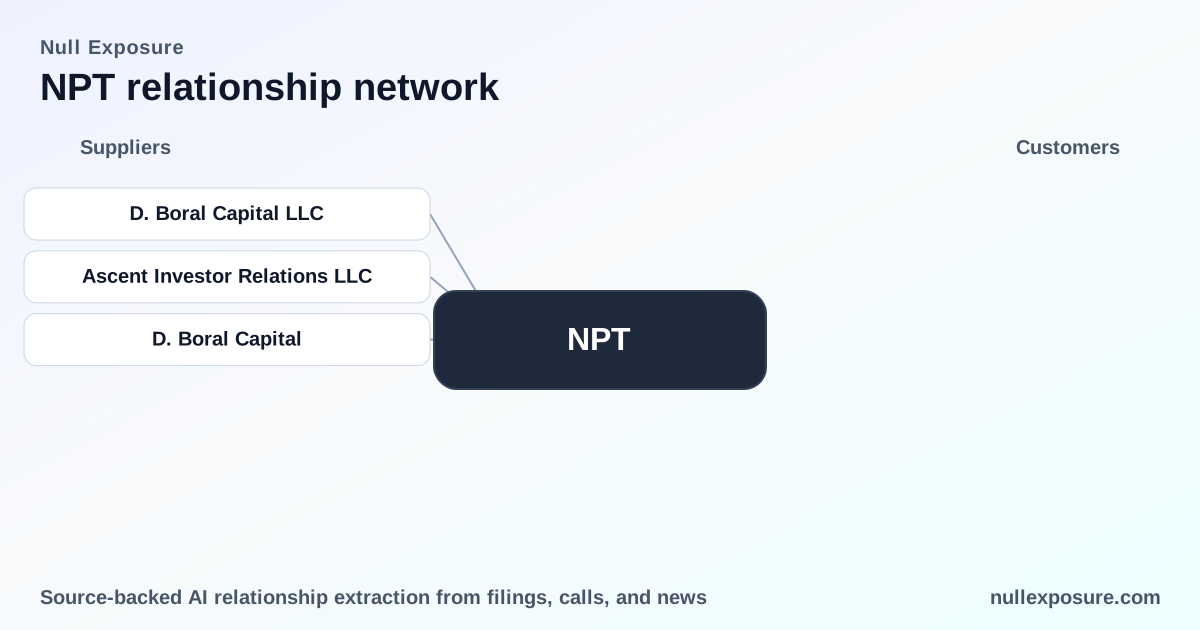
The captured relationships show NPT using specialist providers for discrete capital market activities. D. Boral Capital is documented as the sole book-running manager on an offering tied to Texxon Holding Limited, and Ascent Investor Relations is listed as the external IR contact on the same communications. These are not platform vendors; they are event-driven advisors whose compensation and activation will be concentrated around deals.
- Concentration: The supplier set is highly concentrated and transactional — a small number of advisors cover high-impact functions.
- Contracting posture: The use of a sole book-runner suggests NPT (or its related issuer activity) accepts single-provider execution for speed and control during offerings.
- Criticality: These relationships are mission-critical during capital raises and investor outreach; operational disruption of either provider would materially affect execution.
- Maturity and disclosure: Publicly visible disclosures are limited to transactional press materials, which signals either minimal ongoing retainer relationships or limited public disclosure practices.
If you want a deeper read on supplier disclosures and historical relationship signals, visit https://nullexposure.com/.
Relationship details (every reported counterparty)
D. Boral Capital LLC — acted as sole book-running manager for the offering tied to Texxon Holding Limited. According to a GlobeNewswire press release dated October 23, 2025, D. Boral Capital LLC served as the sole book-running manager on the offering; the same detail is repeated in a Yahoo Finance syndication of the release and in RenaissanceCapital’s IPO coverage (Oct 2025). These references indicate a single-lead underwriting model for the transaction (GlobeNewswire, Yahoo Finance, RenaissanceCapital, Oct 2025).
Ascent Investor Relations LLC — listed as the investor relations contact for the Texxon Holding Limited communications. The GlobeNewswire press release and its Yahoo Finance mirror include Ascent Investor Relations LLC contact details and an IR phone/email for Tina Xiao, positioning Ascent as the external IR firm supporting investor communications for the offering (GlobeNewswire and Yahoo Finance, Oct 2025).
Why these relationships matter to investors and operators
The presence of a sole book-runner and an external IR firm together creates a tight execution loop for capital raises: underwriting and market-facing communications are both outsourced, which accelerates deal timelines but concentrates execution risk. For investors and counterparties, that translates into a few practical signals:
- Speed over redundancy: Single-provider selection favors fast execution and consistent messaging, but reduces redundancy if the provider fails or withdraws.
- Reputational coupling: The market perception of the offering is linked to the underwriter and IR shop; reputational or regulatory issues at either firm will reflect directly on the issuer activity.
- Event-driven cost structure: Expect fee spikes around offerings rather than steady vendor expense; operational budgets should account for lumpy, high-impact spend during transactions.
Practical due-diligence checklist
When evaluating NPT supplier risk in this context, focus on three areas:
- Confirm contractual terms for underwriting and IR engagements (fees, termination rights, regulatory responsibilities).
- Verify provider track records for similar-sized US listings and cross-border transactions; underwriters and IR firms determine market reception.
- Assess contingency arrangements: who would step in if an exclusive provider withdraws mid-process?
These steps reduce execution risk and illuminate whether the current supplier posture is strategic or merely opportunistic.
Constraints and what their absence signals
The data payload contains no explicit contractual constraints or long-form supplier commitments disclosed as constraints. At the company level, the absence of public constraint disclosures is itself a signal: either long-term contractual constraints do not exist, or NPT’s public reporting of supplier terms is limited. For investors this implies:
- Lower visibility on supplier commitments increases reliance on primary diligence (contracts, references) rather than public filings.
- Operational flexibility—no disclosed binding constraints suggests NPT retains the ability to change providers quickly, which is positive for agility but raises questions about continuity planning.
Final takeaways and next steps
Key takeaway: NPT’s documented supplier relationships are narrow and transaction-centric — D. Boral Capital as sole book-runner and Ascent Investor Relations as the external IR contact for the referenced offering — signaling a lean outsourcing model optimized for discrete capital-market events. For investors assessing counterparty or supplier risk, prioritize contract review, contingency planning, and provider reputation checks.
For a consolidated supplier-risk dashboard and ongoing monitoring of NPT disclosures, visit https://nullexposure.com/. If you want tailored intelligence on NPT’s vendor contracts and interruption risk, start here: https://nullexposure.com/.
Close your diligence loop by validating the listed provider engagements against contract copies and regulatory filings; vendor concentration around capital markets execution is a measurable operational risk that should be priced into underwriting and counterparty exposure models. For further supplier signals and deeper supplier coverage, see https://nullexposure.com/.