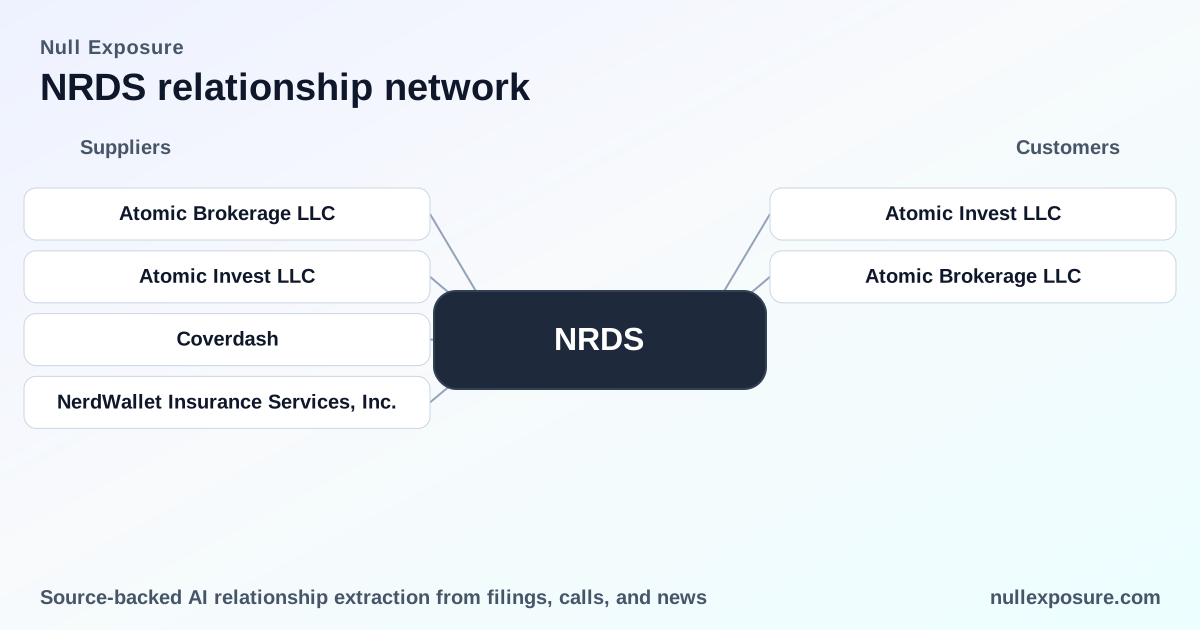
NerdWallet (NRDS) — Supplier relationships you need to price into the risk model
NerdWallet operates a consumer-facing personal finance platform that connects users to financial product providers and licensed affiliates; the company monetizes through advertising, partner referral fees, and revenue-sharing on advisory and brokerage referrals—including AUM-linked compensation when users open investment accounts. For investors and operators, the supplier map is dominated by a small set of partners and in-house licensees that deliver regulated financial services, so revenue upside is paired with outsized operational and compliance risk driven by those relationships.
Explore detailed supplier intelligence at https://nullexposure.com/.
Why suppliers matter to the investment case
NerdWallet’s growth profile and margins depend on driving high-intent traffic to partners and capturing referral economics. That model creates two structural characteristics investors must price in:
- Contracting posture and criticality: NerdWallet outsources regulated product delivery (investment advisory, brokerage, insurance distribution) to partners and affiliated legal entities, making those suppliers operationally critical to monetization.
- Concentration and revenue linkage: A handful of partner agreements produce referral fees and AUM-based compensation, which concentrates counterparty risk even if headline revenue is diversified across product verticals.
- Maturity and formality: Supplier engagement is governed through licensed affiliates and registered entities, which reduces legal risk relative to informal partnerships but increases compliance burden and exposure to regulatory changes.
NerdWallet itself discloses that it “relies on third parties to perform certain key functions,” a company-level signal that supplier performance is material to results.
What the supplier roster looks like — the relationships you should underwrite
Atomic Invest LLC — the AUM referral engine
NerdWallet has an ongoing commercial relationship with Atomic Invest LLC, a registered investment adviser that receives referrals from NerdWallet for Automated Investing and Treasury accounts; NerdWallet receives 0% to 0.85% of assets under management annualized, payable monthly, plus a share of free cash interest, a direct AUM-linked revenue stream disclosed across NerdWallet content (multiple FY periods). (See NerdWallet investment pages, e.g., https://www.nerdwallet.com/article/investing/i-bonds — FY2022/FY2025 disclosure.)
Atomic Brokerage LLC — brokerage services and compliance overlay
Brokerage functions for Atomic’s investment offering are provided by Atomic Brokerage LLC, a FINRA/SIPC member and affiliate; NerdWallet discloses this arrangement as a potential conflict of interest and the legal vehicle that executes brokerage flows for referred clients. This is a critical fulfillment partner because brokerage licensing and custody are prerequisites for referral economics. (See NerdWallet disclosures, e.g., travel/investing pages: https://www.nerdwallet.com/investing/learn/switch-brokers-move-investments — FY2025.)
Coverdash — business insurance lead and fulfillment partner
NerdWallet Small Business routes commercial insurance quote requests and instant Certificate of Insurance (COI) access through partner Coverdash, which supplies real-time quotes from multiple insurers and COI issuance functionality; this supports NerdWallet’s SMB product monetization and contributes to lead-generation revenue in the business-insurance vertical. (See builders-risk insurance page: https://www.nerdwallet.com/business/insurance/learn/builders-risk — FY2025.)
NerdWallet Insurance Services, Inc. — in-house insurance distribution capability
NerdWallet uses a licensed affiliate, NerdWallet Insurance Services, Inc. (California resident license OK92033), to offer insurance services in states that require licensed intermediaries; this entity is the company’s internal distribution vehicle for certain insurance products and is disclosed on consumer-facing pages. Having a licensed affiliate creates captive distribution optionality while exposing the company to insurance regulatory compliance. (See disclosure on NerdWallet content, e.g., travel/cheapest-business-class page: https://www.nerdwallet.com/travel/learn/cheapest-business-class-awards-to-europe — FY2020.)
Operational constraints and what they imply for valuation and operations
NerdWallet’s public disclosures include a company-level statement that it “relies on third parties to perform certain key functions,” which is a clear operating constraint with investment implications:
- Outsourcing posture: The business model intentionally externalizes regulated execution (investment advice, brokerage, insurance distribution) to licensed third parties and affiliates, reducing capital intensity but increasing dependence on partner execution and contract stability.
- Concentration risk: Because referral economics (including the AUM share with Atomic) are material to product monetization, a loss or deterioration of a single partner agreement would create concentrated revenue downside disproportionate to its nominal share.
- Regulatory and compliance exposure: Using registered advisers and broker-dealers reduces legal risk compared with unlicensed arrangements, but it increases the company’s exposure to partner-level regulatory actions, licensing changes, and required disclosures that can depress conversion and AUM flows.
- Maturity and switch-cost dynamics: Relationships with licensed affiliates imply formalized contracts and operational integration; switching partners is plausible but operationally costly and could temporarily depress monetization while replacements are integrated.
These constraints are company-level signals—do not attribute them to any single partner unless the public excerpt explicitly names that partner.
Investment implications — price for partner concentration and compliance execution
- Revenue multiples should reflect both AUM-derived recurring revenue and execution risk from partner reliance; NerdWallet’s forward EV/EBITDA (~5.11 EV/EBITDA per public metrics) discounts some operational leverage, but investors should stress-test partner scenarios given the disclosed outsourcing posture.
- Monitor partner economics: changes to the 0–0.85% AUM referral structure or any change in brokerage/custody arrangements for Atomic would have outsized P&L impact.
- Evaluate regulatory updates and FINRA/SEC actions affecting the registered affiliates — enforcement risk to Atomic or to an affiliate increases funding and reputational risk to NerdWallet’s referral franchise.
If you want detailed counterparty scoring and exposure modeling for NRDS supplier relationships, see structured supplier intelligence at https://nullexposure.com/.
What operators should prioritize
- Strengthen contract terms that protect referral economics and data access in case of partner termination.
- Increase redundancy where possible (alternate licensed partners, COI issuance pathways) to reduce single-point-of-failure risk in business insurance and investing funnels.
- Maintain robust disclosure and compliance oversight for affiliate arrangements to lower friction in user conversion and to reduce litigation/regulatory tail risk.
For a rapid vendor-risk diagnostic and to map material supplier exposure into valuation scenarios, visit https://nullexposure.com/ and request an NRDS supplier-impact briefing.
Final takeaway
NerdWallet’s monetization is efficient but partner-dependent: referral fees and AUM shares delivered through Atomic and insurance distribution via Coverdash and an in-house licensed affiliate provide predictable revenue streams, but they concentrate operational and regulatory risk. Investors should underwrite conversion and partner-stability shocks into fair value, and operators should prioritize contractual protections and redundancy to preserve growth compounding.