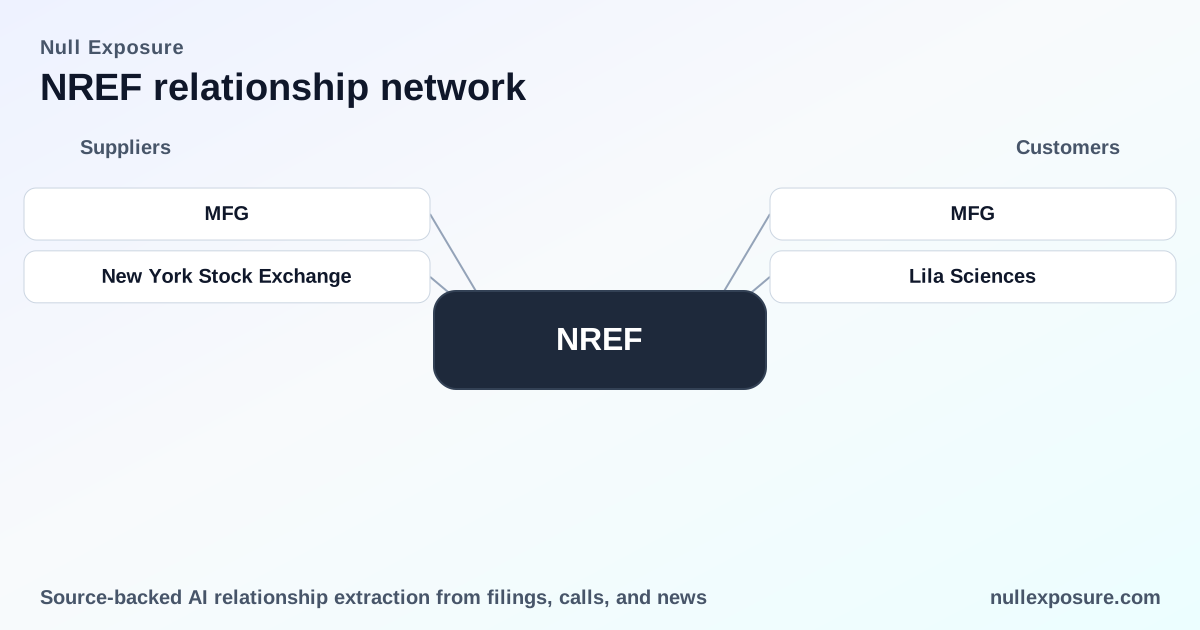
NexPoint Real Estate Finance (NREF): supplier relationships and what they mean for investors
NexPoint Real Estate Finance (NREF) is a mortgage REIT that originates, acquires and manages first- and second-lien loans and single-asset, single-borrower commercial real estate securities; the company is externally managed, earns net interest income and fee revenue from its loan and securities portfolio, and pays a significant portion of cash flow as dividends to shareholders while using short-term financing and equity issuance programs to manage liquidity. For investors evaluating supplier risk, the critical facts are NREF’s external management structure, short-term contracting posture, and selective counterparty engagements that support securitizations and capital-market listings. If you want a quick supplier exposure map, visit the supplier hub at https://nullexposure.com/ for a concise view of counterparties and contract terms.
How NREF makes money and how that shapes supplier needs
NREF’s revenue profile is straightforward: interest and fee spread from mortgage assets plus incidental earnings on structured positions. The company delegates most day‑to‑day operations to an external manager — NexPoint Real Estate Advisors VII, L.P. — and compensates that manager via an annual fee equal to 1.5% of Equity, paid monthly in cash or stock. That structure concentrates operational dependency on the Manager and creates a service-provider relationship that is central to NREF’s capacity to originate, underwrite and manage assets.
Contracting posture is clearly short-term: the Management Agreement was renewed on February 6, 2025 for a one-year term and continues on successive one-year renewals, and the company has utilized short-dated credit (for example, a NexBank loan that matured with 364‑day extension options). Short-term contracts give the company flexibility but also heighten counterparty renewal risk and underscore the importance of maintaining market access. NREF complements its capital plan with a framework ATM equity distribution program that provides optionality to sell common or Series A preferred shares up to $100 million — a framework relationship with investment banks rather than a long-dated exclusive commitment.
Counterparty notes: the relationships you need to know
Mizuho — active re-REMIC counterparty (structured finance)
NREF disclosed a re-REMIC transaction with Mizuho in which NREF sold the B piece of its 2017-K62 D/B tranche and purchased a horizontal risk-retention tranche representing roughly 5.8% of the re-REMICs, repositioning its exposure within the securitization stack. This was discussed on the company’s Q4 2025 earnings call transcript (reported March 2026). (Source: InsiderMonkey earnings-call transcript, March 10, 2026 — https://www.insidermonkey.com/blog/nexpoint-real-estate-finance-inc-nysenref-q4-2025-earnings-call-transcript-1705304/)
New York Stock Exchange — listing venue for common and preferred shares
NREF’s common stock and Series A Preferred Stock are listed on the New York Stock Exchange under the symbols NREF and NREF PRA, respectively, providing on‑exchange liquidity and visibility for investors. The company announced Series A preferred details in a PR Newswire release in March 2026. (Source: PR Newswire release, March 2026 — https://www.prnewswire.com/news-releases/nexpoint-real-estate-finance-inc-announces-series-a-preferred-stock-dividend-302696242.html)
Operational constraints and what they signal for supplier risk
Several company‑level constraints in public materials explain how supplier relationships behave in practice:
-
Short-term contracting posture. The Management Agreement is a one‑year renewable contract (renewed Feb 6, 2025), and the company has used short‑dated lending arrangements (e.g., a NexBank loan with maturity and extension options). This structure prioritizes operational flexibility and places emphasis on the ongoing counterparty relationship rather than long-duration contractual lock‑ins.
-
Framework capital markets relationships. The ATM equity distribution agreements with multiple sales agents create non-exclusive, on-demand access to equity capital, which is a framework rather than a fixed supply contract — useful for opportunistic funding but not a guaranteed long-term liquidity line.
-
Geographic concentration. Corporate and management operations are centered in Dallas, Texas, signaling a North America operational footprint with centralized management teams.
-
Service-provider dependency and active engagement. The Manager conducts substantially all operations and earned recurring management fees ($3.9M in 2024), indicating high criticality and concentration around the Manager and its affiliate network. These relationships are described as active in filings and financial disclosures.
Taken together, these constraints create a supplier risk profile where operational continuity depends more on relationship quality and market access than on long-term contractual guarantees. That elevates the importance of counterparties that provide transactional services (securitization, trading, exchange listing) and capital markets distribution on flexible terms.
What investors should watch next
- Monitor securitization counterparties and transactions. The re-REMIC with Mizuho shows NREF’s active trading of structured risk and willingness to hold horizontal risk-retention tranches; watch quarterly disclosures for changes in REMIC positions and counterparty counterparties.
- Track the Manager relationship and its compensation cadence — fees are recurring and material to operations. Any material change to the Management Agreement or the Manager’s capacity would be immediately consequential.
- Watch the ATM program utilization and any short-term lending renewals to assess liquidity posture and dilution risk.
Key takeaways:
- External management is the single biggest supplier concentration risk.
- Short-term contracts and framework relationships grant flexibility but raise renewal and market-access risk.
- Counterparties such as Mizuho (structured finance) and the NYSE (listing venue) are operationally significant but not substitutes for a stable management arrangement.
If you need a visual breakdown of NREF’s supplier map or want to compare counterparty concentration across mortgage REITs, explore a tailored supplier report at https://nullexposure.com/.
Final verdict for investors and operators
NREF operates a capital‑intensive, externally managed business where counterparty quality and market access determine execution. The firm’s short-term contractual posture supports nimble asset repositioning but increases dependence on repeat counterparties and capital markets windows. The Mizuho re-REMIC activity demonstrates active portfolio engineering; the NYSE listing anchors liquidity. For investors, the focus should be on tracking managerial continuity, securitization exposures, and ATM usage as leading indicators of operational stability and funding risk.
For a deeper supplier relationship analysis and real-time counterparty alerts, visit our platform at https://nullexposure.com/ and request the NREF supplier dossier.