Energy Vault (NRGV): Supplier relationships that drive scale — and where the risk lives
Energy Vault is an energy storage systems integrator and asset owner that monetizes through system sales, long‑term energy services contracts and an Asset Vault platform that acquires operational projects. The business combines off‑the‑shelf component procurement, third‑party manufacturing and EPC execution to deliver storage systems, while selectively retaining ownership and contracts to capture asset cash flow. For investors, the model produces two revenue streams — project sales and asset‑level revenues — but also concentrates operational and execution risk in supplier and service relationships. Learn more and map counterparties at https://nullexposure.com/.
How Energy Vault actually operates and why suppliers matter
Energy Vault’s reported results (Revenue TTM $83.8M; Gross Profit TTM $19.0M; negative EBITDA) confirm a company in growth mode but not yet consistently profit generating. The company operates as an integrator and project developer rather than a vertically integrated manufacturer: product stacks are assembled from widely available components, third‑party factories produce meaningful subsets of hardware, and third‑party EPC firms build systems under Energy Vault’s project management. That operating posture accelerates deployment but shifts execution risk to suppliers, EPC contractors and service partners — and makes supplier agreements, like the ones below, material to both growth trajectory and margin compression.
For a consolidated supplier map and deeper counterparty intelligence visit https://nullexposure.com/.
Supplier relationships you need on your radar
Peak Energy — strategic supply tie for sodium‑ion cells
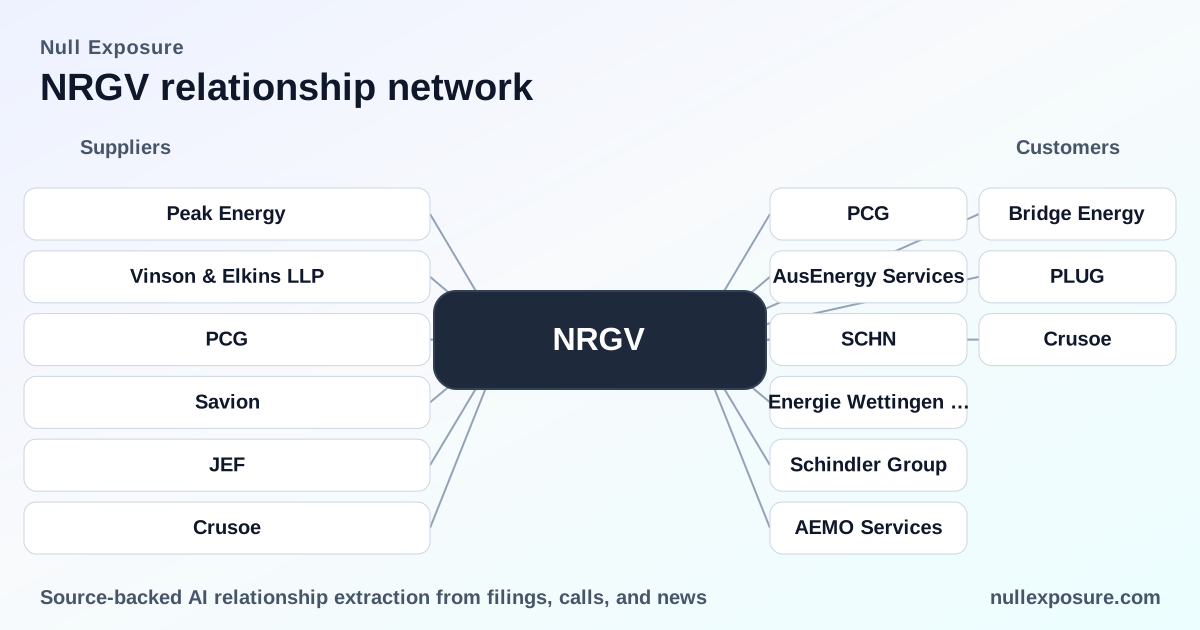
Energy Vault executed a definitive supply agreement securing 1.5 GWh of U.S.‑manufactured sodium‑ion battery systems from Peak Energy, positioned to support AI‑first data center deployments and reduce system cost. According to a BatteriesNews release and contemporaneous Yahoo Finance coverage (March 10, 2026), the arrangement is framed as a strategic development agreement with supply commitments for large‑scale deployment.
Vinson & Elkins LLP — legal advisor on capital raise
Vinson & Elkins acted as legal advisor to Energy Vault in connection with the closing of a $300 million preferred equity financing, underscoring the use of external legal counsel for significant capital transactions. That detail was disclosed in coverage of the financing (advfn, March 2026).
Jefferies LLC — placement agent and financial advisor on financing
Jefferies served as sole placement agent and exclusive financial advisor on Energy Vault’s $300 million preferred equity raise, signaling active use of investment bank distribution to secure growth capital (advfn, March 2026).
Pacific Gas and Electric Co. (PCG) — distribution operator on an owned resiliency asset
Energy Vault owns the Calistoga Resiliency Center, with PG&E acting as the distribution system operator under a long‑term energy services agreement, establishing a utility counterparty model where the company retains assets but outsources certain operational interface responsibilities (PV‑Magazine USA, September 30, 2025).
Savion (Shell subsidiary) — original developer of an acquired Texas BESS
A 150 MW battery energy storage project originally developed by Savion was acquired by Energy Vault through its Asset Vault investment platform, marking the company’s strategy to grow a contracted/owned project pipeline by buying third‑party developed assets (AltEnergyMag, October 23, 2025).
Crusoe — framework for deploying modular AI data center capacity
Energy Vault entered a strategic framework agreement with Crusoe to deploy Crusoe Spark modular AI factory units alongside Energy Vault’s systems in support of Crusoe Cloud, linking storage deployment with distributed compute demand (Finviz coverage, March 2026).
What the company disclosures say about operating constraints and supplier posture
Energy Vault’s public disclosures describe three consistent operating‑model signals that shape supplier relationships and execution risk:
- Buyer/integrator posture: Energy Vault sources many components “off‑the‑shelf” and procures from multiple sources worldwide, signaling breadth of suppliers but an emphasis on integration rather than part fabrication. This lowers capital intensity of manufacturing but increases reliance on external supply continuity.
- Contract manufacturing reliance: Filings state that Energy Vault does not generally manufacture core components and that some parts are made at supplier factories while others are produced near project sites, indicating a hybrid manufacturing model that depends on supplier quality control and logistics.
- Service‑provider dependencies: The company relies on third‑party EPC firms for construction under Energy Vault supervision and holds service agreements with data center operators and other service providers, making system delivery and ongoing operations contingent on external contractors and network/service availability.
Taken together these constraints present a consistent picture: Energy Vault is a systems integrator and asset owner that trades manufacturing CAPEX for supplier and contractor execution risk. That trade improves capital efficiency but concentrates critical execution points around supply contracts, EPC delivery and utility/service partner performance.
For more detailed counterparty analysis and relationship visualizations, see https://nullexposure.com/.
Investment and operational implications — what investors and operators should focus on
- Commercial scale depends on supply commitments: The Peak Energy 1.5 GWh commitment demonstrates a pathway to scale cell supply for sodium‑ion systems, which is central to cost reduction and margin improvement. Contracts with credible cell suppliers materially change unit economics.
- Capital sourcing is active and bank‑led: The Jefferies‑led placement and external legal counsel illustrate continued reliance on external capital markets and advisors to fund growth and asset acquisitions; monitor future financing cadence and dilution impact.
- Asset ownership requires different risk controls: Acquisitions through the Asset Vault platform (Savion deal) imply Energy Vault is growing an asset book; that shifts the risk profile toward long‑term O&M, counterparty credit (utility counterparties like PG&E) and merchant market exposures.
- Execution risk sits with suppliers and EPCs: The company’s non‑manufacturing posture makes supplier concentration, lead times and quality control leading indicators for delivery timelines and margin performance. Operational diligence should prioritize supplier KPIs and EPC performance metrics.
- Commercial synergies with AI/compute partners: The Crusoe framework ties storage capacity to modular compute demand, creating a potentially higher‑value bundled offering for edge/AI customers; track contract economics and revenue recognition models.
Bottom line
Energy Vault’s model is scalable via supplier partnerships and asset acquisitions, but scaling requires flawless execution across a broad supplier and contractor ecosystem. The Peak Energy supply agreement, Savion asset acquisition and utility operating agreements with PG&E are concrete inflection points that accelerate deployment but also concentrate operational risk in external relationships. Investors and operators should prioritize monitoring supplier commitments, EPC execution, and financing activity as the clearest levers of near‑term performance.
For a full map of these and other counterparties — and to track how supplier relationships evolve — visit https://nullexposure.com/.