Nurix Therapeutics (NRIX): Supplier relationships, capital posture, and operational constraints
Nurix Therapeutics operates as a discovery-to-clinic small-molecule biopharma focused on oncology and immune disorders, monetizing value through clinical-stage programs, selective partnerships, and recurring use of equity markets to fund development. The company outsources virtually all clinical and manufacturing work, and management supplements R&D runway through at‑the‑market (ATM) equity programs that enable rapid access to public capital. For investors and operators evaluating supplier counterparty risk and capital strategy, the interplay between single-source manufacturing dependence and aggressive equity distribution capacity is the defining dynamic. Learn more about how we track supplier signals at https://nullexposure.com/.
Why supplier relationships matter for Nurix: the operating model in plain terms
Nurix intentionally remains asset-light on manufacturing and clinical operations. Clinical trials, drug substance, and finished product manufacturing are outsourced to contract research organizations (CROs) and contract manufacturing organizations (CMOs). This model conserves capital and speeds program execution but concentrates operational risk in a small set of external partners. Contract terms are generally short‑term and cancelable, which gives Nurix flexibility but requires continuous vendor management and contingency planning.
What this means for investors:
- Critical dependency: Outsourcing is not peripheral — it is central to Nurix’s ability to advance candidates, making supplier continuity a material risk to timelines and costs.
- Concentration risk: The company discloses single‑source suppliers for key inputs, elevating disruption sensitivity.
- Geographic exposure: Nurix relies on third parties in APAC, including China, for contract manufacturing, introducing geopolitical and supply‑chain complexity.
Constraints that shape partner risk and procurement posture
Nurix’s public disclosures and filings show a consistent set of operating constraints that inform supplier evaluation:
- Contracting posture — short‑term/cancelable: Nurix executes vendor agreements that are generally cancelable on notice, which delivers cost control and flexibility but increases the operational overhead of re‑sourcing if a supplier fails.
- Geographic concentration — APAC reliance: The company uses third‑party manufacturers in China for some processes, which introduces logistics, regulatory, and geopolitical vectors to supplier risk.
- Materiality — suppliers are critical: The company explicitly states it outsources substantially all clinical and manufacturing activity, creating a dependency that would materially affect operations if disrupted.
- Relationship roles — manufacturer and service provider: Partners function both as CMOs (manufacturing) and CROs (clinical services), reinforcing the need to evaluate capability across both process scale and trial execution.
- Relationship stage — active: Outsourcing is current and ongoing for multiple programs, not a legacy or one‑off arrangement.
- Segment spend — mid‑range expenditures: Contract manufacturing line items reported in filings show spend levels consistent with the $10m–$100m band, signaling material but manageable vendor spend that justifies rigorous vendor oversight.
These constraints outline an operating profile that is capital‑efficient but operationally concentrated. Investors should underwrite timelines and dilution expectations with supplier continuity factored into scenario analyses.
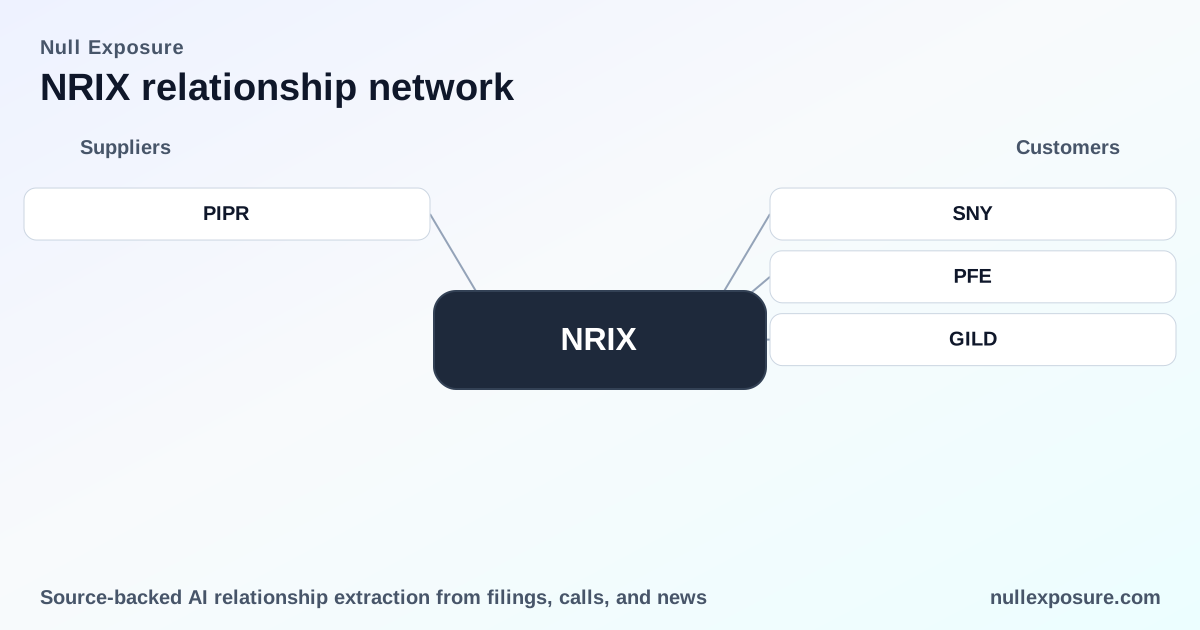
Supplier relationship snapshot: Piper Sandler ATM arrangements
Nurix has an active capital market supplier relationship with Piper Sandler tied to equity distribution services. The public record contains multiple mentions of the same program change; below are each of the reported items from our coverage.
-
Nurix entered into an amendment to sell up to $413.65 million of common stock via an at‑the‑market program with Piper Sandler, enlarging its equity distribution capacity. TradingView reported this amendment on March 10, 2026. (TradingView, March 10, 2026)
Source: https://www.tradingview.com/news/tradingview:4fb61fa925ee5:0-nurix-therapeutics-adds-413-65m-at-the-market-equity-facility-with-piper-sandler/ -
Market commentary reiterated that Nurix expanded the equity distribution agreement to allow up to $413.65 million of sales through Piper Sandler, framing the move as a lever for balance sheet flexibility in FY2026. Simply Wall St covered the expansion on March 10, 2026. (Simply Wall St, March 10, 2026)
Source: https://simplywall.st/stocks/us/pharmaceuticals-biotech/nasdaq-nrix/nurix-therapeutics/news/a-look-at-nurix-therapeutics-nrix-valuation-after-expanded-e/amp -
Nurix’s FY2026 SEC reporting confirms the company has utilized ATM offerings under an Equity Distribution Agreement with Piper Sandler as a recurring financing tool. TradingView summarized the 10‑K reporting on March 10, 2026. (TradingView, March 10, 2026)
Source: https://www.tradingview.com/news/tradingview:8b8af13f6fc2f:0-nurix-therapeutics-inc-sec-10-k-report/
These entries collectively document an explicit capital‑markets service relationship: Piper Sandler provides equity distribution capacity that Nurix leverages to manage funding for its outsourced pipeline.
Capital strategy, dilution, and supplier-risk interplay
Nurix’s operating model and its Piper Sandler relationship create a tight coupling between supplier continuity and capital strategy. ATM programs give management flexibility to access capital quickly, smoothing financing between larger strategic financings and mitigating the need for dilutive large rounds timed to binary events. That flexibility trades off against dilution risk: sustained or repeated ATM selling at lower prices materially dilutes shareholders even as it preserves program execution.
On the supplier side, single‑source CMOs and APAC manufacturing mean that any production hiccup can extend trial timelines and increase cash burn, which in turn increases the likelihood of equity issuance. Investors should underwrite development scenarios with supplier disruption probabilities baked into cash‑flow models.
Key operational considerations:
- Inventory and redundancy planning: Given short‑term contracts and single‑source suppliers, Nurix must maintain contractual and operational levers to pivot quickly in the event of supplier failure.
- Regulatory and geopolitical exposure: APAC manufacturing relationships necessitate contingency strategies for regulatory inspections and cross‑border logistics.
- Capital readiness: The expanded ATM with Piper Sandler signals management expects a financing runway that can be topped up on demand for development continuity.
If you want a structured supplier-risk profile and capital scenario analysis for NRIX, start with a strategic scan at https://nullexposure.com/.
What investors and operators should do next
Nurix’s profile is straightforward: asset‑light R&D, critical external suppliers, and active use of equity markets for funding. For actionable next steps, focus on these items:
- Conduct diligence on supplier redundancy and qualification timelines; prioritize suppliers with validated tech transfer capabilities.
- Model cash burn under multi‑month manufacturing delays and stress-test dilution under ATM issuance scenarios.
- Monitor ATM utilization and broker communications with Piper Sandler for pace and pricing of sales.
For a deeper supplier and capital‑market readiness review, visit our research portal at https://nullexposure.com/.
Bottom line
Nurix combines an efficient outsourced operating model with a deliberate equity‑market financing playbook. That combination supports aggressive clinical advancement but concentrates risk in a few external partners and the public markets. Investors should weigh the upside of program progress against the dual vulnerabilities of supplier disruption and dilution through ATM programs. For ongoing surveillance of NRIX supplier exposures and capital events, return to https://nullexposure.com/ for updated supplier maps and financing alerts.