Neurosense Therapeutics (NRSN): Supplier relationships that shape clinical value creation
Neurosense Therapeutics is a clinical-stage biotechnology company that advances neurodegenerative therapies and derives value by progressing candidates through clinical milestones, then commercializing or licensing successful assets. The company monetizes by unlocking clinical proof-of-concept for its lead programs and converting that clinical value into partnership payments or downstream commercial deals; its supplier relationships are therefore directly tied to its ability to generate credible clinical data. Learn more about the supplier exposure and risk profile at https://nullexposure.com/.
Why suppliers are strategic for a trial-stage neuro company
For a small, clinical-stage company like Neurosense, external suppliers are not peripheral vendors — they are mission-critical extensions of R&D and regulatory execution. The company reports no revenue, a market capitalization of roughly $27.1 million, and negative operating economics (latest EBITDA -$8.55M, EPS -$0.36), which makes the ability to access high-quality development, biomarker and diagnostic services essential to advancing programs without building costly internal capabilities.
- Contracting posture: Neurosense operates as an outsourcer of specialized functions; it uses third-party development and diagnostic partners to execute clinical protocols.
- Concentration and criticality: Given the company’s stage and zero revenue, a small set of suppliers providing assay development or clinical measurement technology carries outsized importance to trial timelines and data quality.
- Maturity of supplier relationships: Partnerships that embed methodological qualification and validated measurement systems accelerate regulatory readiness and de-risk later-stage study design.
If you want an ongoing feed of supplier intelligence for small-cap biotech relationships, visit https://nullexposure.com/ for more context and tracking.
The supplier announcements — two relationships investors should factor in
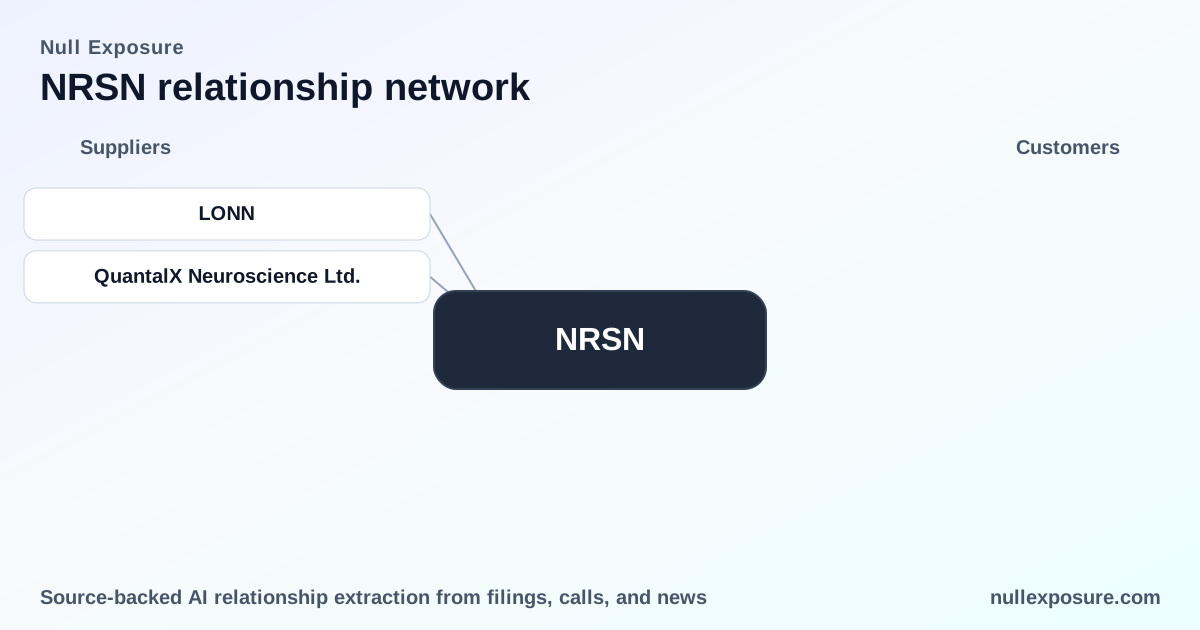
Below are the supplier relationships disclosed in public announcements and their plain-English implications.
Lonza — biomarker development and assay qualification for NDE-derived measures
Neurosense has contracted Lonza to develop, optimize and qualify a method for measuring biomarkers from neuron-derived exosomes (NDEs); this assay will be integrated into development of the company’s lead ALS candidate, PrimeC. The engagement positions Lonza as the analytical and process partner responsible for turning exploratory biomarker signals into a validated, trial-ready measurement. According to a PR Newswire release dated March 10, 2026, Lonza will provide the development and qualification work that feeds into PrimeC’s development plan (PR Newswire, March 10, 2026: https://www.prnewswire.com/il/news-releases/neurosense-collaborates-with-lonza-to-identify-exosome-based-biomarkers-in-order-to-advance-neurodegenerative-disease-treatments-and-diagnostics-302111745.html).
QuantalX Neuroscience Ltd. — objective brain-function measurements for AD Phase 2
Neurosense announced a collaboration with QuantalX to incorporate the Delphi‑MD measurement platform into an upcoming Alzheimer’s disease Phase 2 trial; Delphi‑MD is expected to provide multiple objective, clinically interpretable measurements of brain function to strengthen endpoint assessment. This supplier relationship supplies an independent measurement modality intended to improve trial sensitivity and reduce reliance on subjective scales. The collaboration was detailed in a PR Newswire statement (PR Newswire, March 10, 2026: https://www.prnewswire.com/il/news-releases/neurosense-and-quantalx-collaborate-to-improve-early-detection-and-treatment-of-neurodegenerative-diseases-301743129.html).
What these relationships imply for clinical execution and valuation
Both announced suppliers are directly aligned with endpoint and biomarker robustness, which are the primary drivers of value for a company without commercial revenue. Investors should treat these partnerships as value-creating operational leverage:
- Lonza’s assay qualification work reduces regulatory and reproducibility risk by converting exploratory signals into a validated tool that can be referenced in submissions and cross-trial comparisons. That reduces the probability of equivocal biomarker readouts that compromise trial interpretation.
- QuantalX’s objective measurement platform strengthens endpoint signal-to-noise, helping to preserve statistical power in modestly sized Phase 2 designs — a critical cost and timeline advantage for a small-cap sponsor.
These supplier relationships are strategic, not substitutable in the near term: both relate directly to the quality of trial data that will determine the company’s next de-risking inflection points.
Company-level constraints and operating-model signals
There are no supplier-specific contractual constraints flagged in available disclosures; the public relationship announcements do not include constraint excerpts that would tie particular obligations to third parties. Treat that empty constraint set as a company-level signal: no public evidence of restrictive supplier clauses or single-supplier lock-ins was found in these announcements.
From the company data, investors should note these operating-model characteristics as part of a practical risk profile:
- High operational leverage: Clinical-stage, zero reported revenue and negative EBITDA mean that clinical milestones are the primary source of value creation. Supplier performance directly affects valuation volatility.
- Governance and capital structure signals: Insider ownership is material (25.5%) and institutional ownership is low (1.7%), indicating concentrated insider control and limited institutional validation to date.
- Balance-sheet implications: With tight public-market capitalization and no operating income, Neurosense will rely on milestone-driven partner funding, equity raises, or non-dilutive grants to sustain multi-site trials; suppliers able to structure milestone or phased engagements provide optionality.
How investors should operationalize this supplier intelligence
Treat the Lonza and QuantalX relationships as positive execution signals that materially lower technical risk around biomarker qualification and endpoint measurement. That said, operational and financing risk remain dominant; successful delivery against supplier contracts will be an important near-term watch item.
Key checklist for monitoring:
- Confirm assay qualification milestones from Lonza and public confirmation of validated method transfer.
- Track trial protocol language for Delphi‑MD inclusion and whether those measurements are prespecified endpoints or exploratory signals.
- Monitor financing cadence: any delay in supplier deliverables coupled with constrained financing will materially affect timelines.
If you want structured alerts and a supplier-centric view across small-cap biotech engagements, check the platform at https://nullexposure.com/ for subscription options and real-time tracking.
Bottom line for investors
Neurosense’s supplier relationships with Lonza and QuantalX materially strengthen the company’s ability to generate credible clinical readouts — an essential condition for de-risking a clinical-stage biotech with no current revenue. Lonza brings assay development and qualification capability; QuantalX brings objective measurement technology to clinical endpoints. Both relationships should be viewed as operational catalysts that reduce specific technical risks tied to biomarker validity and endpoint robustness.
For investors focused on event-driven value creation, these engagements are important short- to medium-term signals to monitor alongside financing developments and trial results. For a subscription to ongoing supplier and partner intelligence that can inform investment decisions, visit https://nullexposure.com/.