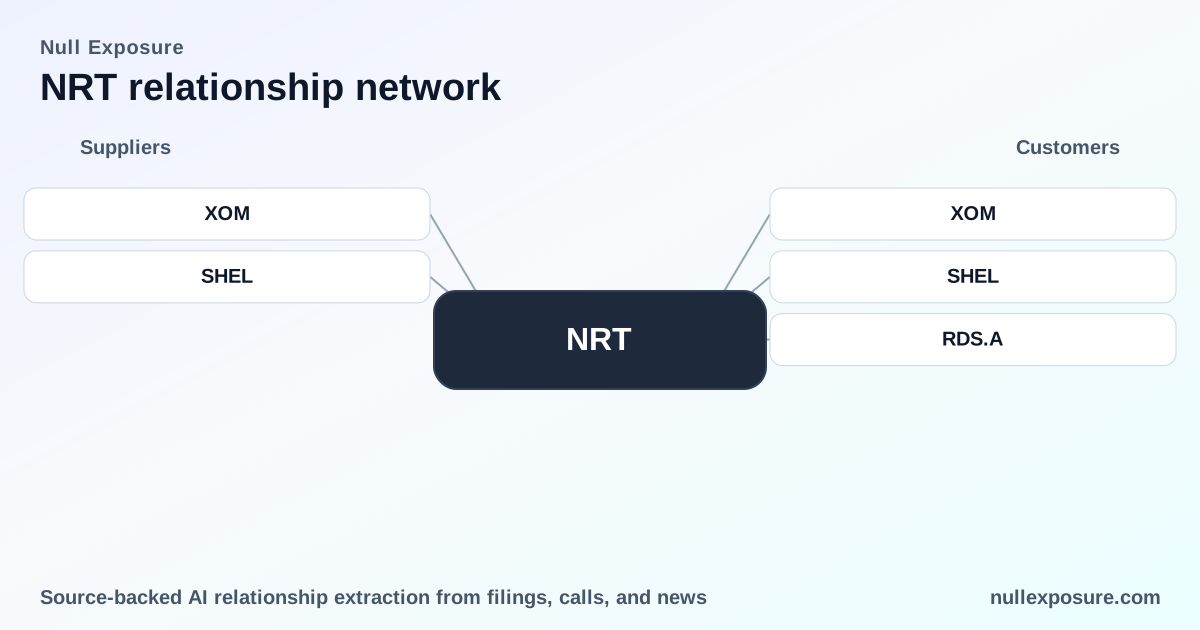
North European Oil Royalty Trust (NRT): Supplier relationships that underwrite the payout
North European Oil Royalty Trust (NRT) monetizes overriding royalty rights on hydrocarbon production in Germany, collecting contractually defined payments from upstream operators rather than operating assets itself. The trust’s cash flow is therefore a function of production volumes, commodity prices and the contractual payment mechanics it has with a small set of large oil majors; recent filings show line-item payments and adjustments that flow directly into distributable cash. Investors should treat NRT as a cash-flow vehicle whose performance is driven by a narrow set of counterparty contracts and the production profile of German fields.
Learn more about coverage and signals at https://nullexposure.com/.
Why supplier relationships are the business for NRT
NRT does not run wells. The company’s economic model is contract-driven royalty collection: it holds rights that entitle the trust to a percentage or fixed payment tied to production from specified blocks operated by major oil companies. That contracting posture creates a predictable revenue mode but concentrates counterparty and commodity risk in a few counterparties. From an operational perspective, NRT’s role is passive and financial — it is critically dependent on the upstream operators’ production, regulatory approvals and settlement processes rather than on technical field operations.
Company-level data returned no explicit contractual constraints in the reviewed feed, which itself is a signal: no new restrictive covenants or material contractual amendments were reported in the supplied relationship payload. Treat the absence of listed constraints as a neutral company-level signal — investors must nevertheless monitor operator filings for bespoke provisions, change-of-operator clauses and payment triggers.
The counterparties that matter — every relationship in the record
Mobil
A Form 8‑K excerpt reported in March 2026 records specific positive end-of-quarter adjustments and a Mobil sulfur payment that flowed to the trust, with discrete line items noted ($30,820; $51,072; and a Mobil sulfur payment of $79,183) for the first quarter of fiscal 2026. This is a direct operating cash inflow line in NRT’s accounting and illustrates how line-item settlements from operators affect distributable cash. (Form 8‑K reporting as captured on ADVFN, FY2026)
ExxonMobil
The trust’s primary assets include overriding royalty rights on German gas and oil production held under agreements with ExxonMobil, which is one of the principal upstream counterparties ensuring the trust’s revenue stream. ExxonMobil’s role is that of long-term operator and payor; monitoring its production and commercial decisions in Germany is essential for forecasting NRT receipts. (QZ report, FY2024)
ExxonMobil Corp.
Recent communications reiterate that rights are held under contracts with local German exploration and development subsidiaries of ExxonMobil Corp., confirming that the counterparty relationship is executed through regional operating affiliates rather than a detached third party. That structure affects where production risk and regulatory exposures sit. (MarketScreener release, FY2026)
Royal Dutch/Shell Group of Companies
MarketScreener notes that some royalty rights are held under contracts with local German exploration and development subsidiaries of the Royal Dutch/Shell Group of Companies, establishing Shell as a second major payor and operational counterparty to the trust’s assets. Contract performance and reporting from Shell’s German affiliates are therefore direct drivers of NRT cash flow. (MarketScreener release, FY2026)
Royal Dutch/Shell Group
A QZ coverage piece likewise identifies the Royal Dutch/Shell Group as a core counterparty for the trust’s overriding royalty rights in Germany, reinforcing that Shell’s production and contractual settlements are materially important to NRT’s revenue base. (QZ report, FY2024)
What the relationship map implies for concentration and risk
- Concentration: NRT’s revenue is concentrated in contracts with two major groups — ExxonMobil and Royal Dutch/Shell — and their respective German subsidiaries. That concentration creates idiosyncratic counterparty exposure: operational trouble, asset sales, or renegotiations by either operator would materially change forecast cash flows.
- Contracting posture: The trust is a passive royalty holder. That reduces operating risk but increases reliance on counterparties’ reporting, settlement timing and specific payment mechanisms (evidenced by line-item sulfur payments and adjustments).
- Criticality: Counterparty performance is critical. Unlike an operator, the trust cannot remediate production declines directly; it is dependent on upstream capital allocation and decline curves.
- Maturity: The referenced rights are on existing German production, implying a mature asset base with predictable but potentially declining output; short-term adjustments (such as the noted sulfur payment) are part of the trust’s cash flow volatility profile.
If you want continuous signal coverage of NRT counterparties and payment-line items, visit https://nullexposure.com/ for monitoring options.
Near-term monitoring checklist for investors
- Watch operator filings from ExxonMobil and Shell’s German subsidiaries for production updates, asset sales, and cost-recovery items that flow through to royalty calculations.
- Track quarter-end adjustments and special line items (the March 2026 Form 8‑K shows how a sulfur payment and end-of‑quarter adjustments are recorded), because these can swing distributable cash in any quarter.
- Monitor commodity price trends and German regulatory developments that could affect production economics or lifting costs, which in turn change royalty receipts.
- Confirm that there are no unreported contractual constraints or change-of-operator triggers in newly filed documents; the supplied record included no such constraints, which is a company-level signal but not a substitute for ongoing diligence.
Investment implications and operational takeaways
- Valuation should reflect counterparty concentration and production decay rather than operational execution risk. The trust’s cash flow is high-quality when production is stable, but it is exposed to idiosyncratic operator and commodity moves.
- Earnings volatility will be driven by discrete settlements and adjustments — investors should treat line-item payments (for example sulfur-related settlements) as recurring noise until a pattern is established via multiple periods of reporting.
- Active surveillance of ExxonMobil and Shell disclosures is the highest-yield monitoring activity for NRT holders; changes to those operators’ German portfolios directly alter the trust’s revenue base.
For an ongoing feed of supplier signals, filings and relationship-level alerts, see https://nullexposure.com/.
Bottom line
NRT is a contract-first cash-flow vehicle whose value depends on a small number of major oil majors operating in Germany. The two counterparty groups identified — ExxonMobil and Royal Dutch/Shell — are the material suppliers whose contractual performance underpins distributions. Investors should price in concentration risk, maturity-driven production decline and episodic settlement items, while keeping a narrow, disciplined monitoring program focused on operator filings and quarter-end adjustments.