NSA-P-A (National Storage Affiliates Trust Series A Pref): Income Profile and Supplier Relationships
National Storage Affiliates Trust issues 6.000% Series A Cumulative Redeemable Preferred Shares with a $25 liquidation preference that function as a fixed-income substitute inside a REIT structure: the trust owns and operates a portfolio of self‑storage facilities and monetizes through rental income, property management services and operator-led facility performance. For income-focused investors, the Series A preference delivers predictable cash yield and seniority over common equity, while the company’s operating model—regional operators managing branded properties—creates concentrated supplier relationships that drive on-the-ground performance. Learn more at https://nullexposure.com/.
What the Series A claim means for cashflow and capital structure
The Series A instrument is a cumulative preferred share paying 6.000%, with a $25 liquidation preference per share. Cumulativity legally requires unpaid dividends to accumulate, creating a fixed payout obligation that sits above common equity distributions in the capital stack. That design converts operating cashflow from real estate leases and ancillary revenue streams into a predictable, credit-like obligation for the trust.
Two direct investor implications:
- Income priority and downside protection: liquidation preference and cumulative dividends increase recovery priority relative to common holders.
- Fixed-cost leverage on operating cashflow: the dividend obligation reduces free cashflow available for common distributions and growth, increasing sensitivity to occupancy and rent volatility.
Public numeric disclosure in the supplied materials is limited (no market cap or income detail reported), so investors must rely on underlying REIT performance metrics and operator results to assess coverage and sustainability.
How NSA runs the business: operators, brands and contracting posture
NSA operates a mixed model: it owns properties and partners with regional operating providers to run facilities—often under contract—rather than centrally managing every location. This structure is efficient for scaling but creates specific supplier‑relationship dynamics investors must evaluate:
- Contracting posture: the use of participating regional operators implies a combination of management contracts and operating agreements; the trust’s cashflow is therefore partially contingent on third-party operator execution.
- Concentration risk: if a small number of operators manage a large share of assets, operational issues or termination of those contracts could materially affect NOI (net operating income).
- Criticality and maturity: operator relationships are operationally critical and tend to be long-lived; the maturity and renewal terms of these contracts determine short‑to‑medium term operational stability.
Because the publicly supplied record here does not enumerate contract lengths or counterparty concentration metrics, these remain primary items for focused diligence.
Operator relationships uncovered in public results
The public supplier-scope results returned one explicit operating relationship. Below is a plain-English description and citation.
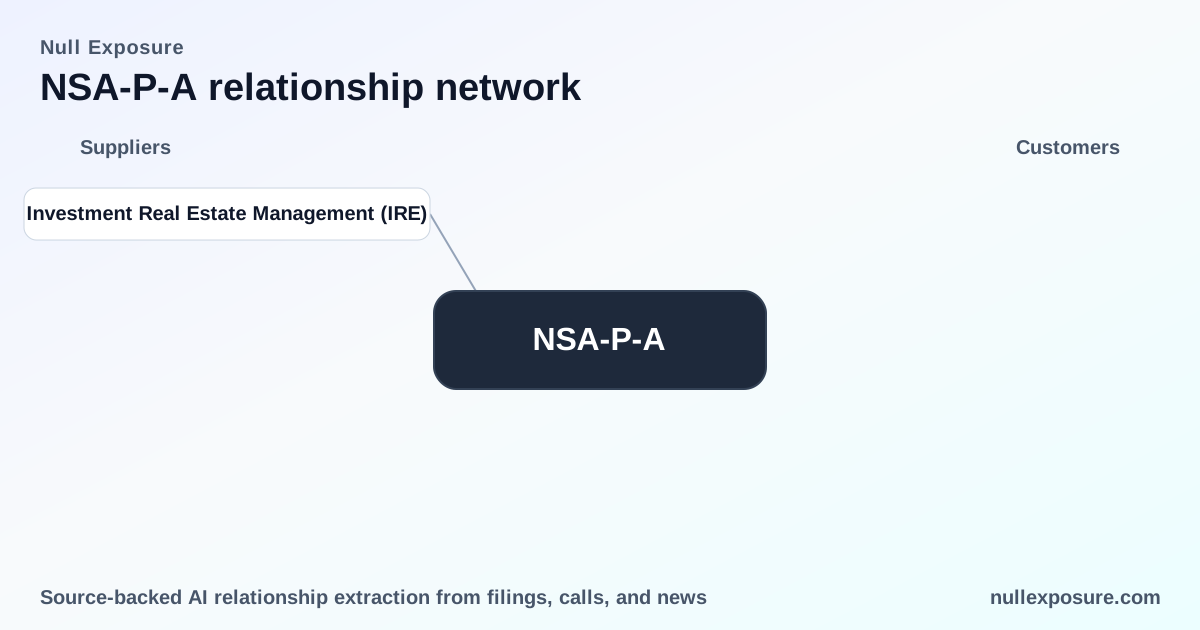
- Investment Real Estate Management (IRE) — IRE is identified as one of NSA’s former participating regional operators and operates self-storage properties under the Moove In brand. This relationship indicates NSA has used third-party regional operators to run branded facilities, and IRE’s status as a former participant suggests operator turnover is a real operational factor for the trust. Source: InsiderMonkey, FY2026 (article first seen March 10, 2026), https://www.insidermonkey.com/blog/13-best-dividend-stocks-paying-over-6-1672632/7/.
What the single sourced relationship signals to investors
The publicly surfaced mention of IRE is limited but material in tone: it confirms NSA’s reliance on external regional operators for property-level management, and it documents operator changes over time. That single data point is a trigger for deeper checks rather than a complete picture:
- Operational continuity risk: a “former” operator reference signals that operator networks evolve and that transitions could affect short-term operations and tenant experience.
- Execution dependency: day-to-day revenue collection, occupancy management and ancillary revenue generation are executed by operators; counterparty performance translates directly to cashflow.
If you track preferred income instruments inside real estate portfolios, operator diligence is as important as balance sheet analysis for preferred‑share credit assessment.
Discover deeper supplier analytics at https://nullexposure.com/ for tailored diligence workflows.
Practical implications and risk checklist for investors and operators
Assess the following items before sizing and holding NSA‑P‑A:
- Operator contract terms: duration, termination triggers, and performance covenants.
- Counterparty concentration: number of operators covering the majority of NOI and the identity of any large operator outliers.
- Dividend coverage: historical NOI-to-preferred‑dividend coverage and sensitivity to occupancy declines.
- Liquidity and redemption terms: redemption mechanics for the preferred series and how they interact with trust liquidity and refinancing windows.
- Track record of operator turnover: frequency and operational impact of changes like the IRE transition.
Key takeaway: preferred yield is attractive but operational execution is a first‑order credit risk inside an operator-driven REIT model.
How to act on this profile
- For income-oriented portfolios: treat NSA‑P‑A as a senior income instrument requiring both real‑estate performance analysis and operator counterparty review.
- For operators and vendors: understand NSA’s contracting posture and how performance covenants translate to commercial obligations and incentives.
If you want structured vendor and exposure tracking for this and similar instruments, visit https://nullexposure.com/ to see how supplier intelligence integrates into capital allocation and counterparty risk workflows.
Bottom line
NSA’s Series A preferred shares deliver a fixed, cumulative income stream backed by a self-storage REIT that leverages regional operators. The public supplier signal we found—Investment Real Estate Management operating under the Moove In brand and classified as a former participating regional operator—reinforces that third-party operator dynamics are central to asset performance. For investors, the security of preferred dividends depends as much on occupancy and rent trends as it does on the stability and quality of operator relationships. For active diligence, prioritize contract terms, concentration, and dividend coverage to convert yield into durable return.