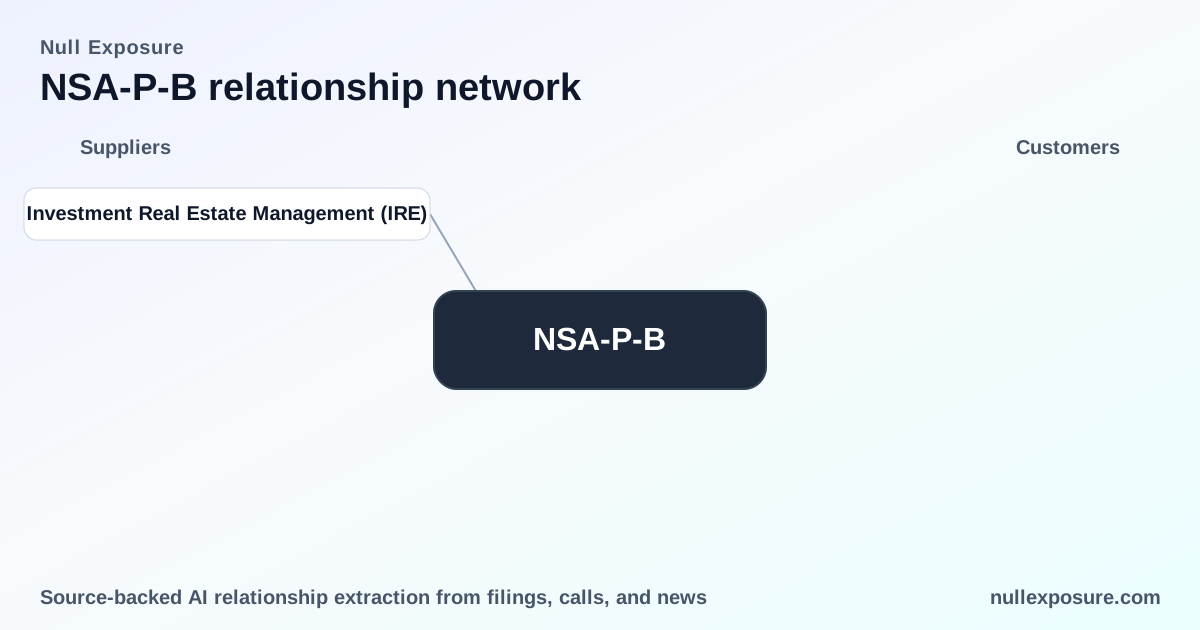
National Storage Affiliates Trust (NSA-P-B): Operator Partnerships and the IRE Joint Venture
National Storage Affiliates Trust (NSA-P-B) is a self-storage REIT that monetizes real estate through a partnership-heavy operating model: NSA owns facilities and delegates operations to regional partners under long-term commercial arrangements and joint ventures. The firm extracts cash flow through property-level rents and management fees while preserving capital efficiency by leveraging local operating expertise rather than building a wholly centralized operating platform. For investors, the core thesis is simple: NSA’s return profile depends on real-estate fundamentals plus the execution and stability of its regional operator relationships.
Learn more about how we track supplier and operator relationships at NullExposure: https://nullexposure.com/
Why operator relationships drive valuation more than property count
NSA is not a pure play property manager nor a single-operator platform — it is a capital owner that relies on third-party operators to run day-to-day facilities. That contracting posture creates a set of repeatable advantages and attendant risks:
- Capital efficiency: NSA scales by capital deployment while outsourcing operational overhead to regional operators, enabling more rapid geographic penetration without proportional SG&A build-out.
- Operational dependence: Revenue is exposed to counterparty execution—occupancy, pricing and cost control are catalyzed at the operator level.
- Counterparty concentration and diversification: Using many regional operators reduces dependence on any single partner, but meaningful JVs or larger affiliates can create concentrated operational risk if terms shift.
- Maturity and governance: Joint ventures and formal participation agreements imply higher governance intensity than loose franchise relationships; these mechanisms both lock in capital partners and raise the stakes when disputes occur.
These characteristics are company-level signals: they describe how NSA structures its business and how supplier relationships translate directly into investor outcomes.
The IRE relationship: a direct operational tie with strategic meaning
Investment Real Estate Management (IRE) is listed in the public results as a current operational partner for NSA. In FY2026 NSA announced a new joint venture with an affiliate of IRE, which is a former participating regional operator and manages self-storage properties under the Moove In brand. This is a strategic partnership that formalizes capital and operations alignment between NSA and a known regional operator. According to an InsiderMonkey report in March 2026, "earlier in November, the company announced a new joint venture with an affiliate of Investment Real Estate Management (IRE)." (InsiderMonkey, March 10, 2026: https://www.insidermonkey.com/blog/national-storage-affiliates-nsa-target-trimmed-at-ubs-as-reits-head-into-2026-reset-1673625/)
- Investment Real Estate Management (IRE): An affiliate of IRE entered a joint venture with NSA in FY2026; IRE operates properties under the Moove In brand and was previously a participating regional operator for NSA. (InsiderMonkey, March 10, 2026)
This relationship converts an operator into a capital partner, increasing both the integration and criticality of the counterparty. For investors, that elevates the importance of monitoring JV economics, governance terms, and the operator’s track record on operations and rent trajectory.
What the IRE JV implies about NSA’s contracting posture
The IRE joint venture tells a clear story about NSA’s commercial posture:
- From contractor to co-investor: The move from a participating operator to a JV partner suggests NSA is willing to co-invest with regional operators when alignment and local expertise justify shared economics.
- Higher governance, deeper alignment: JVs typically include governance mechanisms and performance contingencies that are stronger than pure management contracts, reducing agency friction but increasing complexity.
- Potential concentration of operational risk: While NSA’s broader strategy is to diversify across many operators, JV relationships can create pockets of concentrated exposure where operator performance has outsized impact on returns.
These are company-level operating model signals, not tied solely to IRE unless explicit JV terms disclose otherwise. The public note in FY2026 confirms the existence of the JV but does not disclose detailed economics in the source referenced.
Risk and opportunity checklist for investors evaluating NSA-P-B supply relationships
Assess NSA through the lens of operator-counterparty analysis:
- Operator track record and brand (e.g., Moove In) — critical to occupancy and pricing execution.
- JV economics and governance — determine whether NSA captures outsized upside or assumes operational downside.
- Geographic overlap and concentration — JVs in high-growth markets are value accretive; too many JVs in one region create vulnerability.
- Exit mechanics — the ease with which NSA can unwind or re-contract an operator affects long-term flexibility.
Key takeaway: NSA’s investment return profile is a hybrid of property-level market fundamentals and the strength of its operator relationships; the IRE JV deepens alignment but concentrates exposure where the JV applies.
Learn more about supplier mappings and operator-level exposure at NullExposure: https://nullexposure.com/
Practical due diligence steps and monitoring cadence
For equity investors and portfolio managers, a repeatable monitoring framework improves risk-adjusted decisions:
- Review JV disclosures when available for hurdle rates, preferred returns, and capital commitment schedules.
- Track operator brand performance indicators (same-store occupancy, pricing per square foot) reported in trustee or operator filings.
- Monitor news flow and sentiment for operator disputes, re-contracting announcements, or management turnover.
- Stress-test portfolio scenarios where operator underperformance depresses NOI by 5–15% in JV clusters.
Final view and investor action
NSA’s business model is deliberately partnership-centric: ownership and capital allocation are freed from day-to-day operations by relying on regional operators, and joint ventures like the IRE transaction intensify capital alignment. That structure delivers scalable capital deployment but embeds operator counterparty risk into the equity valuation. For active investors, the path to alpha is through rigorous tracking of JV terms and operator execution rather than through headline property counts alone.
If you evaluate supplier and operator risk as part of your investment process, NullExposure’s supplier relationship coverage provides a structured lens to monitor partner actions and trends: https://nullexposure.com/
For follow-up, request the NSA supplier relationship dossier on our platform or subscribe for continuous operator-level alerts at NullExposure.