Norfolk Southern (NSC) — supplier relationships, strategic reach, and procurement constraints investors should price in
Thesis: Norfolk Southern operates and monetizes a freight-rail network by hauling merchandise and intermodal freight across a 19,420‑mile route system and monetizing track access, freight rates, and service premiums; the business converts capital-intensive infrastructure and rolling stock into recurring freight revenue and stable free cash flow, supported by a disciplined operating margin and dividends. NSC’s strategic moves — acquisitions that extend geographic reach and selective legal engagement — change the supplier and contract contours that underlie revenue resiliency and operational risk. For deeper relationship intelligence, visit https://nullexposure.com/.
What Norfolk Southern actually runs and earns
Norfolk Southern is a Class I freight railroad with headquarters in Atlanta and operations across 22 eastern states and rights into Canada via key corridors. The company converts ownership of track, locomotives, and logistics capacity into freight revenue; trailing twelve‑month revenue stands at $12.18 billion with EBITDA reported at $5.597 billion and a market capitalization near $65.3 billion (latest quarter end 2025‑12‑31). High fixed costs and asset intensity drive a business model that monetizes scale, network density, and routing efficiency rather than low‑margin volume alone.
Key financial and operating signals:
- Scale and profitability: Revenue per share of $54.13, operating margin around 31.2%, and net profit margin of 23.6% indicate industry‑leading unit economics.
- Capital intensity: The balance of rolling stock and track maintenance drives long procurement cycles and concentrated supplier relationships, which affects working capital and capex timing.
Recent supplier and strategic relationships that matter
Below are the relationships surfaced in recent reporting and legal disclosures. Each entry is a concise, plain‑English summary with source context.
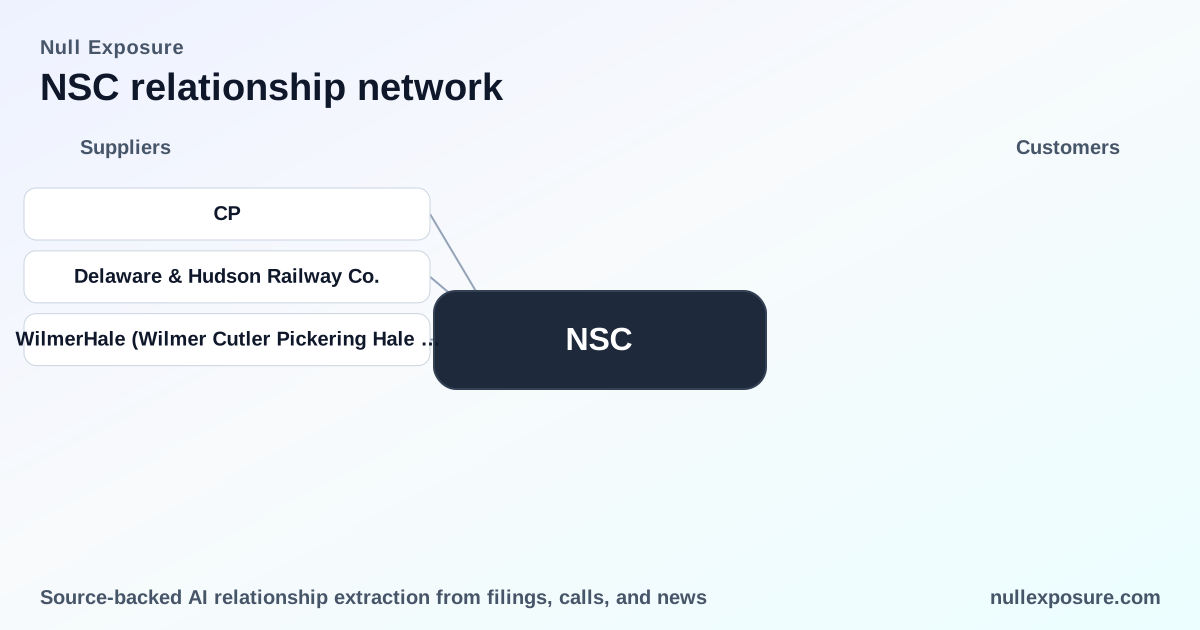
Canadian Pacific Railway / acquisition of Delaware & Hudson
Norfolk Southern is purchasing the Delaware & Hudson Railway Co., a subsidiary formerly under Canadian Pacific Railway, to increase NSC’s northeastern geographic reach and routing flexibility. This transaction expands NSC’s local service footprint and strengthens east‑coast market access, according to a March 10, 2026 TruckingInfo report describing the purchase from Canadian Pacific. (Source: TruckingInfo, March 10, 2026)
Delaware & Hudson Railway Co.
The Delaware & Hudson Railway Co., acquired from Canadian Pacific, represents a tactical extension of NSC’s route network in the Northeastern U.S., providing localized terminal access and interchange capability that supports incremental freight flows. The acquisition was reported as part of Norfolk Southern’s strategy to bolster northeastern reach (same TruckingInfo coverage, March 10, 2026).
WilmerHale (Wilmer Cutler Pickering Hale and Dorr LLP)
WilmerHale served as Norfolk Southern’s outside counsel in securities litigation and successfully argued for dismissal on appeal, representing NSC and individual defendants through the litigation lifecycle. The firm’s published note confirms the Second Circuit victory and the dismissal of the securities action in early March 2026 (Source: WilmerHale, March 2, 2026).
Constraints that shape NSC’s supplier posture and procurement risk
Company‑level disclosures emphasize the manufacturing and supplier limitations inherent to the rail industry. As the filing notes: “Due to the capital‑intensive nature, as well as the industry‑specific requirements of the rail industry, high barriers of entry exist for potential new suppliers of core railroad items, such as locomotives and rolling stock equipment. As a result, we are dependent on certain key suppliers and manufacturers of locomotive and railroad items.”
Translate that into investor‑grade operating characteristics:
- Contracting posture: Procurement cycles are long and heavily contractually protected; major purchases (locomotives, railcars, signaling systems) are negotiated as long‑dated supply agreements with performance clauses and service guarantees.
- Concentration: The vendor base for core equipment is narrow; reliance on a handful of manufacturers increases supplier concentration risk and reduces bargaining elasticity in tight markets.
- Criticality: Suppliers for locomotives, rolling stock, and signaling are mission‑critical; delivery delays or quality issues immediately impair revenue capture and network capacity.
- Maturity and switching costs: Supplier relationships are mature, capital‑heavy, and tied to long replacement cycles, implying significant switching costs and favoring incumbent vendors.
These constraints are company‑wide signals for how Norfolk Southern sources equipment and manages procurement risk, not tied to any single relationship unless contractual language specifies otherwise.
Investment implications: where relationships move the needle
The acquisition of Delaware & Hudson from Canadian Pacific is an operationally meaningful, low‑beta way to grow route density and capture marginal freight lanes without building new track. That incremental reach reduces some origin‑to‑destination friction and can lift utilization, revenue per carload, and operating leverage. However, the underlying procurement reality — concentrated suppliers and long lead times — constrains how quickly NSC can scale locomotive and rolling stock capacity to match network growth.
Legal outcomes matter for capital allocation. A successful dismissal of securities litigation, as represented by WilmerHale, reduces litigation overhang and preserves management focus on operations and M&A integration, which is a direct positive for free cash flow deployment and investor confidence (WilmerHale announcement, March 2, 2026).
For infrastructure investors and operators evaluating supplier exposure, the key takeaway is that Norfolk Southern’s growth is achieved through selected acquisitions and operational optimization, but its ability to convert that growth to durable margin gains depends on vendor relationships for locomotives, rolling stock, and signaling equipment.
Explore more supplier‑level intelligence and relationship maps at https://nullexposure.com/.
Practical risk checklist for portfolio managers
- Monitor vendor concentration around locomotives and critical engineered components; a small supplier disruption can have outsized service impacts.
- Track integration milestones for the Delaware & Hudson acquisition — interchange performance and terminal throughput will be early signals of revenue capture.
- Watch legal and regulatory outcomes: favorable judicial outcomes materially reduce contingent liabilities that could divert cash to settlements or fines.
Final read and next steps
Norfolk Southern is leveraging asset-scale and targeted acquisitions to extend market reach while operating within a procurement framework defined by high barriers to entry and concentrated manufacturers. Investors should price in the dual reality of strong operating margins and a persistent supplier concentration risk that limits short‑term flexibility. For a practical, relationship‑level view that supports underwriting and due diligence, visit https://nullexposure.com/ and request the NSC supplier dossier.
If your investment or operational due diligence requires more granular supplier contracts, term schedules, or integration timelines, start with the company’s recent filings and then augment with targeted supplier checks available through https://nullexposure.com/.