Napco Security (NSSC): Carrier Partnerships Convert Product Sales into Ongoing Connectivity Revenue
Napco Security Technologies develops, manufactures and sells security hardware — notably StarLink cellular radios — and monetizes through hardware sales augmented by ongoing connectivity and service relationships tied to cellular networks. As legacy copper phone lines are retired, Napco’s radios convert one-time installs into recurring connectivity economics and higher lifetime value per installation, while exposure to carrier network choices shapes both addressable market and unit economics. For a quick exploration of supplier exposures and their investor implications, visit Null Exposure.
How Napco’s business model actually works in practice
Napco is a hardware-first security vendor with growing embedded services economics. The company generates the majority of its revenue from product sales (Revenue TTM: $192.0M) while retaining robust profitability (Operating Margin TTM: 30.6%, Profit Margin: 24.7%). As commercial and residential customers migrate off copper voice lines, Napco’s StarLink radios become the standard path for alarm communication — converting a hardware sale into an ongoing need for cellular airtime and remote monitoring connectivity. That dynamic pushes Napco from a pure hardware supplier toward a supplier with recurring-service dependency, enhancing revenue visibility but introducing ongoing carrier cost exposure.
Why carrier relationships are a strategic and financial fulcrum
Two operating facts define Napco’s supplier posture. First, coverage across multiple national carriers increases the addressable base — installs that would have failed under single-carrier constraints can now be completed. Second, multi-carrier support introduces ongoing variable costs (Napco referenced purchasing minutes to support multi-carrier radios), which change margin profiles as the installed base grows. The company’s contracting posture is therefore supplier-of-device with embedded service obligations: Napco sells the endpoint and also contracts for the connectivity that endpoint requires. Given institutional ownership (>91% institutions) and the company’s size (Market Cap ~$1.53B), these supplier dynamics are material to revenue growth, margin sustainability, and capital allocation.
Visit Null Exposure for deeper supplier relationship analytics and benchmarking.
The carrier relationships you need to track
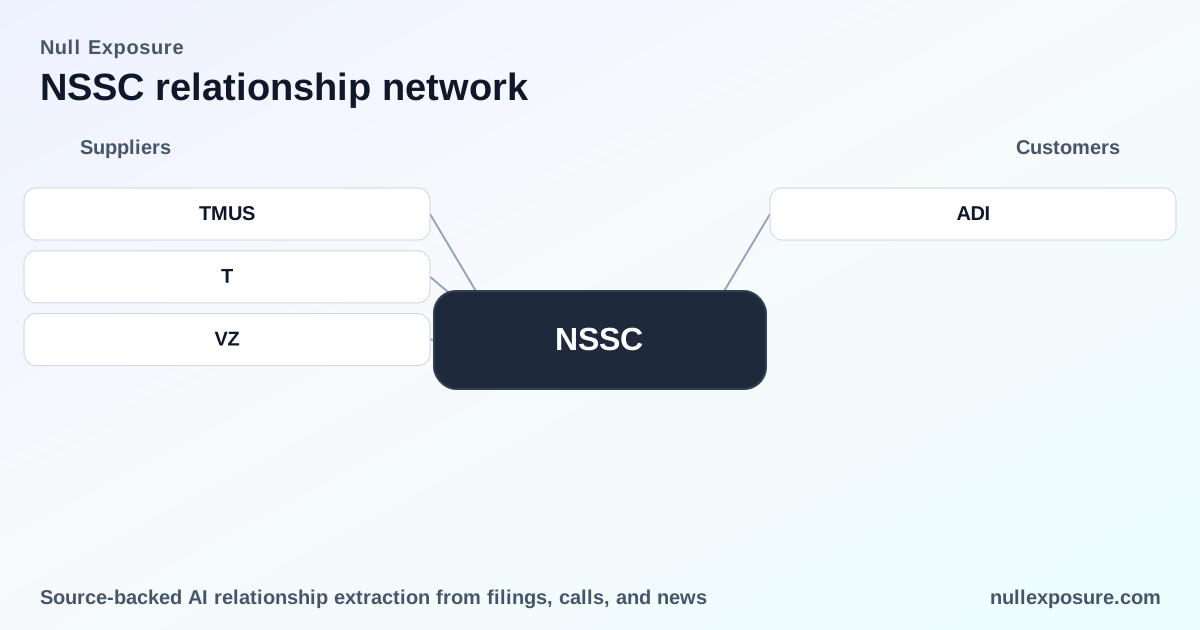
Napco’s public comments across recent earnings transcripts explicitly reference major national carriers — each relationship is operationally meaningful because StarLink radios are certified or configured to run on these networks. Below are the relationships disclosed in the reporting set.
AT&T — large national coverage that underpins commercial opportunity
Napco stated that its StarLink radios operate on AT&T networks and positioned that capability as a structural advantage as legacy copper lines are retired, increasing Totex for building owners and installable endpoints for Napco. This was discussed in the company’s Q1 FY2026 and Q2 FY2026 earnings call transcripts (InsiderMonkey).
Source: Q1 FY2026 and Q2 FY2026 earnings call transcripts published on InsiderMonkey.
Verizon — core backbone for residential and commercial fallbacks
Napco confirmed StarLink compatibility with Verizon and highlighted Verizon alongside AT&T as foundation networks enabling deployments across “millions of commercial and residential buildings,” a central point in both Q1 and Q2 earnings call commentary (InsiderMonkey). Verizon’s nationwide coverage is a key enabler of Napco’s scale.
Source: Q1 FY2026 and Q2 FY2026 earnings call transcripts published on InsiderMonkey.
T‑Mobile — newly added carrier expands addressable market and product complexity
Management announced the introduction of a triple‑carrier radio that brings T‑Mobile into the supported carrier set, explicitly noting the operational implication that Napco must “buy minutes to support that,” signaling increased recurring connectivity spend as the company expands multi‑carrier support (Q1 and Q2 FY2026 transcripts, InsiderMonkey). The T‑Mobile addition materially enlarges installable geographies and competitive resilience for Napco’s product.
Source: Q1 FY2026 and Q2 FY2026 earnings call transcripts published on InsiderMonkey.
What these relationships imply for investors and operators
- Growth levers: Multi-carrier compatibility expands Napco’s addressable market as copper retirements accelerate, supporting above-market revenue growth given the company’s proven funnel (Revenue and Quarterly Revenue Growth YoY: +12.2%).
- Margin dynamics: Shipping radios at scale delivers strong gross margin (Gross Profit TTM: $108.7M) but connectivity costs are recurring and will exert downward pressure on per-install gross margin unless Napco captures pricing power on service bundling or passes costs to customers. Management’s comment about buying minutes directly signals a non-trivial variable cost line.
- Concentration and criticality: Napco’s dependence is not on any single carrier but on national wireless infrastructure; this diversity reduces single‑point carrier risk while increasing integration complexity and supplier management costs. Carrier relationships are critical to product function — their uptime and pricing directly affect Napco’s service reliability and margins.
- Maturity and contracting posture: Napco operates as a mature manufacturer with strong profitability and institutional ownership; contracts with carriers look like supplier/partner integrations rather than exclusive long-term carrier deals, implying flexibility but also exposure to commercial terms that can change with telecom pricing dynamics.
Risk checklist investors should run before assigning multiple turns of valuation
- Read management commentary for ongoing disclosures of minute‑purchase economics and how those costs are allocated or recovered. (Management already referenced minute purchases in earnings calls — InsiderMonkey Q1/Q2 FY2026 transcripts).
- Monitor adoption cadence as copper retirements accelerate; a fast transition increases addressable market but also accelerates connectivity spend.
- Watch for carrier rate negotiations and wholesale minute pricing, which will be the primary operating lever for Napco’s recurring margin profile.
- Track competitive responses from alarm systems that sell alternative connectivity or bundled monitoring packages; Napco’s margin capture depends on product differentiation and channel strength.
Final takeaways and next step
Napco has converted a hardware-centric model into a hybrid hardware-plus-connectivity supplier. The company’s multi-carrier StarLink radios are a growth engine as legacy copper lines disappear, but they introduce ongoing connectivity costs and supplier complexity that investors must model explicitly. For investors and operators focused on supplier exposure and network dependency, Napco’s disclosed carrier relationships with AT&T, Verizon and now T‑Mobile are the ones to monitor closely.
If you want transaction-ready supplier analytics and scenario stress tests for Napco and comparable vendors, start with the research at Null Exposure — actionable intelligence for investment and operations teams.