NetApp (NTAP) — supplier relationships that shape the hybrid‑cloud thesis
NetApp sells hybrid cloud data services and storage software supplemented by channel hardware and cloud-native offerings; it monetizes through a mix of product sales, subscription software, and cloud services delivered via distributor and hyperscaler partnerships. Investors should view NetApp as a channel‑centric infrastructure vendor whose growth and risk profile are driven as much by distributor concentration and manufacturing commitments as by adoption of cloud‑native products with hyperscalers. For more supplier intelligence and relationship mapping, visit https://nullexposure.com/.
The partnership map investors must track
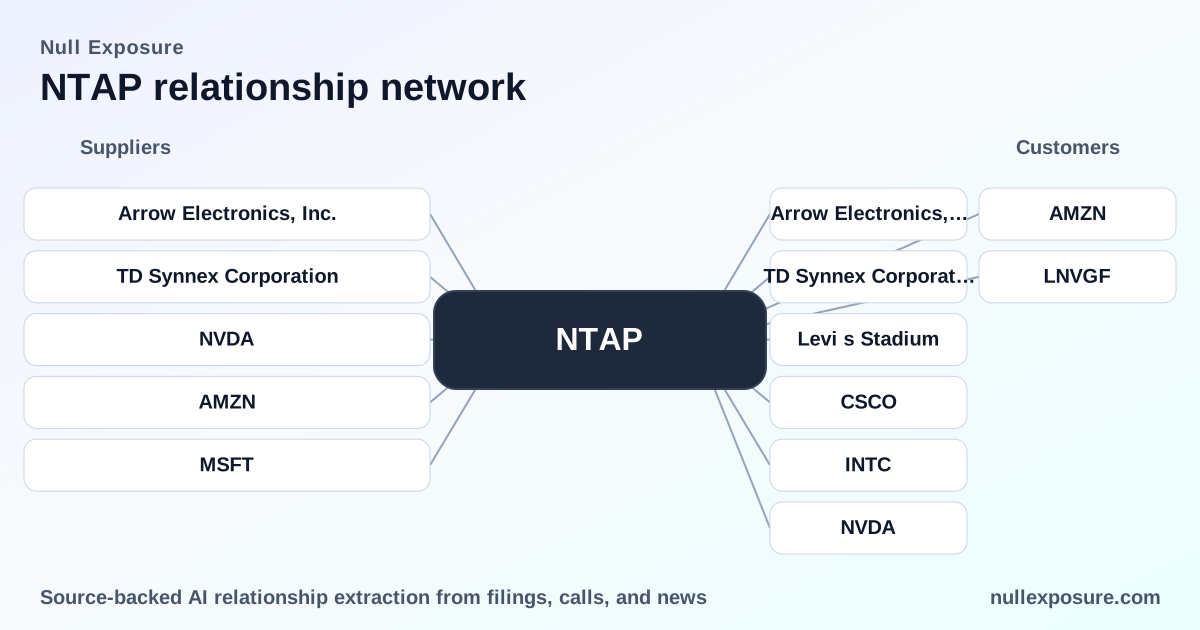
NetApp’s public disclosures and recent coverage identify a small set of distributors and strategic cloud partners that collectively drive revenue and product integration. Below are every relationship surfaced in the record, with a concise investor‑oriented description and source reference.
Arrow Electronics, Inc.
Arrow is listed as a distributor that accounted for 10% or more of NetApp’s net revenues in FY2025, positioning it as a material channel partner for product distribution and inventory flow. According to NetApp’s FY2025 Form 10‑K, Arrow qualified as one of the distributors representing at least 10% of net revenues. (NetApp 10‑K, FY2025)
TD Synnex Corporation
TD Synnex (previously Tech Data) likewise recorded 10%+ of NetApp’s net revenues in FY2025, underscoring continued concentration in a handful of global distributors for go‑to‑market scale. NetApp’s FY2025 10‑K lists TD Synnex as a distributor that represented 10% or more of net revenues. (NetApp 10‑K, FY2025)
NVIDIA (NVDA)
NetApp integrated the NetApp AI Data Engine with NVIDIA’s AI data platform to accelerate customers’ creation of AI‑ready datasets across hybrid cloud environments — a strategic product integration that strengthens NetApp’s AI infrastructure value proposition. A Business Today report covering NetApp Insight Xtra 2026 highlights the NetApp AI Data Engine integration with NVIDIA’s platform. (Business Today, Feb 23, 2026)
Amazon Web Services (AWS / AMZN)
AWS is referenced as the provider of FSx for NetApp ONTAP, chosen by customers for immutable volume copies and enhanced ransomware protection, indicating a security‑driven use case for NetApp’s cloud file services. The FY2026 earnings call transcript notes a customer selecting AWS FSx for NetApp ONTAP specifically for immutable copies and cyber resilience. (Earnings call transcript coverage, Q3 FY2026)
Microsoft Azure (MSFT)
Microsoft’s Azure features Azure NetApp Files as a selected solution for enterprise workloads, with a multinational insurance client citing performance, ease of use, and enterprise reliability — validating NetApp’s strategic placement inside Azure’s file storage portfolio. The Q3 FY2026 earnings call transcript references a large insurance company choosing Azure NetApp Files for those reasons. (Earnings call transcript coverage, Q3 FY2026)
What the supplier disclosures reveal about how NetApp operates
NetApp’s disclosures and the relationship list together paint a clear operating model profile:
- Channel concentration is material. Two distributors — Arrow and TD Synnex — individually represented 10%+ of net revenues in FY2025, which creates meaningful revenue concentration risk and bargaining dynamics with a small set of distributors. This is a company‑level signal drawn from NetApp’s FY2025 10‑K.
- Manufacturing is largely outsourced but operationally critical. NetApp outsources manufacturing and assembly to contract manufacturers across multiple geographies and maintains commitments to manage lead times and forecasts; this indicates a lean manufacturing posture that amplifies supplier management as a core operational competency.
- Commitments are large and time‑bound. NetApp disclosed off‑balance sheet purchase commitments totaling approximately $1.0 billion at April 25, 2025, with $0.6 billion due in fiscal 2026 and $0.4 billion in non‑cancelable inventory commitments — a clear indicator of material spend concentration and cash‑flow timing exposure.
- Product integration with hyperscalers is strategic and revenue enhancing. Partnerships with NVIDIA, AWS, and Microsoft translate into product integrations (AI Data Engine, FSx for NetApp ONTAP, Azure NetApp Files) that drive higher‑value, recurring software and cloud services revenue streams.
These points collectively define NetApp’s contracting posture as one of strategic channel reliance and outsourced manufacturing dependency, with mature, high‑value hyperscaler relationships that lift margins while exposing the business to distributor concentration and supply timing risk.
For a deeper look at supplier exposure and contract commitments, explore the supplier intelligence on https://nullexposure.com/.
How investors should think about risk and upside
NetApp’s model mixes the defensive advantage of enterprise‑grade file services inside major clouds with the traditional risks of hardware and channel distribution.
- Upside: Hyperscaler integrations (NVIDIA, AWS, Azure) accelerate software and cloud revenue mix, increase average contract value, and position NetApp to capture AI and data‑centric workloads at premium pricing.
- Risk: Distributor concentration and significant non‑cancelable purchase commitments create execution risk in downturns or inventory corrections; outsourced manufacturing spreads operational risk across third parties and geographies but requires tight supplier governance.
- Earnings sensitivity: Channel inventory cycles and off‑balance purchase commitments make revenue and working capital more volatile than a pure‑software peer; investors should model working capital swings and monitor distributor order patterns.
Key takeaway: NetApp’s hyperscaler partnerships materially improve long‑term revenue quality, while distributor concentration and purchase commitments demand active monitoring of order flows and supplier performance.
If you track supplier concentration for portfolio companies, see more actionable supplier risk dashboards at https://nullexposure.com/.
What to watch next and recommended investor actions
- Monitor quarterly disclosures for revenue attributed to major distributors and updates on purchase commitments; changes in Arrow or TD Synnex order volumes will be early indicators of demand shifts.
- Track product adoption metrics for Azure NetApp Files, FSx for NetApp ONTAP, and the NetApp AI Data Engine — adoption acceleration will show up in recurring revenue and margin expansion.
- Evaluate supply‑chain resilience metrics: contract manufacturer performance, lead times, and geography‑specific risks given NetApp’s outsourced manufacturing footprint.
For a commercial view of supplier links and to subscribe to relationship alerts, visit https://nullexposure.com/.
NetApp’s supplier story is one of concentrated distribution risk balanced by high‑value hyperscaler integrations; investors should weigh the near‑term supply and working‑capital exposures against a structural move toward cloud software and AI‑ready data services.