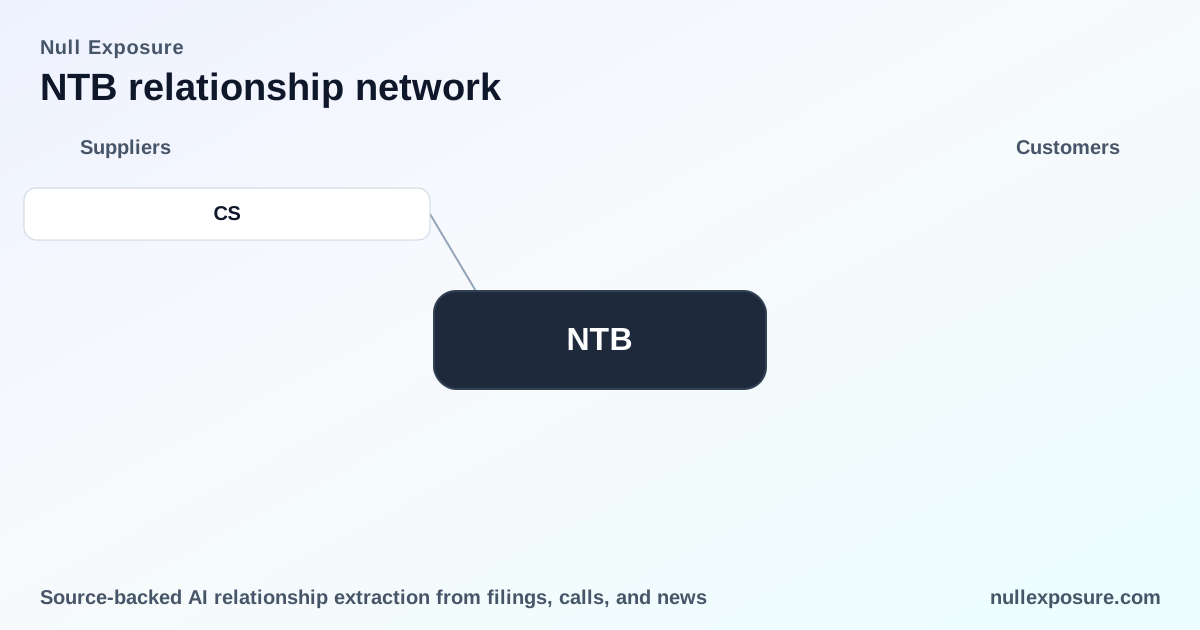
Bank of N.T. Butterfield & Son Ltd (NTB): Trust-led growth from a large asset intake
Bank of N.T. Butterfield & Son Ltd operates as a diversified bank headquartered in Bermuda, monetizing through deposit and lending spreads, fiduciary and trust fees, and private banking services to high-net-worth and institutional clients. The bank’s recent performance shows strong profitability—Revenue TTM $606.8M, Profit Margin 38.2%, Return on Equity 21.4%—and a compact market cap (~$2.09B), which frames supplier relationships as material drivers of fee income and client flows rather than low-margin commodity services. For investors evaluating supplier exposure, the key point is that trust and custody relationships are strategically important to Butterfield’s fee growth trajectory, especially after a large asset acquisition that has been integrated and whose contractual restrictions recently expired. Learn more about supplier signals and monitoring at https://nullexposure.com/.
How the Credit Suisse asset intake changes the supplier landscape
Butterfield’s recent commentary links a spike in trust revenue directly to the Credit Suisse asset acquisition and post-acquisition client inflows. That acquisition turned an external counterparty event into an internal client volume gain for Butterfield, converting what could have been a short-term fee arrangement into recurring fiduciary revenue. Expiration of a fee standstill on that contract creates immediate upside to fee recognition and client monetization, but also raises concentration and counterparty-history considerations that investors must track.
All reported supplier relationships and what they mean for investors
-
Credit Suisse — An earnings-call transcript posted to InsiderMonkey (10 March 2026) states that trust revenue is “primarily related to the Credit Suisse asset acquisition that we have now completely integrated,” and notes that the prior standstill on fees has expired, enabling higher fee capture from the integrated assets.
Source: InsiderMonkey earnings call transcript (Q4 2025 / FY2026), 10 March 2026 — https://www.insidermonkey.com/blog/the-bank-of-n-t-butterfield-son-limited-nysentb-q4-2025-earnings-call-transcript-1693313/ -
Credit Suisse — A press release transcript carried by The Globe and Mail (10 March 2026) repeats management’s point that trust strength derives from the Credit Suisse asset acquisition integration and the end of the fee standstill, reinforcing that this supplier-to-client conversion is material to fee trends.
Source: The Globe and Mail press release (Q4 2025 / FY2026), 10 March 2026 — https://www.theglobeandmail.com/investing/markets/stocks/NTB/pressreleases/135786/butterfield-ntb-q4-2025-earnings-call-transcript/
Note: both items reference the same underlying commercial development (Credit Suisse asset integration and standstill expiry) and together confirm that management attributes a defined portion of trust revenue growth to that event.
What this reveals for Butterfield’s operating model
- Contracting posture: Butterfield operates with long-term fiduciary and custody arrangements that can include negotiated standstills and fee schedules; the expiration of a negotiated standstill implies commercial leverage to re-price or re-recognize fees once contractual constraints lapse.
- Concentration: A material asset intake from a single large counterparty elevates short-to-medium term concentration in trust revenue; investors should treat this as a growth catalyst with attendant concentration risk.
- Criticality: Relationships that supply client assets or migrate custody into Butterfield are high criticality—they directly affect recurring fee income, client AUM, and cross-sell opportunity for lending and treasury services.
- Maturity: Management’s statement that the Credit Suisse assets are “completely integrated” signals a mature operational status for that transaction, moving the exposure from integration risk to revenue-recognition and retention risk.
These are company-level signals drawn from management commentary; no constraint excerpts in the record explicitly assign other constraints to third parties.
Investor implications and risk checklist
Butterfield’s financials—trailing P/E ~9.3, Price-to-Book ~1.78, dividend yield ~3.82%—position the company as a profitable, yield-bearing bank where fee momentum can re-rate valuation. For investors and operators evaluating NTB supplier relationships, focus on the following:
- Monitor client retention and net new assets from the Credit Suisse intake over the next four quarters; an early retention shortfall would quickly reveal the true revenue quality.
- Track fee recognition and margin contribution now that the standstill has expired; confirm whether fee schedules revert to market levels or remain negotiated.
- Assess counterparty and operational risk: large migrations can embed settlement, custody, and regulatory-compliance workstreams that affect cost and capital.
- Watch concentration metrics in quarterly filings and segment disclosures; a durable reliance on a single source for trust growth creates vulnerability to reversals.
A practical starting point for deeper supplier due diligence is available at https://nullexposure.com/.
Tactical monitoring items for active managers
- Request quarterly AUM flows and client retention data related to the Credit Suisse integration if available in investor materials.
- Reconcile fee revenue growth in the trust segment to realized vs. deferred fees after the standstill expiry.
- Confirm counterparty exposures in funding and settlement chains that could be second-order dependencies of the Credit Suisse migration.
Bottom line: upside unlocked, complexity increased
Butterfield converted a third-party asset event into a direct trust revenue driver, unlocking near-term fee upside while increasing concentration and operational complexity. Management’s comments—published in multiple call transcripts and press outlets on 10 March 2026—are explicit: the asset intake is integrated and the contractual fee restraint has expired, which justifies upgraded attention to trust fee sustainability and retention metrics. Given Butterfield’s strong profitability and reasonable valuation, this supplier-driven revenue lift is a positive catalyst for investors who will actively monitor retention and fee realization.
For a focused supplier-risk assessment and continuous monitoring of NTB dynamics, visit https://nullexposure.com/.
Bold claims and material relationship statements in this note are drawn from company commentary and market press coverage cited above; pursue the primary transcripts and financial filings for confirmation before underwriting position changes.