NetClass Technology (NTCL): Supplier relationships, governance, and what operators should price-in
NetClass Technology sells education and enterprise IT solutions in China and monetizes through software licensing, services, and institutional contracts with schools and corporations. Revenue is small and concentrated; the company is loss-making with an asset-light software model and concentrated insider control that affects supplier and audit relationships. For a complete supplier profile and searchable relationship map, visit https://nullexposure.com/.
How NetClass runs the business and where the money comes from
NetClass operates as a China-focused software-as-a-service and solutions provider to the education sector and corporate customers. Revenue for the trailing twelve months is about $9.8 million with gross profit roughly $2.24 million, placing the company in a low-margin, early-commercialization phase. The company reported negative EBITDA (approximately -$9.15 million) and a diluted EPS of -$0.60 through the latest quarter ended December 31, 2025, reflecting continued investment ahead of scale. Market capitalization stands at $6.18 million, insider ownership is high at 50.24%, and institutional ownership is minimal at 2.68%, indicating concentrated control and limited institutional validation.
These characteristics translate into a supplier posture where pricing power is modest, contracting cycles tie to education budgets and procurement calendars, and commercial partners should assume tight cash flow management and selective vendor commitments when engaging with NetClass. For operators evaluating or bidding to supply NetClass, the company profile and supplier map are summarized at https://nullexposure.com/.
Governance moves that shape supplier risk
Recent corporate actions have hardened control dynamics at NetClass. A shareholder meeting in December resulted in governance changes that strengthen the influence of Class B shareholders, and the incumbent board consolidated its positions. Concentrated control affects vendor negotiations, procurement transparency, and the continuity of auditor and compliance relationships. Financial operations and supplier payments will follow priorities set by an entrenched board rather than diffused public ownership.
According to a Globe and Mail press release on March 10, 2026, the AGM reappointed all incumbent directors and ratified Wei, Wei & Co., LLP as the independent auditor for the fiscal year ended September 30, 2025 — a move described in the notice as reinforcing the board’s existing control and the influence of Class B shareholders.
The supplier-related relationship you need to know: Wei, Wei & Co., LLP
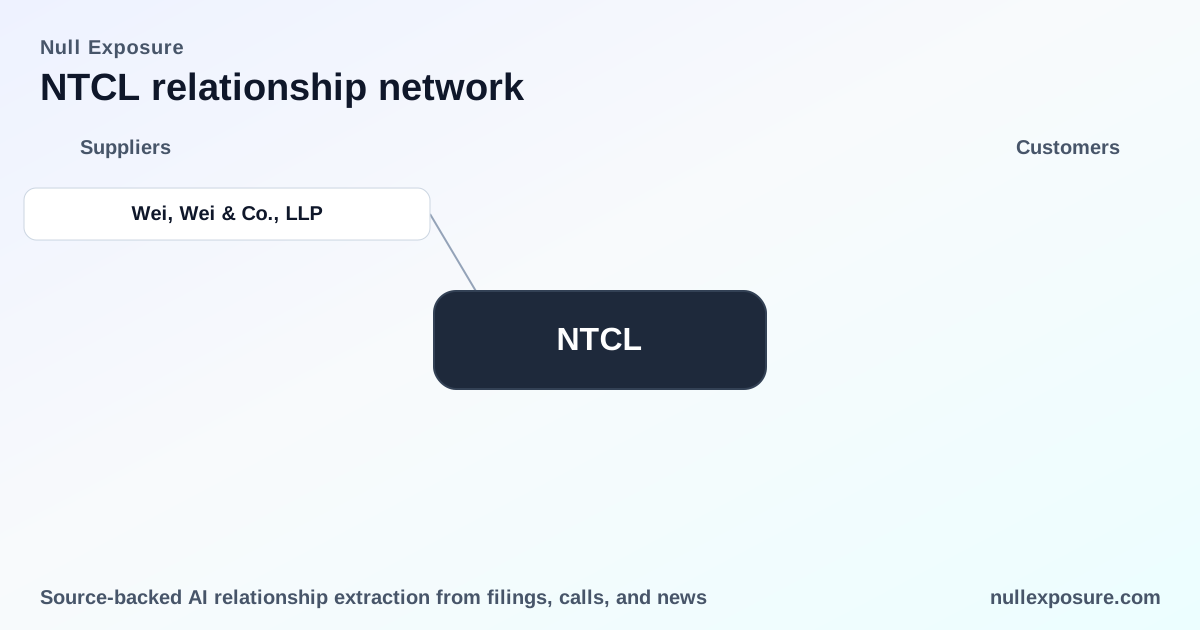
Wei, Wei & Co., LLP was ratified as the independent auditor for NetClass for the fiscal year ended September 30, 2025. This appointment was confirmed at the company AGM and reported in a press release in March 2026. According to that report, the auditor ratification was part of a slate of governance outcomes that entrenched the current board structure and amplified Class B shareholder influence (Globe and Mail, March 10, 2026).
Why this matters for suppliers and underwriters: auditor continuity and auditor selection signal how transparent financial reporting will be and how audit-resistant related-party or control transactions could be treated by management and the board. Vendors, insurers, and financing partners should treat auditor appointments as a governance signal when sizing counterparty and payment risk.
What the data does and does not show about constraints
The supplier relationship data for NetClass does not include explicit operational constraints or contract-level flags in the current feed. That emptiness itself is an operational signal: no third-party constraint excerpts were captured, so observable supplier-level red flags are limited to governance disclosures and public financials. Present company-level signals are:
- Contracting posture: Given NetClass’s small revenue base and high insider control, procurement is likely to be centralized and relationship-driven rather than market-driven. Expect longer qualification cycles and bespoke contracting for institutional customers.
- Concentration: Large insider ownership and low institutional ownership create concentrated decision-making; supplier concentration risk increases when a single controlling group governs supplier selection.
- Criticality: The core product set targets education institutions and corporate training, which are mission-critical to clients but not yet at scale for NetClass; suppliers delivering essential platform services will gain negotiating leverage if NetClass relies on them for uptime and compliance.
- Maturity: Financials indicate a company still scaling commercial adoption; vendors should price in working-capital friction and prefer shorter payment terms or milestone-linked schedules.
These are company-level operational characteristics derived from financials and governance disclosures rather than line-item contract excerpts.
How suppliers and investors should adjust valuation and engagement tactics
Given NetClass’s profile — small market cap, negative EBITDA, concentrated insider control, and a recent auditor ratification that consolidated board power — investors and vendor managers should take these actions:
- Price for working-capital risk: require firm payment milestones, retainers, or accelerated invoicing to compensate for potential cash-cycle constraints.
- Build governance checks into commercial contracts: include audit rights, termination triggers for late payment, and clear escalation paths given the high insider control.
- Stress-test concentration exposure: avoid single-supplier single-customer dependencies that would expose operations to NetClass board-level decisions.
For investors, governance consolidation is a valuation consideration: control entrenchment increases execution risk and reduces the probability that minority shareholders or independent directors will force corrective action. That outcome affects downside protection and liquidity.
Mid-article action: explore a deeper supplier risk map at https://nullexposure.com/ to see how governance and relationships interact across the supplier base.
Practical next steps and monitoring checklist
Operators evaluating NetClass as a customer, vendor, or counterparty should adopt a three-point monitoring checklist:
- Monitor auditor continuity and disclosures — auditor ratification and any related-party notes in audit reports reveal governance posture.
- Confirm payment terms and collateral — insist on milestone-linked payments and clear remedies given tight cashflow indicators.
- Track ownership and board changes — changes to Class B supervoting measures, director appointments, or insider share movements materially alter counterparty risk.
For investors, measure progress by revenue growth, gross margin expansion, and any shift in institutional ownership that would signal market validation.
Bottom line: position for concentration and governance risk
NetClass is a small, loss-making software company with high insider control and recent governance moves that consolidate board authority, factors that directly influence supplier relationships and audit independence. Suppliers should price conservatively and protect cash, while investors should treat governance entrenchment as a negative for minority shareholder outcomes and for the predictability of commercial contracts.
For a full walk-through of NetClass’s supplier relationships, visit https://nullexposure.com/ — the supplier map and relationship summaries provide actionable signals for procurement teams, credit officers, and investors.