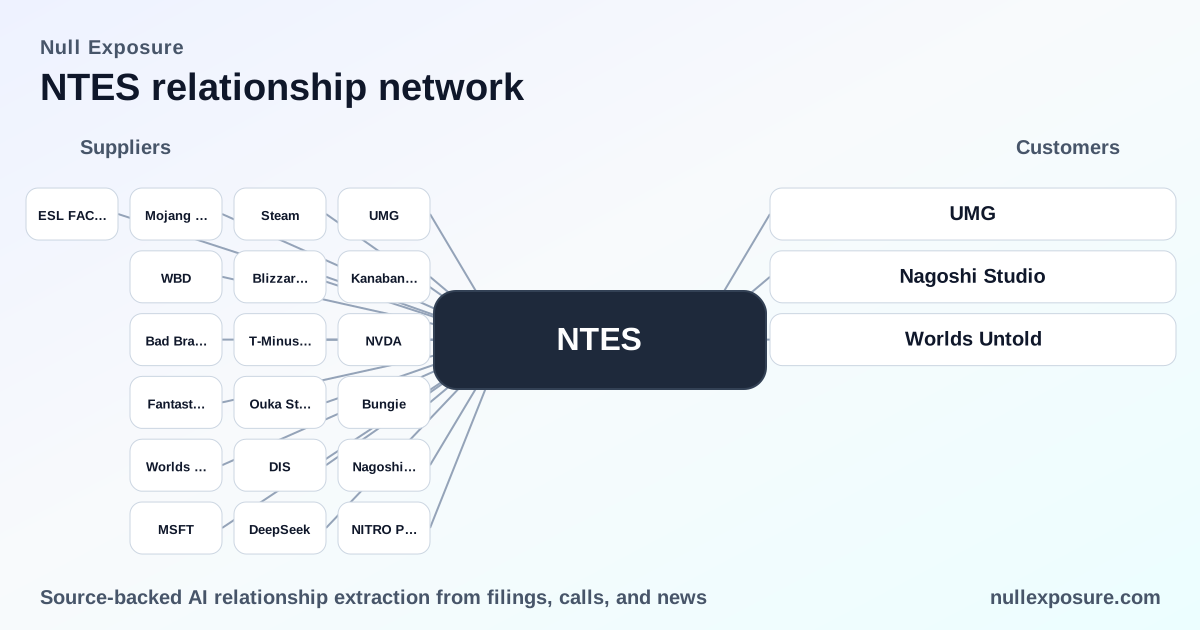
NetEase Inc (NTES) — supplier relationships that underwrite product breadth and international expansion
NetEase operates a dual business: a China-focused online services platform built on gaming, music and commerce, and a global games-publishing arm that licenses and co-develops IP with third parties. The company monetizes through in-game purchases and subscriptions, music licensing and distribution fees, platform commerce, and licensed publishing revenue from third‑party IP partnerships. For investors, supplier and partner relationships are a central operating lever: they supply creative IP, technology stacks, distribution channels and localized content that convert R&D and user-acquisition investments into recurring revenue.
Explore deeper supplier relationship intelligence at https://nullexposure.com/ — real-world relationship context matters for valuation.
What this partner map tells you about NetEase’s operating model
NetEase’s visible suppliers show a hybrid contracting posture: long-term licensing deals coexist with project-level studio investments and short-term vendor relationships for art and tech. This leads to three company-level signals investors should weigh:
- Concentration and diversification: NetEase spreads exposure across major global entertainment houses (Warner Bros, Marvel, Blizzard, Mojang/Microsoft, Universal Music) and many smaller studios; this reduces single-partner revenue concentration but increases operational complexity across IP and regulatory regimes.
- Criticality and leverage: Major licensing partners supply marquee IP and content that are material to user engagement and retention, while smaller studios and vendors supply tactical assets—art, AI tooling, or platform integrations—that are operationally important but easier to replace.
- Maturity and contracting horizon: Several relationships are multi-year licensing agreements or long-running operations (music distribution, major IP co-development), implying multi-period revenue visibility; in contrast, the closure of experimental studios shows NetEase actively rebalances maturity risk and development spend.
If you evaluate NetEase from a supplier-risk lens, track licensing renewal cadence, regulatory exposure in China, and capital allocation toward internal studios vs. external partners. For additional context on NTES partner flows and signals, visit https://nullexposure.com/.
Supplier and partner roll call — what each relationship contributes
-
Universal Music Group (UMG) — NetEase signed a multi‑year licensing and distribution agreement to make UMG’s catalogue available on NetEase Cloud Music, strengthening content depth for its streaming service and supporting local artist promotion (news reports, January–March 2026; e.g., Finviz and kursiv.media, Mar 2026 / Jan 2026: https://finviz.com/news/293874/netease-becomes-a-distributor-for-universal-music-group-in-china_set-to-support-local-talent and https://uz.kursiv.media/en/2026-01-20/universal-music-group-renews-licensing-pact-with-chinas-netease/). This is a strategic, multi-year content licensing relationship.
-
Kanaban Graphics — Provided launch art and character designs for at least one NetEase game, a tactical creative-vendor relationship that supplies production assets rather than recurring IP revenue (NetEase Games press release, Apr 17, 2025: https://www.neteasegames.com/news/20250417/37000_1228125.html). Operational art vendor that accelerates time-to-market.
-
NVIDIA (NVDA) — NetEase’s title leveraged NVIDIA ray-tracing tech to elevate graphics in an MMORPG, signaling a technology partnership that improves product quality and hardware-aligned marketing (NetEase Games announcement, May 29, 2025: https://www.neteasegames.com/news/20250529/37000_1237450.html). This relationship enhances visual differentiation in high‑end game titles.
-
Bungie — NetEase published a title officially licensed by Bungie (Destiny: Rising), indicating IP licensing and co‑publication with established Western studios to expand portfolio appeal (NetEase Games announcement, Aug 28, 2025: https://www.neteasegames.com/news/20250828/37000_1256677.html). Co‑development/licensing of premium IP for global market reach.
-
Nagoshi Studio — NetEase suspended funding for Tokyo-based Nagoshi Studio, reflecting a strategic pullback from certain international investments and a re-sizing of experimental development exposure (news report, 2026: respawn / Outlook India, Mar 2026: https://respawn.outlookindia.com/gaming/gaming-news/netease-stops-funding-nagoshi-studio-gang-of-dragon-2026). Signal of portfolio pruning and cost discipline.
-
NITRO PLUS — Partnered in releasing an original title (Rusty Rabbit), a creative partnership that expands genre breadth and IP diversity (NetEase Games press release, Apr 17, 2025: https://www.neteasegames.com/news/20250417/37000_1228125.html). Collaborative originations to broaden content slate.
-
Steam (Valve) — NetEase used Steam for PC gameplay tests, showing use of global distribution platforms for testing and broader reach (NetEase Games announcement, Apr 30, 2025: https://www.neteasegames.com/news/20250430/37000_1231945.html). Important channel for international PC engagement and language support.
-
Blizzard Entertainment — NetEase is co‑developing mobile versions of Blizzard IP, a development partnership that could be a material late‑cycle revenue driver (FinancialContent analysis, Feb 2026: markets.financialcontent.com, Feb 11, 2026: https://markets.financialcontent.com/stocks/article/finterra-2026-2-11-netease-ntes-deep-dive-global-expansion-and-ai-integration-drive-2025-growth). High-impact IP co-development.
-
T‑Minus Zero Entertainment — Survived after founder reacquisition in Nov 2025, reflecting NetEase’s earlier de‑risking and subsequent studio ownership changes (respawn / Outlook India, Mar 2026: https://respawn.outlookindia.com/gaming/gaming-news/netease-stops-funding-nagoshi-studio-gang-of-dragon-2026). Illustrates post-investment divestiture dynamics.
-
Ouka Studio — NetEase closed this Japan-based studio in 2024 as part of wider reductions in experimental external spending, an operational reset consistent with the company’s tighter capex posture (respawn article referencing Bloomberg, Mar 2026: https://respawn.outlookindia.com/gaming/gaming-news/netease-stops-funding-nagoshi-studio-gang-of-dragon-2026). Example of tightening R&D footprint overseas.
-
Marvel Games (Disney / DIS) — NetEase published and updated Marvel Rivals with seasonal content and character additions, representing an ongoing licensed-IP publishing relationship (NetEase Games, Dec 12, 2025: https://www.neteasegames.com/news/MarvelRivals/20251212/36929_1276204.html). A marquee entertainment licensing partnership.
-
DeepSeek — DeepSeek powers adaptive NPC AI in NetEase’s Sword of Justice, indicating strategic procurement of AI tooling to enhance gameplay immersion (NetEase Games announcement, May 29, 2025: https://www.neteasegames.com/news/20250529/37000_1237450.html). Technology supplier that improves product differentiation.
-
Mojang AB (Microsoft / MSFT) — NetEase operates titles and partners with Mojang to bring selected international IP into China and regional markets, a recurring licensing/operator role (NetEase Games communications, Jan 11, 2024 and Apr 17, 2025: https://www.neteasegames.com/news/20240111/37000_1131350.html and https://www.neteasegames.com/news/20250417/37000_1228125.html). Longstanding operator relationship for globally recognized IP.
-
Warner Bros (WBD) — Listed among NetEase’s entertainment partners supporting development and publishing, contributing branded content that enhances user acquisition and retention (NetEase Games posts, Dec 12, 2025 and Jan 11, 2024: https://www.neteasegames.com/news/MarvelRivals/20251212/36929_1276204.html and https://www.neteasegames.com/news/20240111/37000_1131350.html). Another large‑scale IP partnership.
-
Bad Brain, Fantastic Pixel Castle, Worlds Untold — These smaller studios were closed following strategic reductions; their shutdowns demonstrate NetEase’s active reallocation away from underperforming or experimental projects (respawn / Outlook India, Mar 2026: https://respawn.outlookindia.com/gaming/gaming-news/netease-stops-funding-nagoshi-studio-gang-of-dragon-2026). Evidence of portfolio rebalancing and cost management.
-
ESL FACEIT Group — NetEase ran esports events (DreamHack Atlanta) in collaboration with ESL FACEIT, showing the company’s investment in tournament ecosystems to drive engagement and live-event monetization (earnings-transcript reporting on Q3 2025, InsiderMonkey: https://www.insidermonkey.com/blog/netease-inc-nasdaqntes-q3-2025-earnings-call-transcript-1648896/). Partnership to commercialize esports and live engagement.
For deeper maps of these supplier dynamics and how they factor into operational risk and revenue forecasts, visit https://nullexposure.com/.
Investment takeaways and action points
NetEase’s supplier relationships reveal a strategy that combines marquee IP licensing with selective external R&D and tactical technology procurement. The current cycle emphasizes cost discipline—evidenced by studio closures and suspended funding—while preserving high-impact licensing ties that sustain monetization. Investors should watch licensing renewals (Universal Music, Blizzard, Mojang/Warner/Marvel), tech partnerships that affect product quality (NVIDIA, DeepSeek), and capital allocation between internal studios and third‑party deals.
If you evaluate revenue durability or potential downside from partner churn, NetEase’s mix of long-term licenses and replaceable vendors argues for moderate partner concentration risk but significant revenue resilience provided flagship IP agreements remain intact.
Final recommendation: incorporate partner renewal timelines into forward revenue models and monitor follow-on press and filings for renegotiations or further studio exits. For ongoing monitoring of supplier relationships and how they translate into revenue exposure, return to https://nullexposure.com/ for updated, investor-focused relationship intelligence.