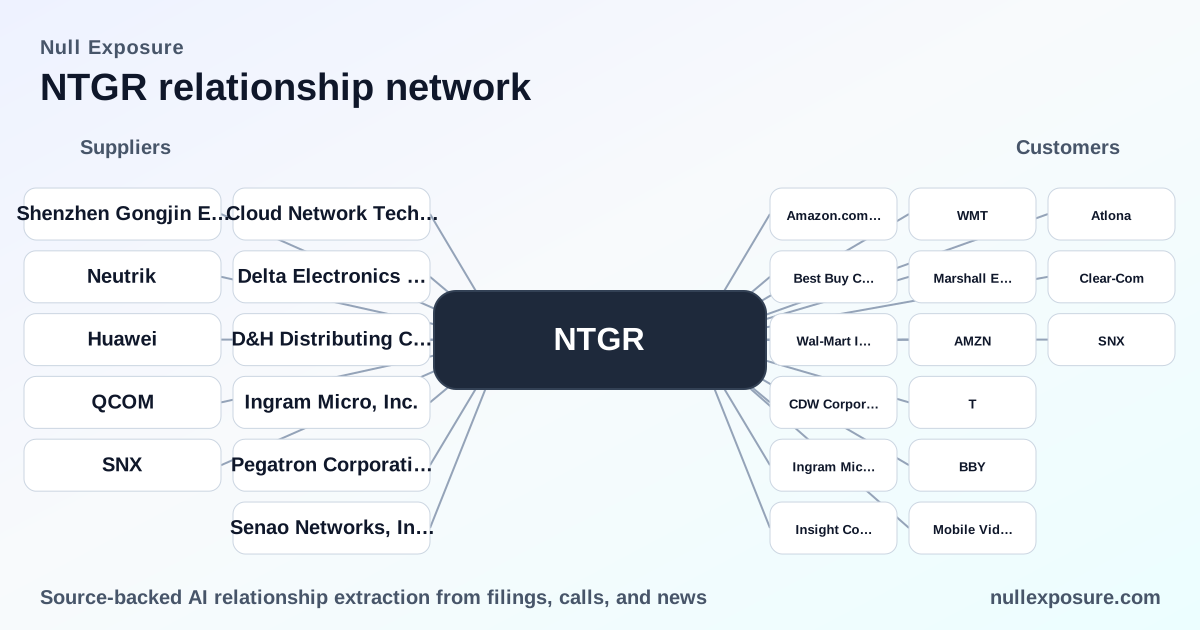
NTGR supplier map: where NETGEAR sources hardware, chips and distribution muscle
NETGEAR sells networking and Internet-connected hardware to channel partners and service providers and monetizes through hardware sales routed primarily via large distributors, while outsourcing the bulk of manufacturing and logistics to a handful of third parties. The company’s operating model is a classic outsourced-hardware supplier: product design and go‑to‑market, partnered manufacturing, and broad distributor reach — a structure that drives margin leverage when volumes scale but also concentrates operational risk in a small set of suppliers and warehouses. For a quick look at how supplier exposures translate into investment risk and operational levers, see Null Exposure for detailed supplier dossiers: https://nullexposure.com/.
The supplier list, in plain English — every named relationship
-
Cloud Network Technology (Hon Hai / Foxconn) — NETGEAR identifies Hon Hai (trading as Cloud Network Technology) among its primary manufacturers, which handle volume production of finished devices. According to NETGEAR’s FY2025 Form 10‑K, Hon Hai is listed alongside a small set of manufacturers responsible for substantially all production. (NTGR FY2025 10‑K)
-
Delta Electronics Incorporated — Delta is named as a primary manufacturer in NETGEAR’s FY2025 filing, indicating a strategic manufacturing role rather than a peripheral vendor. (NTGR FY2025 10‑K)
-
Pegatron Corporation — Pegatron is included among the limited group of third‑party manufacturers NETGEAR depends on for product assembly. (NTGR FY2025 10‑K)
-
Senao Networks, Inc. — NETGEAR’s FY2025 disclosure lists Senao as one of the company’s manufacturing partners, reinforcing the multi‑vendor manufacturing strategy concentrated in Taiwan. (NTGR FY2025 10‑K)
-
Shenzhen Gongjin Electronics Co., Ltd. (T&W) — NETGEAR reports manufacturing activity in Haiphong, Vietnam at a facility owned by Shenzhen Gongjin (T&W), which provides regional production capacity outside Taiwan and China. (NTGR FY2025 10‑K)
-
D&H Distributing Company — NETGEAR sells directly to distributors and explicitly cites D&H as one of its largest distributor customers, reflecting reliance on broad channel partners for go‑to‑market reach in North America. (NTGR FY2025 10‑K)
-
Ingram Micro, Inc. — Ingram Micro is another named top distributor, which indicates NETGEAR routes a meaningful portion of sales volume through tier‑one global distribution channels. (NTGR FY2025 10‑K)
-
TD SYNNEX (SNX) — TD SYNNEX is listed among NETGEAR’s largest distributors, a relationship that ties NETGEAR’s fulfillment and reseller access to one of the industry’s largest distribution platforms. (NTGR FY2025 10‑K)
-
Neutrik — Trade press coverage around NETGEAR’s M4350‑16M4V switch highlights use of Neutrik locking connectors (etherCON, opticalCON, powerCON), signaling supplier selection for ruggedized connector components in enterprise switches. (4rfv industry news, March 2026)
-
Qualcomm (QCOM) — Product announcements for NETGEAR’s Nighthawk M7 portable Wi‑Fi 7 hotspot name Qualcomm’s Dragonwing SDX72 chipset as the modem‑to‑antenna solution, confirming Qualcomm as a key silicon supplier for high‑end wireless devices. (MarketScreener pre‑order announcement, 2026)
-
Huawei (litigation) — NETGEAR has active litigation accusing Huawei of withholding licenses for standard‑essential patents required for Wi‑Fi standard compliance, which represents an IP risk that can affect product designs and licensing costs. The complaint and attendant analysis were profiled in a March 2026 legal briefing. (Crowell client alert on NETGEAR v. Huawei, March 2026)
What the contracts and constraints tell investors about NTGR’s operating model
NETGEAR’s public disclosures deliver a compact but revealing portrait of how the company runs its supply chain:
-
Contracting posture: outsourced and concentrated. The 10‑K language — “we depend on a limited number of third‑party manufacturers for substantially all of our manufacturing needs” — demonstrates an explicit outsourcing posture, where NETGEAR focuses on design, channel relationships and brand while manufacturing is farmed out. That trading‑partner dependency places supplier contracting power and execution risk squarely in a few suppliers’ hands. (NTGR FY2025 10‑K)
-
Concentration is systemic and material. Filings classify the manufacturing base as a limited set of partners; NETGEAR’s own words identify the arrangement as critical to operations. This is a material concentration risk: production interruptions, capacity constraints or price increases at any major contract manufacturer will have an outsized impact on NETGEAR’s ability to ship product. (NTGR FY2025 10‑K)
-
Geographic footprint and logistics posture. NETGEAR uses third‑party warehousing facilities in Northern and Southern California, the Netherlands, Singapore and Australia, which shows a deliberate multi‑region warehousing footprint spanning NA, EMEA and APAC — useful for service levels but also exposing the company to cross‑border logistics risk and regional labor/transport disruptions. (NTGR FY2025 10‑K)
-
Maturity and tenured agreements. The filing references long‑dated operational agreements (e.g., Distribution Operations Agreement and Warehousing Agreement dated in 2001), a signal that core distributor and logistics relationships are long‑standing and operationally embedded, reducing short‑term replacement risk but potentially locking in legacy terms. (NTGR FY2025 10‑K)
-
Role diversity across suppliers. Constraints flag both manufacturing and distribution roles explicitly; that structure concentrates manufacturing criticality but distributes commercial risk across multiple distributors. This combination drives a classic working‑capital dynamic — inventory sits across contract manufacturers and warehouses while sales are recognized through distributor channels.
Investment implications and practical red flags
-
Supply concentration is the primary operational risk. Investors should monitor production schedules and capacity at the named manufacturers and watch for order backlogs or public statements from Foxconn, Delta, Pegatron or Senao that could presage shipment delays or cost pressure. The company’s FY2025 filing explicitly frames this as a critical dependency. (NTGR FY2025 10‑K)
-
Chip and component supplier health matters to product competitiveness. Qualcomm’s participation in flagship devices ties NETGEAR’s wireless performance to Qualcomm’s roadmaps; follow chip availability and pricing cycles. (MarketScreener, 2026)
-
IP litigation is a non‑negligible risk vector. The Huawei complaint over standard‑essential patents could generate licensing costs or design constraints, affecting margins and product availability if injunctions or royalties are imposed. (Crowell, March 2026)
-
Channel execution is a performance lever. Relationships with TD SYNNEX, Ingram and D&H concentrate go‑to‑market exposure: distributor inventory management and promotions will directly affect NETGEAR’s revenue cadence. (NTGR FY2025 10‑K)
For deeper supplier-level analysis and actionable monitoring strategies, visit Null Exposure and explore the NTGR supplier dossier: https://nullexposure.com/.
Final read for investors
NTGR operates with a lean, outsourced manufacturing model and a heavy reliance on tier‑one distributors. That structure is a double‑edged sword: low fixed manufacturing overhead and rapid scale when demand is sustained, but high concentration risk and sensitivity to supplier disruptions, component shortages and IP litigation. Track manufacturing capacity signals, Qualcomm chipset availability, and the progress of the Huawei litigation as your leading indicators.
If you want a supplier risk scorecard or alerts for any change in these relationships, Null Exposure provides supplier monitoring and dossier updates tailored to investors: https://nullexposure.com/.