Network-1 Technologies (NTIP): A concentrated patent licensor with an enforcement-first monetization model
Network-1 Technologies acquires and enforces patented technologies and monetizes primarily through licensing revenues and litigation recoveries tied to those patents; the company supplements that operating model by purchasing patent portfolios and pursuing settlements or judgments to generate cash. Revenue is small and episodic while legal outcomes drive valuation; investors should treat Network-1 as a litigation- and licensing-led royalties vehicle rather than a traditional operating company. Learn more or monitor ongoing supplier relationships at https://nullexposure.com/.
Why Network-1’s licensing-and-enforcement model defines investment outcomes
Network-1’s public profile is straightforward: the business acquires patent portfolios, licenses the rights to implementers, and enforces those rights when counterparties decline to settle. Financial scale is tiny relative to market value — the company reports trailing revenue of $150k and negative EBITDA, while market capitalization sits near $33.9M — which makes legal recoveries and selective licensing agreements the primary drivers of near-term cash flow and investor returns. This is a high-variance, event-driven proposition: upside comes from successful enforcement and portfolio monetization; downside comes from limited recurring revenue and legal expense volatility.
Key operating characteristics that shape supplier and partner relationships:
- Contracting posture: Network-1 engages outside law firms on a contingency basis (15–40% of net recovery), which lowers near-term cash outflow but transfers execution risk and aligns litigation partners to results.
- Concentration and criticality: The company’s income depends on a small number of patented technologies and the enforcement outcomes tied to them; suppliers that enable enforcement (law firms, IP brokers) are critical.
- Maturity and fixed obligations: The company keeps a minimal physical footprint — its principal office lease in New Canaan, Connecticut was short-term and expired in April 2025 — signaling a lightweight operational base focused on IP asset management.
If you track supplier exposure or counterparty risk tied to Network-1, start with legal partners and recent patent sellers; detailed supplier relationship data and trend monitoring are available at https://nullexposure.com/.
The FY2025 IoT acquisition that matters to suppliers and licensees
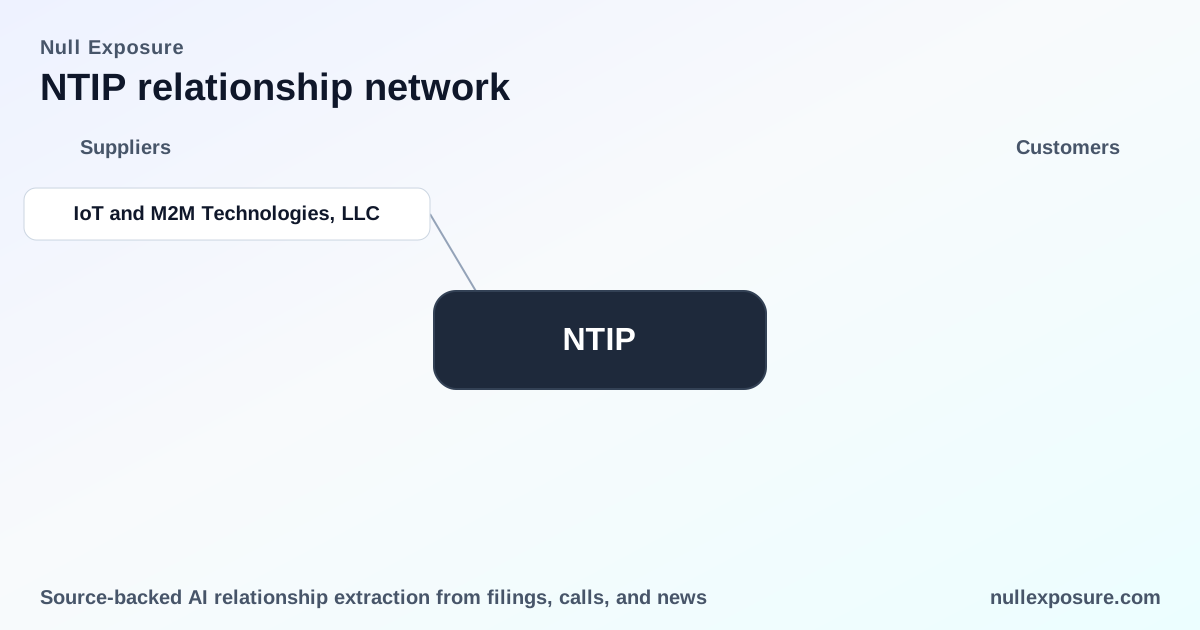
Network-1 disclosed a discrete acquisition on March 31, 2025: the company purchased a “Smart Home Patent Portfolio” from IoT and M2M Technologies, LLC that covers interoperability enabling technology for smart-home IoT devices. That acquisition is the single visible supplier relationship in the records provided and is the kind of focused portfolio purchase that drives Network-1’s licensing pipeline.
IoT and M2M Technologies, LLC — PJStar press release
Network-1 acquired a patent portfolio from IoT and M2M Technologies, LLC on March 31, 2025, focused on smart-home interoperability technology; the acquisition was disclosed in Network-1’s second-quarter 2025 results. Source: PJStar press release covering Network-1’s Q2 2025 results (posted March 10, 2026).
IoT and M2M Technologies, LLC — Des Moines Register press release
The same acquisition of the Smart Home Patent Portfolio from IoT and M2M Technologies, LLC is reflected in a Des Moines Register press release, which reiterates the March 31, 2025 purchase and its relevance to smart-home device interoperability. Source: Des Moines Register press release on Network-1’s Q2 2025 results (posted March 10, 2026).
IoT and M2M Technologies, LLC — News-Press press release
A News-Press distribution of Network-1’s Q2 2025 results also reports the March 31, 2025 acquisition of the Smart Home Patent Portfolio from IoT and M2M Technologies, LLC, confirming the transaction across multiple press outlets. Source: News-Press press release on Network-1’s Q2 2025 results (posted March 10, 2026).
Each of these press releases documents the same counterparty transaction; for supplier-risk monitoring and diligence, consider the portfolio’s claim set, enforcement jurisdictions, and downstream licensee targets.
How the documented constraints shape the company’s supplier posture
The extracted constraints offer direct signals about Network-1’s operating model rather than specific supplier contracts:
- Contingency litigation contracts: Network-1 engages law firms on contingency arrangements that take 15–40% of net recoveries depending on case stage, a structure that conserves cash but concentrates execution risk on a small set of litigation partners. This is a company-level contracting posture that affects cash flow timing and the marginal economics of any recovery.
- Geographic footprint: The company’s principal office lease in New Canaan, Connecticut, expired April 30, 2025, indicating a lean physical operation centered in North America. This is a company-level signal about operational maturity and cost structure.
- Active relationship stage: Short remaining lease terms as of late 2024 show Network-1 operating with minimal fixed commitments, consistent with an asset-light approach to IP management.
Together, these signals indicate a low fixed-cost, event-driven operating model that outsources legal execution and maintains limited operational baggage — advantageous for upside capture in successful litigations, but dependent on a narrow set of external partners and one-off transactions.
Investment considerations: concentrated upside, clear downside
For investors evaluating NTIP supplier relationships and counterparty risk, focus on three realities:
- Revenue and valuation disconnect: Trailing revenue of $150k versus a market cap near $33.9M and an extreme Price-to-Sales ratio indicate the market prices in expected future licensing recoveries rather than current operations. The investment case relies on successful enforcement and licensing conversions.
- High insider ownership and limited institutional presence: Insiders own roughly 40% of shares and institutions about 22.8%, which concentrates control and may influence transaction timing and disclosures.
- Event concentration risk: A small number of patent acquisitions and litigation outcomes determine cash flow; outside counsel contingency arrangements shift short-term capital requirements but concentrate counterparty execution risk.
Watch items that will change the supplier and risk profile: new portfolio purchases, announced settlements or license agreements, and any disclosures about law firm arrangements or contingency splits. For ongoing supplier tracking and alerts on these items, visit https://nullexposure.com/.
Bottom line and next steps for due diligence
Network-1 is a specialist acquirer and enforcer of patents where value realization is dominated by legal outcomes and selective licensing. Investors or counterparties should underwrite specific litigation scenarios, review contingency fee economics, and validate the asserted claim coverage of newly acquired portfolios such as the Smart Home Patent Portfolio from IoT and M2M Technologies, LLC.
If you monitor supplier concentration, legal counterparty exposure, or portfolio-driven revenue risk, keep Network-1 on a short watchlist for filings and press releases — and use the supplier relationship hub at https://nullexposure.com/ to track new notices and disclosures.