Nutrien Ltd (NTR) — supplier relationships that matter for investors and operators
Nutrien is a vertically integrated agricultural inputs company that monetizes through sales of crop nutrients, retail agri‑services, and logistics. The company generates cash by distributing fertilizers and crop inputs at scale, operating retail stores and bulk supply chains, and allocating capital via dividends and share repurchases; with trailing revenue of $25.95 billion and EBITDA of $5.41 billion, Nutrien’s supplier posture is transactional but commercially significant for input continuity in crop seasons. For a closer look at how these supplier ties affect operational risk and capital allocation, visit https://nullexposure.com/.
What the supplier map shows in plain language
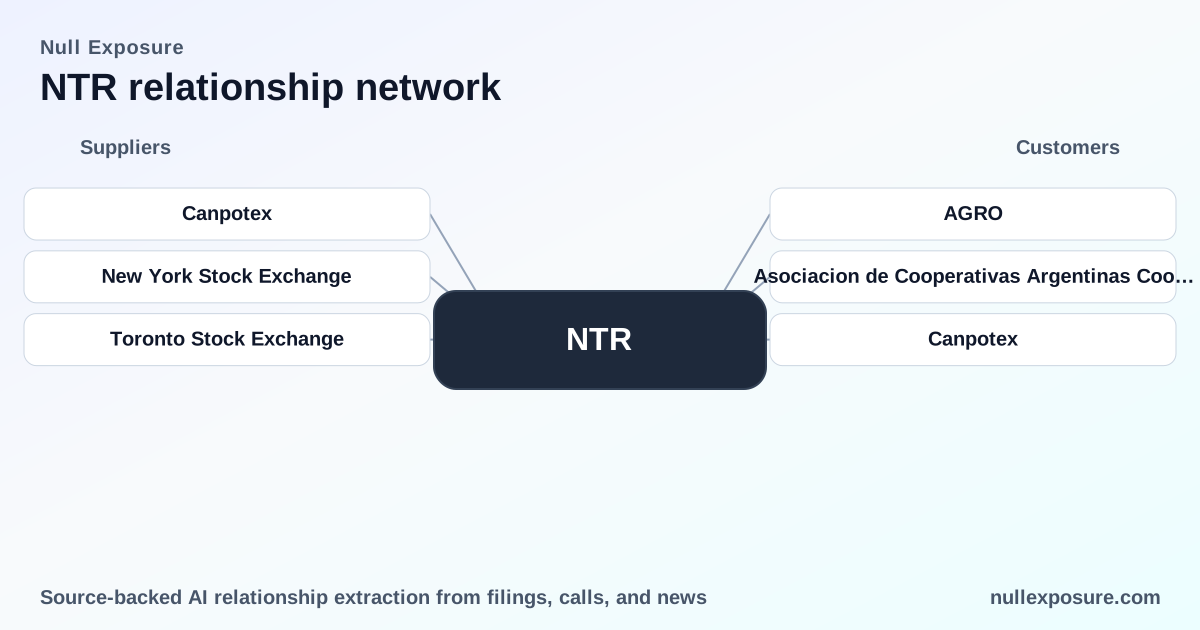
Nutrien’s supplier relationships reported in public filings and press releases are small in number but operationally informative: one trading/commodity counterparty and two exchange venues used for its share repurchase activity. These items together illustrate a company that runs high‑volume procurement, manages liquidity through market venues, and uses repurchase programs as an element of capital strategy.
Key company‑level signals (company disclosures and financials):
- Concentration: Purchases from Canpotex totaled $150 million for the year ended December 31, 2025, which is roughly 0.6% of Nutrien’s trailing revenue, indicating low spend concentration in the context of total sales but an important commodity relationship for potash supply.
- Contracting posture: Procurement references are transactional purchase records rather than long‑term contract terms disclosed in the cited materials, pointing to a procurement approach that balances spot and contracted supply.
- Criticality and maturity: The parties named exist within mature market structures — exchange facilities for repurchases and an established fertilizer exporter as a supplier — suggesting operational relationships that are stable but operationally critical during peak seasons.
- Capital allocation signal: Acceptance of a normal course issuer bid on major exchanges shows active capital returns that coexist with ongoing supplier purchases.
Canpotex — the direct supplier spend snapshot
Nutrien reported purchases from Canpotex of $50 million for the quarter ending December 31, 2025 and $150 million for the full year ended December 31, 2025 (2024: $146 million), indicating a slight increase in annualized purchases year‑over‑year. This level of spend is modest relative to Nutrien’s revenue but reflects a direct commercial link to an important potash exporter. According to Nutrien’s full‑year results and guidance press release (March 10, 2026), these figures are reported as procurement line items rather than detailed contractual obligations.
Source: Nutrien press release, "Nutrien reports full year 2025 results and provides 2026 guidance" (published March 10, 2026).
New York Stock Exchange — repurchase execution channel
Nutrien’s renewed normal course issuer bid (NCIB) states that purchases of common shares may be made through the facilities of the New York Stock Exchange as permitted under applicable securities laws, giving the company an execution path for U.S. market buybacks and liquidity management. This disclosure is an operational detail relevant to treasury and counterparty execution, rather than a supplier relationship in the procurement sense.
Source: BizWire release carried on FinancialContent, "Nutrien announces TSX approval for its renewed share repurchase program" (February 26, 2026).
Toronto Stock Exchange — domestic repurchase venue and notice accepted
The Toronto Stock Exchange accepted Nutrien’s notice to commence an NCIB authorizing purchases of up to 5% of issued and outstanding common shares, allowing domestic repurchases through TSX facilities and signaling active capital return policy alongside operational spending. The TSX acceptance confirms that Nutrien will use established exchange mechanisms for buybacks in Canada.
Source: BizWire release carried on FinancialContent, "Nutrien announces TSX approval for its renewed share repurchase program" (February 26, 2026).
Mid‑analysis action: for a concise supplier risk brief tailored to Nutrien’s counterparties, see https://nullexposure.com/.
What investors and operators should take from these relationships
- Operational risk is concentrated more in commodity markets than in single‑supplier exposure. The Canpotex spend, while meaningful for potash availability, represents a small percentage of total revenue; supply disruptions would be operationally relevant but not existential to Nutrien’s diversified sourcing and integrated retail footprint.
- Liquidity and execution are managed through regulated exchange channels. The NCIB’s use of TSX and NYSE facilities demonstrates that Nutrien executes capital returns within standard market structures, which reduces execution risk for repurchases but increases the importance of timely disclosure and regulatory compliance.
- Procurement posture is transactional and scale‑driven. Reported amounts are purchase totals; they do not disclose granular contract tenure or price‑linkage. Operators should treat these as stable but commercially negotiable relationships that can be adjusted with market pricing and seasonal demand.
Practical implications for asset allocators and supplier managers
- For investors: focus on the combination of cash generation and capital allocation. Nutrien’s dividend and NCIB activity, together with EBITDA and EV/EBITDA multiples (EV/EBITDA ~8.37), make capital returns and margin resiliency key monitoring points alongside fertilizer market cycles.
- For procurement and supply chain teams: maintain multiple sourcing options for potash and other nutrients despite the modest share of spend with any single supplier, because commodity availability and timing have outsized operational impact during planting and application windows.
- For treasury and corporate development: use transparent exchange channels for buybacks to balance market impact and regulatory visibility, as demonstrated by Nutrien’s reliance on the TSX and NYSE for its NCIB.
Final action: to review supplier relationship impact across other agribusiness counterparties and to commission a bespoke counterparty risk memo for Nutrien, visit https://nullexposure.com/.
Bottom line
Nutrien’s disclosed supplier relationships are limited in number but instructive: Canpotex is a recurring potash supplier with modest spend relative to revenue, while TSX and NYSE disclosures reflect how Nutrien executes capital allocation, not procurement. Together these signals indicate a company operating with mature market counterparties, a transactional procurement posture, and active capital management — the combination investors and operators should track when assessing exposure to fertilizer market cycles and counterparty execution risk.