NextTrip Inc (NTRP) — supplier relationships and operating signals investors should price
NextTrip Inc lists itself in travel services and operates an online distribution and content business that monetizes through licensing, channel distribution and partnership fees. Public filings connected to a March–April 2025 content acquisition and subsequent license agreements show the company pays structured license fees and issues equity in certain transactions; transaction sizes in filings sit squarely in the $100k–$1m band, indicating mid‑sized supplier commitments rather than enterprise-scale vendor spend. If you are evaluating NTRP as a supplier partner or counterparty, the combination of licensing dependencies, externally hosted infrastructure and a concentrated supplier set drives the core commercial and operational risk profile. For a concise supplier map and vendor risk summary visit https://nullexposure.com/.
Quick take: how NextTrip runs its supplier book
NextTrip’s supplier posture is contract-driven, distribution-focused and financially modest in scale. Key operating model signals from filings and disclosures:
-
Contracting posture — licensing-oriented. The company enters formal license agreements with non‑refundable fees and time‑bound exclusivity carveouts, reflecting a rights‑for-fee commercial model rather than pure services procurement. Company filings tied to the Journy.tv acquisition document a non‑exclusive License Agreement with specified exclusivity exceptions and aggregate fee schedules (example: $336,801 paid over 30 months).
According to the company filing in connection with the Journy.tv acquisition (April 1, 2025), the License Agreement required an aggregate non‑refundable license fee of $336,801 over thirty months. -
Concentration and criticality — focused distribution partners. Major supplier access cited in filings includes market gatekeepers such as Expedia, Nuitée, Global Distribution Systems and Signature Vacations, suggesting a concentrated set of distribution and inventory providers that are critical to revenue delivery. The company explicitly references reliance on these partners for hotel, vacation rental and cruise access in acquisition materials.
-
Maturity and spend scale — mid‑market vendor economics. Multiple disclosed cash payments and equity issuances tied to acquisitions and license consideration (examples: $300k cash at closing; $500k paid to FSA members plus equity grants) establish a recurring spend band in the $100k–$1m range rather than multi‑million vendor contracts. These deal sizes indicate a lean operating budget for content and supplier rights relative to large consumer travel platforms.
-
Operational dependencies — cloud and third‑party services. The company acknowledges heavy reliance on third‑party cloud hosting, encryption/authentication and email systems, and reports that websites are hosted on globally distributed cloud infrastructure — a signal of operational outsourcing and global footprint, which carries both scalability benefits and third‑party concentration risk.
If you want this supplier intelligence framed for diligence or procurement scorecards, see the home page at https://nullexposure.com/.
The one explicit supplier relationship in the public results
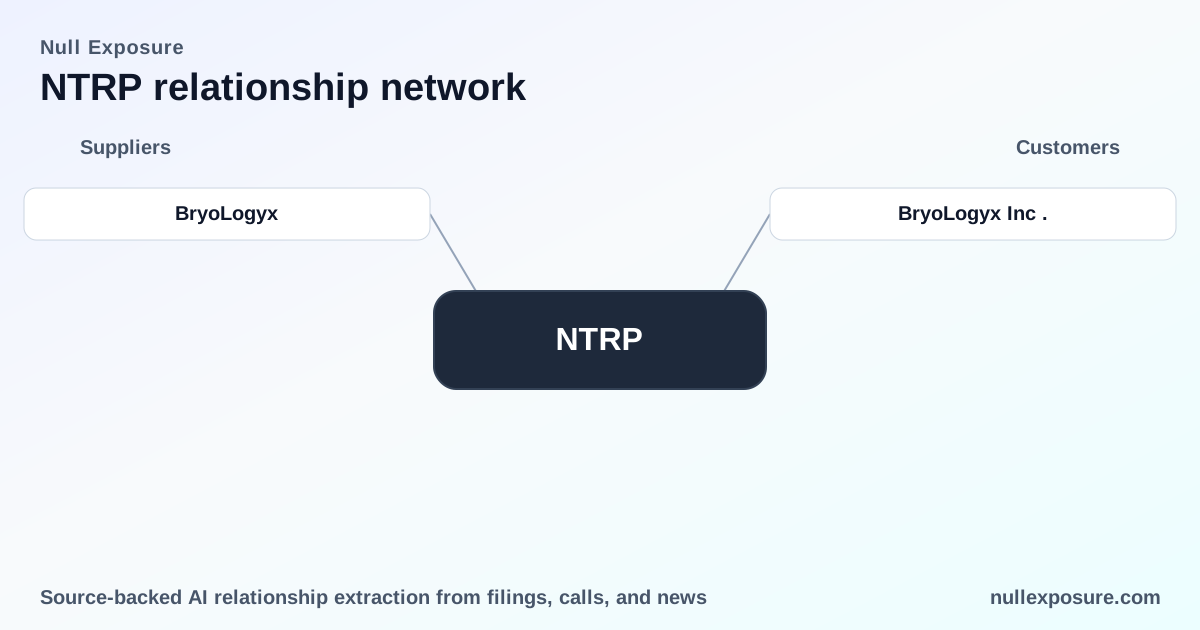
BryoLogyx — A single media report cataloged a transaction in which BryoLogyx agreed to supply synthetic bryostatin‑1 to Neurotrope for clinical trials and potential commercialization for Alzheimer’s and other neurodegenerative indications; the item is captured in news sentiment for FY2020 but surfaced in the dataset on March 10, 2026. This is recorded in a DrugDiscoveryNews article reporting the supply and data transfer transaction.
Source: DrugDiscoveryNews report (March 10, 2026) on the BryoLogyx / Neurotrope agreement — https://www.drugdiscoverynews.com/bryologyx-acquires-bryostatin-1-preclinical-data-package-from-neurotrope-14338.
Note: that relationship as reported links BryoLogyx to Neurotrope; the vendor record here is cataloged under the NTRP supplier scope.
What filings and constraints reveal about vendor posture (company‑level signals)
The public evidence produces clear company‑level signals that are material for any supplier relationship assessment:
-
Licensing over purchase. The company structures access through license agreements with non‑refundable fees and carveouts on sub‑licensing and channel usage — a commercial stance that protects content owners and shifts certain distribution economics to fixed cash and equity consideration (company filing, Journy.tv acquisition, April 1, 2025).
-
Active, service‑provider dependence. Filings state the firm “relies heavily on products and services provided by third‑party suppliers to operate critical business systems,” which positions infrastructure and platform suppliers as operationally critical (company disclosure).
-
Global hosting and scaleability. The company hosts websites on cloud services distributed globally; that supports international reach but increases dependency on global cloud providers and associated resilience / compliance controls (company filing).
-
Distribution segment orientation. Supplier lists called out in filings — Expedia, Nuitée, GDS providers, Signature Vacations — underline that inventory and distribution partners are a core competitive input, not peripheral suppliers.
-
Spend concentration in mid‑range deals. Multiple excerpts quantify transactional consideration — a $336,801 license fee over 30 months, $300,000 cash at closing for an acquisition, and $500,000 cash to FSA members plus equity issuance — establishing the company’s normal spend bands and the likelihood that supplier negotiations occur at mid‑contract volumes rather than at enterprise procurement thresholds.
These signals combine into a pragmatic vendor risk profile: critical third‑party dependencies, concentrated distribution partners, licensing economics, and mid‑sized contract values. That combination implies high business impact from a small set of suppliers, but limited exposure to very large single‑counterparty financial commitments.
Investment and operational implications for counterparties
For investors and operators evaluating NTRP supplier relationships, prioritize the following:
-
Contract structure diligence. Negotiate license terms that protect your distribution rights and cash flow expectations; the company uses non‑refundable license fees and equity consideration in lieu of higher cash outlays.
-
Concentration mitigation. Obtain clarity on dependency to Expedia, GDSs and key inventory partners; backup distribution channels and technical integration alternatives reduce single‑point risk.
-
Service reliability and compliance. Given the global cloud footprint and reliance on third‑party encryption/authentication, insist on SLAs, data residency and incident response clauses that reflect the services’ criticality.
-
Counterparty credit and timing. Expect mid‑sized up‑front payments and staged license fees; adjust credit limits and payment triggers accordingly.
Mid‑article resource: for a fast supplier risk brief tailored to NTRP, visit https://nullexposure.com/.
Bottom line
NextTrip operates as a distribution and content licensor with contractually driven supplier economics and a concentrated set of critical partners. Filings show the company consistently uses licensing arrangements, makes mid‑range cash and equity payments for acquisitions and rights, and depends heavily on third‑party infrastructure. For counterparties, the priorities are strict contract terms, mitigation of concentration risk, and operational SLAs. For investors, the supplier posture highlights where execution risk and upside intersect: tight supplier relationships enable revenue delivery, but concentrated dependencies amplify operational risk.
For a practical supplier due diligence brief or to track additional NTRP counterparties, go to https://nullexposure.com/.