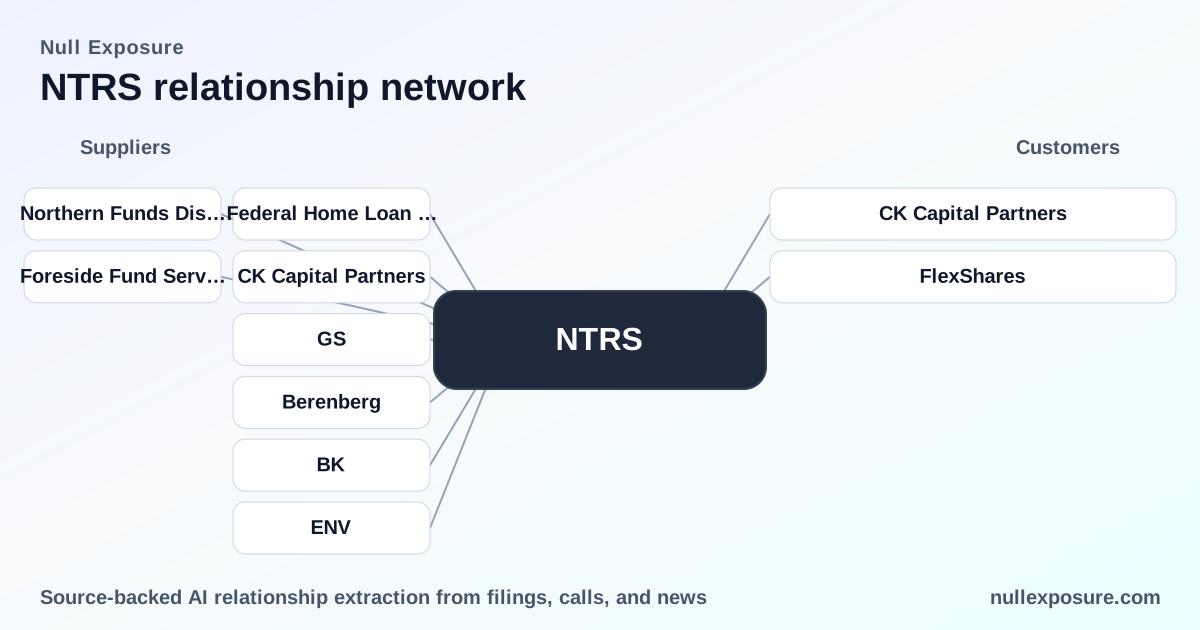
Northern Trust (NTRS) as a Supplier: a practical investor thesis
Northern Trust operates as a custodian, asset manager and service platform for institutional and ultra-high-net-worth clients, monetizing through custody and asset servicing fees, investment management fees, and transactional services tied to scale and trust. Revenue derives from long-duration client relationships and third‑party platform integrations that expand product distribution (tokenized funds, direct indexing, currency hedging) while relying materially on outsourced technology and service providers. For an investor evaluating Northern Trust as a supplier to counterparties or as a vendor-dependent enterprise, the supplier map clarifies commercial reach and operational risk. Learn more about supplier intelligence at https://nullexposure.com/.
How Northern Trust makes money and what its supplier posture implies
Northern Trust’s core monetization is fee-based: custody and administration fees, investment management margins, and distribution fees on fund products. The commercial strategy combines proprietary capabilities with partner platforms to accelerate product distribution (e.g., tokenized share classes and direct indexing), which boosts fee scale without proportionally expanding front-office headcount.
Operationally this model has four practical constraints investors must price into valuation and counterparty diligence:
- Contracting posture: Northern Trust relies on third-party service providers for critical technology and connectivity; contracts therefore emphasize uptime, SLAs, and continuity provisions. The company’s 2024 10‑K explicitly flags third‑party technology dependence as a material operational exposure.
- Concentration and criticality: Several third-party relationships are functionally critical—platforms that host distribution or provide back‑office plumbing influence revenue delivery and client experience.
- Service role maturity: Northern Trust’s supplier relationships are mature and commercial (service provider relationships in the services segment), not experimental pilots; partners are used to scale established product lines into new markets.
- Operational risk: Because outsourced systems underpin front- and back-office workflows, technology disruptions are a material risk to revenue continuity rather than a hypothetical compliance note.
If you are building counterparty exposure or assessing Northern Trust as a strategic supplier, these are the themes to foreground. For an on-demand supplier risk briefing, visit https://nullexposure.com/.
Relationship map: who Northern Trust works with and why
Federal Home Loan Bank of Chicago
Northern Trust discloses in its 2024 10‑K that other borrowings include advances from the Federal Home Loan Bank of Chicago, indicating a liquidity relationship used for funding lines and balance‑sheet management rather than a vendor service. According to the 2024 Form 10‑K, these advances are part of the company’s other borrowings (FY2024).
CK Capital Partners
Northern Trust was appointed to provide asset servicing solutions to CK Capital Partners, a commercial relationship that positions Northern as the administrator and custodian for that manager’s strategies; this was reported in March 2026 by ADVFN (March 2026).
Goldman Sachs
Goldman Sachs is referenced as the provider of digital asset plumbing through its Goldman Sachs Digital Asset Platform (GS DAP®) used by partners hosting Northern Trust’s tokenized products, indicating a multi‑party technology stack for digital fund distribution; this linkage is reported in TradingView/Zacks and Cointelegraph coverage in March 2026 (March 2026).
Berenberg
Northern Trust integrated Berenberg’s AI‑driven currency management strategies into its dynamic currency hedging offering, enhancing hedge flexibility for clients and reflecting Northern’s use of boutique quantitative partners for product improvement; this integration was covered by Intellectia.ai in March 2026 (March 2026).
The Bank of New York Mellon (BNY)
BNY’s LiquidityDirect platform is the initial distribution venue for Northern Trust’s tokenized share classes, demonstrating a distribution partnership where Northern provides product and BNY provides market access and settlement rails; this relationship was described in ADVFN, TradingView and Cointelegraph reporting in March 2026 (March 2026).
Northern Funds Distributors, LLC
Northern Funds Distributors, LLC is identified as a distributor and is explicitly noted as not affiliated with Northern Trust, a structural detail relevant to regulatory and distribution-channel separation documented in ADVFN’s coverage of March 2026 (March 2026).
Foreside Fund Services, LLC
Foreside shows up in reporting as a distributor in the context of fund launches, an example of third‑party fund administration and distribution providers participating in product go‑to‑market; this is noted in ADVFN’s March 2026 report on ETF launches (March 2026).
Envestnet
In January 2026 Northern Trust partnered with Envestnet to offer direct indexing on Envestnet’s advisor platform, broadening advisor access to Northern’s customizable tax‑efficient solutions and embedding Northern’s capabilities inside third‑party wealth platforms; this partnership was cited in a TradingView / Zacks article (March 2026, referencing January 2026 activity).
What the relationship map implies for investors and operators
Distribution partnerships (BNY, Envestnet, third‑party distributors) increase addressable market and lower client acquisition cost, improving monetization leverage over time. Technology and execution partners (Goldman Sachs’ GS DAP, Berenberg, third‑party IT vendors) reduce development expense but create concentrated operational risk: Northern’s 2024 10‑K warns that third‑party system failures are a material exposure. Liquidity access (Federal Home Loan Bank of Chicago) is a tactical balance‑sheet tool rather than a revenue driver, but it affects funding flexibility in stress scenarios.
Operationally, this mixes high revenue stickiness with medium operational concentration: product revenues are durable, but the back‑office and distribution layers depend on external platforms. For investors, the trade-off is higher fee durability versus provider concentration risk; for counterparties, the relevant due diligence is around SLAs, contingency plans and regulatory separation among distributors.
Mid‑article action: get a tailored supplier risk brief at https://nullexposure.com/.
Bottom line and recommended investor actions
Northern Trust combines scale, distribution partnerships and specialized product integrations to expand fee pools; the company monetizes through custodial and management fees while outsourcing non‑core platforms, which accelerates product rollout but increases operational dependence on a small set of third‑party providers. Key monitoring items: SLA quality, incident history with third‑party platforms, and the commercial terms that protect revenue in the event of outsourcing failures.
For executives, investors and researchers needing a concise supplier-risk dossier or ongoing monitoring, start with a supplier report at https://nullexposure.com/. Major takeaway: Northern Trust’s partner ecosystem is a strategic advantage for distribution and capability, but it is also the primary operational vulnerability that investors must underwrite.