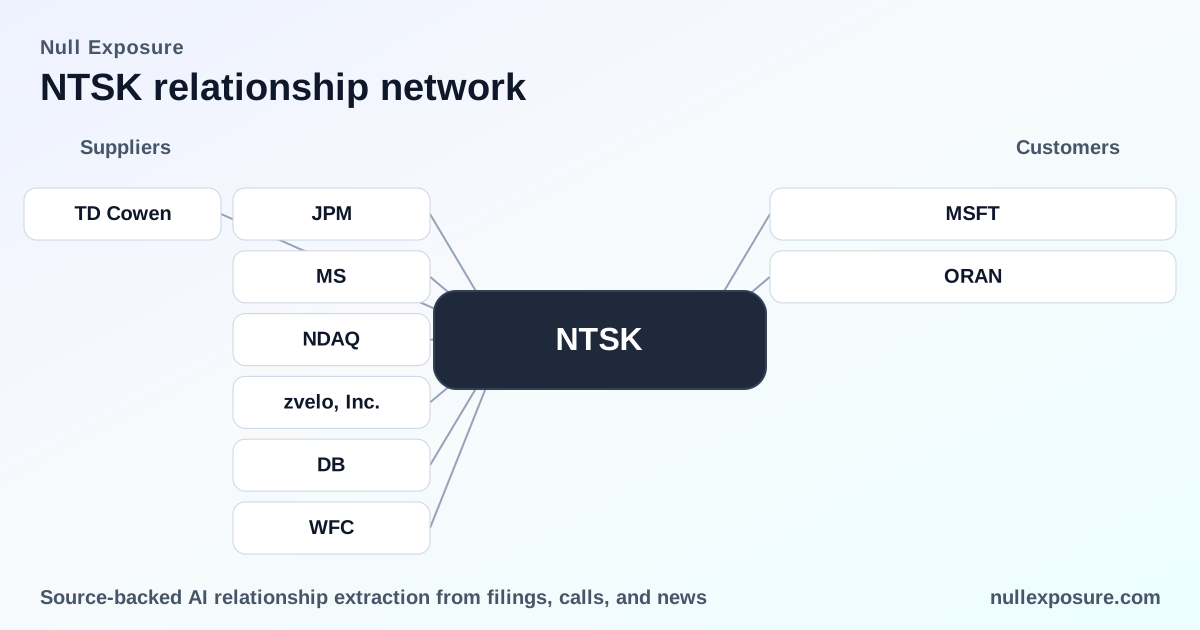
Netskope (NTSK) — Supplier relationships that move the IPO and the risk profile
Netskope sells cloud-native security (SASE/SSE) and analytics to large enterprises on a subscription basis and monetizes through recurring license and support revenue, professional services, and tiered enterprise contracts. The company’s go-to-market is enterprise SaaS: high gross margins, subscription retention, and concentration in large customers drive top-line visibility, while negative EBITDA and operating losses reflect heavy growth and go-to-market investments. For investors and operators, the most consequential supplier relationships today are the financial underwriters behind the public offering and a legacy licensing dispute that introduces legal and vendor-risk considerations. Learn more at https://nullexposure.com/.
Why supplier relationships matter for a security SaaS vendor
Netskope’s operating model is contract-heavy and enterprise-focused: long-term subscriptions and partner-led deals dominate revenue recognition. That creates four company-level constraints to watch as you evaluate supplier risk:
- Contracting posture: Enterprise contracts mean long sales cycles and concentrated renewal risk with large customers.
- Concentration: High institutional ownership and a relatively small free float increase sensitivity to market sentiment and underwriting depth.
- Criticality: Security services are mission-critical for customers, which supports switching costs but raises reputational risk if third-party data or IP issues arise.
- Maturity: Transitioning from private to public markets brings underwriting dependencies and litigation exposure into sharper focus.
Operationally, Netskope reported $708.997M in trailing twelve‑month revenue with negative EBITDA and EPS, underscoring growth-first spending priorities; these financials amplify the importance of stable supplier and underwriting relationships for capital markets access.
Visit the company overview and relationship intelligence at https://nullexposure.com/ for deeper signals.
The underwriting syndicate that underpins the float
Netskope engaged a broad bank syndicate for its IPO, which affects distribution strength and aftermarket support.
Morgan Stanley
Morgan Stanley is serving as one of the lead book‑running managers on Netskope’s IPO, anchoring the offering and influencing pricing and allocation. (MLQ.ai, March 10, 2026 — https://mlq.ai/news/netskope-ipo-shares-begin-trading-on-nasdaq-at-1900-per-share/)
J.P. Morgan
J.P. Morgan is acting alongside Morgan Stanley as a lead book‑running manager, providing another major underwriting anchor to the float and signaling strong institutional placement capability. (MLQ.ai, March 10, 2026 — https://mlq.ai/news/netskope-ipo-shares-begin-trading-on-nasdaq-at-1900-per-share/)
TD Cowen
TD Cowen is listed among additional book‑running managers supporting the IPO, contributing distribution depth to the syndicate beyond the global bulge bracket banks. (SDxCentral, March 10, 2026 — https://www.sdxcentral.com/news/netskope-files-for-nasdaq-ipo-as-sase-vendor-eyes-next-growth-stage/)
Wells Fargo Securities
Wells Fargo Securities is part of the broader underwriting group, adding regional syndicate coverage and sales channels for institutional and wealth clients. (SDxCentral, March 10, 2026 — https://www.sdxcentral.com/news/netskope-files-for-nasdaq-ipo-as-sase-vendor-eyes-next-growth-stage/)
Deutsche Bank Securities
Deutsche Bank Securities appears in the list of supporting managers, enhancing the offering’s European distribution footprint and institutional reach. (SDxCentral, March 10, 2026 — https://www.sdxcentral.com/news/netskope-files-for-nasdaq-ipo-as-sase-vendor-eyes-next-growth-stage/)
Nasdaq
Netskope will list on the Nasdaq under ticker NTSK, establishing the exchange venue and post‑IPO liquidity context for institutional owners and suppliers. (MLQ.ai, March 10, 2026 — https://mlq.ai/news/netskope-boosts-ipo-price-range-12-amid-cybersecurity-surge/)
A vendor dispute that affects IP and contractual risk
zvelo, Inc.
zvelo alleges a License and Service Agreement with Netskope from March 2016 in which zvelo licensed its database products to Netskope; the litigation highlights historical third‑party IP licensing and potential legacy contractual obligations. (JDSupra, litigation summary, reported March 2026 — https://www.jdsupra.com/legalnews/ai-litigation-insights-zvelo-inc-v-1759852/)
What these relationships imply for investors and operators
- Underwriting depth reduces placement risk but raises expectations. The presence of Morgan Stanley and J.P. Morgan as lead book‑runners, backed by a broad syndicate including TD Cowen, Wells Fargo and Deutsche Bank, provides credible distribution and aftermarket support for the IPO (SDxCentral; MLQ.ai, March 10, 2026). That supports an orderly float but creates market expectations for execution and transparency.
- Legacy vendor litigation increases legal and operational risk. The zvelo claim over a 2016 license introduces a discrete supplier‑related legal exposure that is not necessarily material to day‑to‑day operations but is reputational and contract‑risk relevant for enterprise buyers who prize clean IP stacks (JDSupra, March 2026).
- Financials amplify supplier importance. With $708.997M revenue TTM, gross profit of $482.669M, negative EBITDA and EPS, and aggressive go‑to‑market investment, Netskope relies on smooth capital market access and robust underwriting support to fund growth and manage liquidity. Analyst coverage is favorable — the consensus tilts bullish — which underwrites valuation support but raises scrutiny on execution.
If you are evaluating counterparty or vendor exposure for due diligence, these relationships are the first-order items to validate: underwriting commitments and any outstanding licensing disputes. For further structured intelligence and monitoring, check our platform at https://nullexposure.com/.
Practical takeaways for risk and partnership management
- Prioritize contract reviews for legacy licenses. The zvelo allegation is a reminder to include historical licensing in vendor diligence and renewal negotiations.
- Treat the syndicate as part of financing risk. The bank group’s composition matters for aftermarket support and secondary raises—investors should monitor lockups, stabilization activity, and analyst coverage following the IPO.
- Evaluate revenue quality and retention. The enterprise subscription model provides predictable cash flow when renewals are high; investor diligence should probe concentration and major-account churn.
Explore detailed counterparty signals and watchlists at https://nullexposure.com/ to track changes in underwriting composition, litigation filings, and other supplier relationships in real time.
Bottom line
Netskope’s immediate supplier profile is dominated by the IPO underwriting syndicate and a single legacy license dispute. The underwriting group provides distribution strength that supports market access, while the zvelo claim is a vendor‑related legal risk that requires careful monitoring. Given the company’s growth profile and negative operating earnings, these supplier relationships are decisive for capital access and reputation—both central to near‑term investor returns and operational stability.
For ongoing monitoring and deeper relationship intelligence, visit https://nullexposure.com/.