Nu Skin (NUS): Supplier Relationships and Operational Constraints — an investor brief
Nu Skin Enterprises sells wellness and personal care products through a global direct-selling network and captures margin via product sales, sales-force compensation structures, in-house manufacturing and targeted acquisitions that deepen ingredient and production capabilities. Revenue is driven by product turnover through affiliates and a commission-heavy cost structure, while Nu Skin retains control points in Mainland China manufacturing and select U.S. facilities to lower unit cost and protect formulation IP. For investors evaluating supplier exposure, the mix of owned plants, third‑party sourcing, strategic digital partnerships and a recent ingredients acquisition defines both opportunity and concentrated operational risk. Explore supplier coverage and signals on our homepage.
What the operating model implies for supplier risk and contracting
Nu Skin runs a hybrid sourcing model: owned manufacturing in critical APAC markets and reliance on third‑party manufacturers elsewhere. That arrangement reduces exposure to global logistics for China sales but concentrates supplier risk geographically. The company’s cash flow profile is also distinctive: operating expenses run 85–90% of revenue with 40–43% of core revenue paid out as commissions within roughly one to two months, which makes predictable supplier and manufacturing cash flows essential to margins.
Key operating constraints and company-level signals:
- Long-term lease posture: Nu Skin discloses leases with remaining terms of 1 to 12 years and extension options up to 20 years, signaling a longer-term fixed-cost base in property and manufacturing footprint.
- APAC manufacturing criticality: Nu Skin produces the majority of products sold in Mainland China in its own facilities, making regional operations a core continuity risk and a strategic advantage for China sales.
- Material supplier concentration: In 2025, two manufacturing subsidiaries and one third‑party supplier each accounted for more than 10% of product purchases—this is a material concentration that increases vendor-payment and supply continuity importance.
- Manufacturing segment scale: Approximately 21% of product sourcing (outside Mainland China) came from Nu Skin’s manufacturing subsidiaries in 2025, indicating meaningful internal production capability alongside third‑party suppliers.
- Service-provider cash flows: Nu Skin’s compensation-heavy distribution model functions like a service-provider expense structure and creates short-cycle working capital dynamics that interact with supplier payment terms.
These constraints imply high operational leverage to manufacturing uptime and supplier payment terms, along with moderate geographic concentration in APAC and selected U.S. plants.
What the supplier relationships look like today
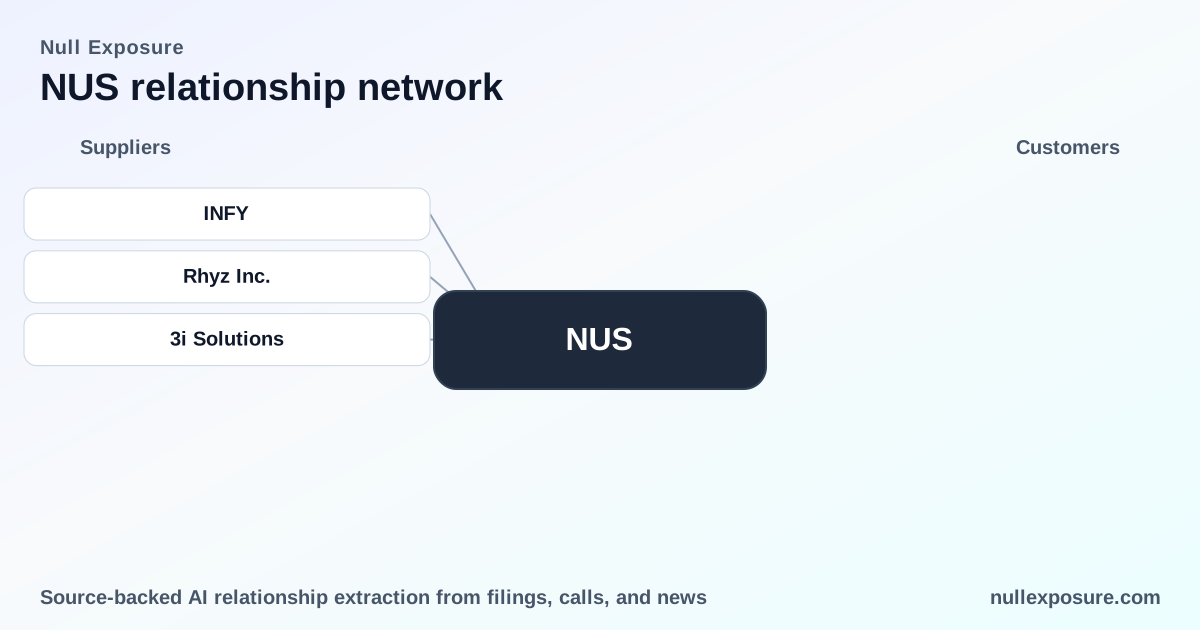
Infosys — social commerce and digital infrastructure (PR Newswire, March 2026) Nu Skin announced a partnership to deploy the Infosys Equinox digital commerce platform to power social-commerce experiences for consumers and affiliates, positioning digital sales channels as a structural growth lever. (PR Newswire release, March 10, 2026 — https://www.prnewswire.com/news-releases/infosys-collaborates-with-nu-skin-to-drive-social-commerce-led-transformation-in-the-beauty-and-wellness-sector-301532999.html)
Rhyz Inc. — owned U.S. manufacturing (Global Cosmetics News, 2026) Nu Skin operates manufacturing facilities in the U.S. through its Rhyz Inc. subsidiary; those plants serve Nu Skin and roughly 120 other customers, reflecting a dual role as both captive manufacturer and external contract manufacturer. (GlobalCosmeticsNews coverage of Nu Skin’s Shanghai facility opening, reported 2026 — https://www.globalcosmeticsnews.com/nu-skin-opens-shanghai-facility/)
Infosys — India operating model and localized rollout (earnings transcript summary, FY2026) Management described a refined India operating model that uses Infosys to deliver a digital-first infrastructure, a localized product portfolio and an adjusted compensation plan to capture India’s growing middle class. This partnership is integral to Nu Skin’s go-to-market modernization in India. (Q4 2025 earnings call transcript summary reported in March 2026 by InsiderMonkey — https://www.insidermonkey.com/blog/nu-skin-enterprises-inc-nysenus-q4-2025-earnings-call-transcript-1695947/)
3i Solutions — strategic ingredients acquisition (Happi, FY2026) Nu Skin acquired 3i Solutions, a Wooster, Ohio ingredients company specializing in oil-soluble, water-dispersible materials for cosmetics and nutrition, strengthening internal formulation capabilities and potentially reducing dependence on some third‑party ingredient suppliers. (Happi breaking news on the acquisition, reported 2026 — https://www.happi.com/breaking-news/nu-skin-acquires-3i-solutions/)
How these relationships change the supplier risk profile
The Infosys partnership shifts a portion of distribution risk into digital and software-enabled commerce — this reduces marginal channel risk but increases execution risk around platform integration and affiliate adoption. The India-focused Infosys work also speaks to market expansion via localization, which is a revenue upside if adoption is rapid.
The Rhyz Inc. pedigree matters: Nu Skin is not simply outsourcing; it operates manufacturing subsidiaries in Utah and China that both supply Nu Skin and third parties. That lowers unit cost and protects formulations, but also builds fixed-cost exposure via long leases. Management’s disclosure that two manufacturing subsidiaries—and one external supplier—accounted for >10% of product purchases in 2025 is a clear concentration signal and a single-source vulnerability for critical SKUs.
The 3i Solutions acquisition is a strategic de-risking move: owning a specialized ingredients firm expands control over raw material innovation and supply and hedges against input shortages. Acquisition-driven verticalization reduces supplier counterparty risk, but integration execution and capex for scaling production will be the watch points.
Mid‑article action: if you need a structured supplier risk view for NUS, start here: https://nullexposure.com/
Investment implications and watchlist
- Concentration risk is real and measurable. Two owned manufacturers plus one third‑party supplier each made up >10% of purchases in 2025, so supplier disruption could have outsized margin impact.
- Operational leverage runs to lease and plant utilization. Long-term leases and owned plants reduce variable cost exposure but raise fixed-cost risk during demand downturns.
- Digital partnership is revenue-accretive if adoption follows. Infosys provides a faster route to modern social commerce and a localized India product strategy—monitor GMV and affiliate recruitment metrics from that rollout.
- Verticalization via 3i Solutions lowers input dependence but requires disciplined integration and capital allocation.
What to watch next (quarterly triggers)
- Supplier purchase concentration disclosures and any changes to the >10% supplier list.
- Metrics on Infosys-enabled GMV, conversion rates, and India revenue growth.
- Integration updates and output ramp from 3i Solutions.
- Manufacturing utilization, inventory days, and lease expense trends.
Bottom line and next steps
Nu Skin’s supplier footprint blends strategic owned manufacturing in APAC and the U.S., targeted acquisitions to internalize ingredients, and a key digital services partnership to modernize distribution. That mix delivers margin control and product security but introduces concentration and fixed-cost exposure that investors should price explicitly into scenarios.
For a deeper, transactional supplier map and constraint monitoring for NUS, visit our hub: https://nullexposure.com/. If you want a custom supplier-risk briefing built from public filings and recent vendor activity, start here: https://nullexposure.com/.