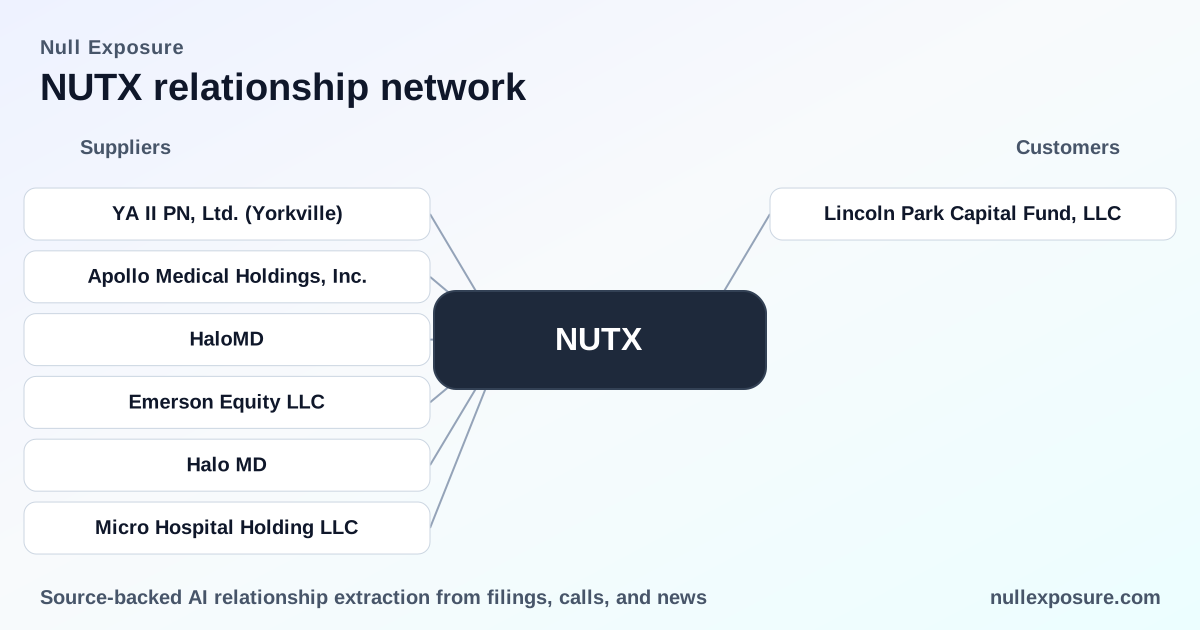
Nutex Health (NUTX) — Supplier relationships that drive revenue and risk
Nutex Health operates an asset-light network of micro-hospitals and related care facilities and monetizes primarily by delivering emergency and outpatient services, billing commercial insurers and Medicare, and extracting wins from the independent dispute resolution (IDR) and arbitration processes that boost reimbursements. The company supplements facility operations with outsourced managerial and placement arrangements and leverages related-party operating leases to scale without owning real estate. For investors and operators evaluating supplier exposure, the critical question is how third-party billing partners, placement agents, and related-party financing interact with Nutex’s revenue recognition and cash flow profile.
Explore deeper supplier intelligence at https://nullexposure.com/.
What the supplier list tells you at a glance
Nutex is generating meaningful operating income — $875m revenue and $413m EBITDA TTM — while running a capital-efficient business (Return on Equity ~59%). Those numbers co-exist with concentrated supplier and related‑party relationships that are material to revenue and working capital. The firm's contracting posture is clearly long‑term on the facilities side, and it relies on third‑party service providers for billing, arbitration and managerial functions, which creates both upside and regulatory/legal risk.
Supplier roll call and what each relationship means for investors
YA II PN, Ltd. (Yorkville)
Nutex terminated a Pre‑Paid Advance Agreement with Yorkville on February 15, 2024; the PPA originally provided Nutex a $15.0 million advance purchased by Yorkville at 90% of face value. This was disclosed in Nutex’s 2024 Form 10‑K filed with the SEC, and it represents a short‑term financing source that the company has since closed out. (Source: Nutex 2024 Form 10‑K, SEC filing)
Apollo Medical Holdings, Inc.
In March 2023 Nutex issued common shares to Apollo Medical Holdings in consideration for IPA managerial services — a non‑cash compensation arrangement that converted managerial services into equity (1,000,000 pre‑split shares, recorded as $1.9 million expense). This establishes Apollo as a managerial services provider compensated via equity rather than cash. (Source: Nutex 2024 Form 10‑K, SEC filing)
HaloMD
Multiple investor alerts and filings tie Nutex revenue performance to an engagement with HaloMD, a third‑party billing/IDR consultant. Public reports allege that Nutex submitted a high percentage of claims through HaloMD and that the relationship produced outsized IDR outcomes; separate investor‑facing litigation claims assert the IDR results were generated by coordinated improper conduct, and these allegations have been the subject of investor class‑action notices in 2025. Collectively, these sources position HaloMD as the principal external driver of disputed‑claim revenue and the most material supplier‑related legal risk in recent investor communications. (Sources: PR Newswire investor alert 2025; GlobeNewswire investor alert 2025; InsiderMonkey analysis and earnings‑call transcript coverage 2025–2026; Newsfile investor notice 2026)
Emerson Equity LLC
Nutex appointed Emerson Equity LLC as the placement agent for its September 2023 private offering, with gross proceeds and offering expenses documented in the company’s 2024 SEC filing. This identifies Emerson Equity as a capital markets intermediary used to raise placement proceeds and pay related fees. (Source: Nutex 2024 Form 10‑K, SEC filing)
Micro Hospital Holding LLC
Micro Hospital Holding LLC, an affiliate controlled by Nutex’s CEO, made advances to a Nutex facility (SE Texas ER) totaling $1.4 million at December 31, 2024 and 2023, and those amounts are reported as related‑party accounts payable. This is a direct related‑party financing relationship that sits on the balance sheet and reflects intra‑group cash flows supporting operations. (Source: Nutex 2024 Form 10‑K, SEC filing)
How the constraints shape Nutex’s operating model and supplier posture
Nutex exhibits an asset‑light, lease‑heavy operating model with long‑term contractual commitments for facilities. The company’s filings report weighted average remaining lease terms for operating and finance leases (measured in years), and explicitly state that Nutex leases facilities on long‑term, market‑rate terms rather than owning real estate. This structure reduces upfront capital expenditures but locks the firm into recurring fixed costs and related‑party lease arrangements that affect leverage and liquidity.
Nutex’s supplier relationships are characterized by a service‑provider posture: the company relies on third parties for physician staffing (consolidated Physician LLCs treated as VIEs) and for billing/IDR services. The filing language that Nutex “has historically provided support” to VIEs and consolidates physician entities signals operational dependence on third‑party service firms while retaining significant balance‑sheet and control exposure.
Spend signals are mixed: placement‑related transaction costs and placement agent fees sit in the $100k–$1m range (the private offering’s fees and expenses were roughly $0.8m), while facility lease cash flows are material and fall into a $10m–$100m spend band (annual lease cash payments in recent years totaled roughly $13m–$20m). These spend bands indicate both routine, smaller capital‑markets expenses and larger, ongoing facility obligations that dominate operating cash requirements.
Risks and opportunities that follow from these relationships
- Concentration risk: HaloMD’s role in disputed claims creates a single‑point dependency for a material portion of disputed‑reimbursement revenue; the ongoing litigation and investor claims increase legal and reputational risk.
- Related‑party governance: Advances from an affiliate controlled by the CEO and leases with related entities require careful governance scrutiny; these arrangements influence working capital and raise questions about conflict mitigation.
- Financing flexibility: Use of short‑term pre‑paid advances and placement agents shows flexible access to capital markets, but reliance on those channels can compress when legal or reputational issues intensify.
- Operational leverage with upside: Nutex reports strong EBITDA and high ROE, delivering high capital efficiency when billing and IDR outcomes perform; that upside is directly tied to third‑party billing success and sustainable compliance.
For hands‑on supplier diligence, prioritize forensic review of IDR claim pipelines, contractual terms with HaloMD (service KPIs, indemnities, fee structures), related‑party lease schedules, and the terms of any deferred or prepaid financing arrangements. More background and supplier scoring is available at https://nullexposure.com/.
Bottom line and recommended next steps
Nutex’s model combines efficient facility operations and high reported returns with concentrated supplier relationships that are critical to revenue realization. HaloMD stands out as the most consequential supplier from a revenue and litigation perspective; related‑party financing and long‑term lease commitments generate material operational dependencies. Investors should weigh strong cash generation against legal exposure and governance complexity before increasing position size.
If you manage counterparty or portfolio risk, begin with a focused supplier audit on HaloMD arrangements, related‑party advances, and the company’s lease schedule — and track ongoing litigation developments closely. For an investor‑grade supplier exposure dashboard and ongoing monitoring tools, visit https://nullexposure.com/.
Key takeaway: Nutex delivers robust profitability through an outsourced billing and operational model, but supplier concentration and related‑party arrangements are the single biggest source of downside risk for investors.