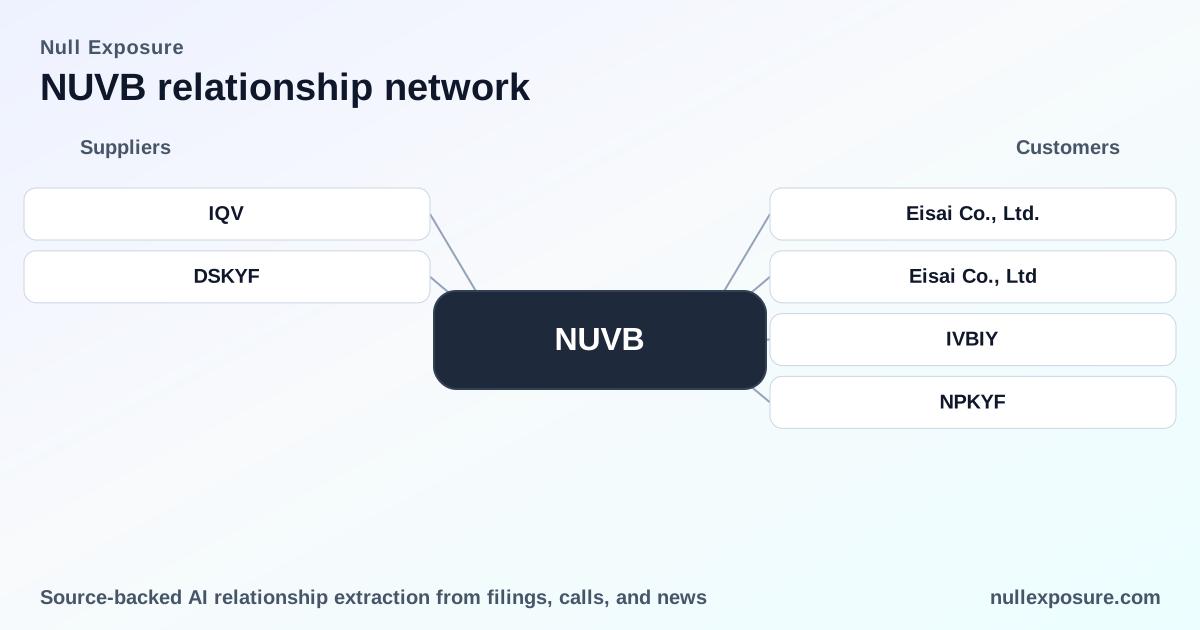
Nuvation Bio (NUVB) — Supplier relationships and operational constraints investors need to know
Nuvation Bio operates as a clinical‑stage oncology developer that monetizes through product commercialization, licensing arrangements, and milestone/royalty streams tied to its pipeline assets; current revenues reflect early commercial activity while the company continues to outsource manufacturing and many technical services. Nuvation’s operating model is concentrated around a small number of suppliers for critical drug substance and third‑party partners for clinical, data and cybersecurity services — a profile that drives both scalability and supplier risk.
For a practical, investor‑grade view of supplier exposures and contractual posture, visit https://nullexposure.com/.
The commercial and operational model in plain terms
Nuvation generates revenue primarily from products it advances toward or into the market and from the commercial exploitation of those products after approval. The company does not operate its own manufacturing or laboratory footprint and instead relies on external manufacturers, contract research organizations (CROs), and professional services firms to deliver production, discovery, clinical development, and IT/cybersecurity functions. This outsourcing strategy reduces fixed cost and capex needs but creates supplier concentration and operational dependency.
Key structural features of the model:
- Long‑term contracting posture for critical drug supply: Nuvation states it sources taletrectinib API and finished product under long‑term agreements and from a single source for that product.
- Manufacturing and service reliance: The company explicitly relies on third‑party manufacturers for clinical and commercial supply and on CROs and professional services firms for discovery, development and cybersecurity functions.
- Revenue profile consistent with early commercial scale: Reported revenue exists but profitability remains negative, reflecting heavy R&D and outsourced operating costs.
What the constraints tell investors about operational risk
The company’s own disclosures deliver clear, actionable signals about supplier risk and maturity of operations:
- Contracting posture — long term: Nuvation discloses that taletrectinib API and drug product are obtained “pursuant to long‑term supply agreements,” indicating formal, multi‑year supplier commitments that support commercialization planning. This reduces short‑term supply volatility but locks the company into specific supplier relationships.
- Concentration risk — single source for a key product: Nuvation reports a single source for taletrectinib API and finished product, which creates critical single‑point supplier risk for that asset and heightens the impact of any production disruption.
- Criticality and maturity — outsourced manufacturing and services: The company does not have internal manufacturing and uses CROs for much of its medicinal chemistry and clinical work, plus multiple vendors for cybersecurity and hosting — signaling a mature outsourcing posture but one that requires robust vendor management and contingency planning.
- Operational implication: Long‑term contracts paired with single‑source arrangements mean supply stability is contractually supported but operationally concentrated, so supplier performance becomes a material operating lever for near‑term commercial outcomes.
Supplier relationships called out in filings and calls
IQVIA — market and prescription data partner
Nuvation referenced IQVIA analytics in its 2025 Q4 earnings call noting that IQVIA data show IBTROZI prescriptions are being written at approximately six times the rate of the two prior ROS1 TKI launches over their first two full quarters post‑approval, indicating faster early market uptake. This positions IQVIA as a commercial intelligence provider used to measure real‑world traction. According to the 2025 Q4 earnings call transcript (first referenced March 7, 2026), IQVIA supplied the prescription uptake data.
Daiichi Sankyo — originator licensor for taletrectinib
In the FY2024 Form 10‑K, Nuvation documents a historical license: in December 2018 Daiichi Sankyo granted AnHeart Therapeutics (AHT) exclusive worldwide rights to develop and commercialize taletrectinib. That filing records the provenance of taletrectinib as coming through a Daiichi Sankyo license to AnHeart. See the FY2024 Form 10‑K disclosure (filed for the year ended December 31, 2024) for the licensing text.
How these relationships interact with company constraints
The IQVIA relationship is commercial intelligence rather than a production supplier, so it does not reduce the single‑source manufacturing concentration. The Daiichi Sankyo license language explains the product lineage for taletrectinib but does not substitute for Nuvation’s stated reliance on a single manufacturing source under long‑term agreements, which remains the critical operational dependency. Collectively, the filings show a company that has formalized intellectual property lineage and commercial analytics while outsourcing the execution of manufacturing and much of R&D to third parties.
Investment implications and risk signals
- Positive: Long‑term supply agreements and active commercial measurement (IQVIA) support a planned commercial scale‑up and give investors clearer visibility on uptake trends; IQVIA data suggests early demand strength for IBTROZI.
- Negative: Single‑source supply for taletrectinib is a concentrated operational risk that could interrupt revenue if the supplier experiences quality, capacity, or regulatory issues. Dependence on external manufacturers and CROs increases counterparty risk and elevates the importance of supplier oversight.
- Operational priority: Investors should evaluate the existence and terms of contingency and quality clauses in supply agreements, the identity and regulatory standing of the single source, and the company’s vendor governance and redundancy plans.
Key takeaways:
- Nuvation is a commercializing biotech with outsourced manufacturing and service functions.
- Taletrectinib supply is under long‑term contracts but single‑sourced — a material concentration risk.
- IQVIA provides real‑world prescription metrics that show strong early uptake for IBTROZI.
For deeper supplier intelligence and contract posture analysis, consult our platform at https://nullexposure.com/.
Recommended next steps for operator and investor due diligence
- Request the redacted supply agreement terms for taletrectinib (capacity guarantees, change‑in‑control rights, quality/recall procedures).
- Verify the identity and regulatory inspection history of the single API/finished product supplier.
- Review contingency sourcing plans and timeline for second‑source qualification.
- Monitor IQVIA prescription trends quarter‑over‑quarter to validate commercialization momentum against sales and inventory data.
For a concise, investor‑facing supplier risk report and alerting on changes to Nuvation’s supplier posture, visit https://nullexposure.com/ — our coverage is tailored to investor and operator decision workflows.
In summary, Nuvation’s outsourcing model enables capital efficiency and rapid scaling, but the company’s commercial success is materially tied to a small set of third‑party suppliers; monitoring contract terms, supplier health, and IQVIA uptake metrics should be central to ongoing due diligence.