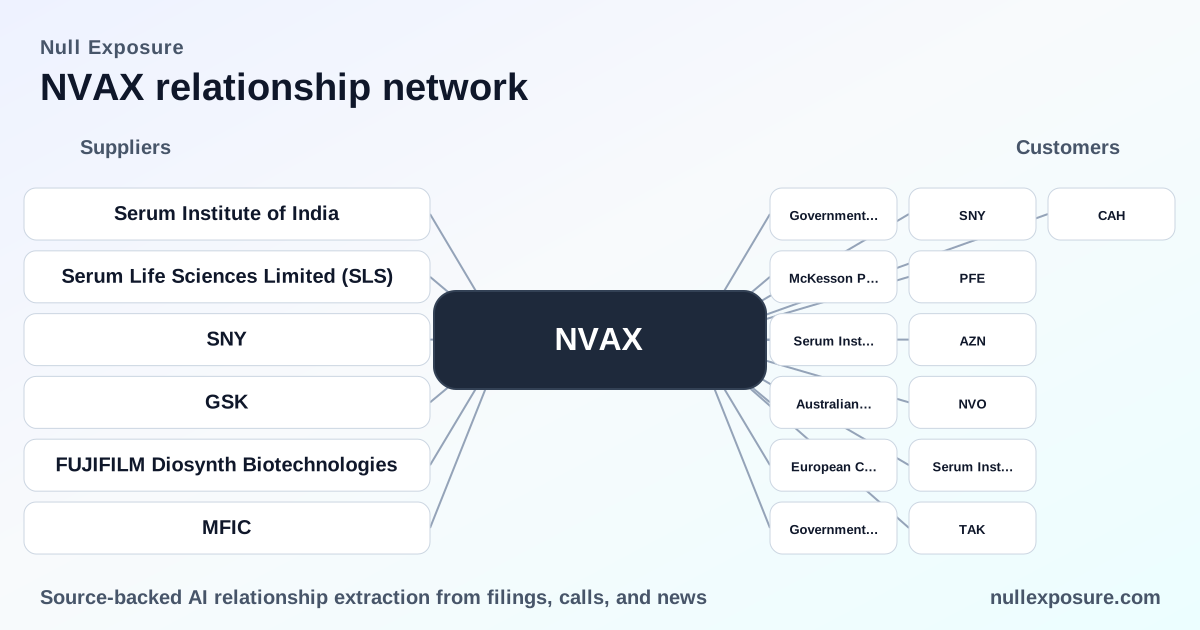
Novavax (NVAX) — Supplier map, commercial posture, and what it means for investors
Novavax is a vaccine developer that monetizes through commercial vaccine sales, co-formulation and manufacturing partnerships, and adjuvant licensing, with revenue driven by product shipments (notably COVID-19 vaccine doses) and strategic manufacturing and commercial alliances. The company outsources the bulk of production and fill/finish operations to third-party manufacturers and partners, and uses off‑balance financing to support working capital. For investors evaluating supplier risk, the core thesis is simple: Novavax is commercially viable today because of deep third‑party manufacturing relationships, but its margin and volume stability are tightly coupled to a small set of suppliers and a handful of strategic distribution partners. Learn more about supplier risk profiling at https://nullexposure.com/.
Why Novavax’s supplier footprint matters for valuation
Novavax’s operating model is built on outsourcing: protein antigen manufacture, fill and finish, and co‑formulation are performed by CMOs/CDMOs and large pharma partners. That model delivers capital efficiency and rapid scale-up, but introduces concentration and execution risk. Financials show meaningful commercial traction — trailing revenue of roughly $1.12 billion and EBITDA of about $591 million — which depend on reliable external manufacturing and commercial execution.
Key company-level signals from regulatory filings and public reporting:
- Concentration risk: The FY2024 Form 10‑K states Novavax “depends significantly on one supplier, SII and its subsidiary, SLS,” for co‑formulation and finishing of COVID-19 vaccine doses — a primary operational dependency that investors must factor into downside scenarios.
- Contract posture: Contracts include both short‑term elements (settlements and lease benefits recognized from manufacturing supply agreements) and longer-term commitments (the SLS Supply Agreement extends through at least June 30, 2028, or two years after the last firm purchase order).
- Critical inputs and maturity: The company requires long‑term access to quillaja extract for its Matrix‑M adjuvant, signaling raw‑material criticality beyond typical CMO risk. Filings indicate most third‑party agreements were active as of December 31, 2024.
- Spend scale hints: Public disclosures reference modest multi‑million dollar non‑cancelable purchase commitments and lease liabilities, suggesting meaningful but not overwhelmingly large contract sizes relative to revenue.
These signals combine into a pragmatic operating profile: asset‑light manufacturing with concentrated execution risk and a mix of short‑ and long‑dated commercial commitments. If you want a detailed supplier risk scorecard, start here: https://nullexposure.com/.
Who Novavax contracts with — the relationships that matter
Below are the supplier and partner relationships identified in filings and recent coverage, with concise, source‑based summaries.
Serum Institute of India
Novavax relies heavily on the Serum Institute of India (SII) and its subsidiary for co‑formulation, filling, and finishing of its COVID‑19 vaccine; the FY2024 10‑K explicitly characterizes SII as a significant single supplier. The filing also notes a collaboration to offer the R21/Matrix‑M malaria vaccine in 15+ African countries by 2025. (Source: Novavax FY2024 Form 10‑K, filed covering year ended December 31, 2024.)
Serum Life Sciences Limited (SLS)
In May 2024 Novavax entered into a supply agreement with SLS under which SLS will supply antigen drug substance and finished COVID‑19 vaccine doses; the agreement has a contractual term that extends to at least June 30, 2028 or two years after the last firm purchase order. This is a material manufacturing and supply arrangement for Novavax’s commercial output. (Source: Novavax FY2024 Form 10‑K.)
Sanofi
Sanofi has taken lead commercial responsibilities for Nuvaxovid in select markets, which changes how Novavax accesses end markets and distribution networks and will affect the company’s direct sales footprint. News coverage in early 2026 noted the partnership shifts commercial execution to Sanofi in specific territories and highlights expanded distribution reach for Novavax product. (Sources: trading and market commentary in February–March 2026; e.g., StockstoTrade and Blockonomi coverage of Sanofi partnership.)
GlaxoSmithKline (GSK)
GSK agreed to provide fill‑and‑finish capacity for 60 million doses of Novavax’s COVID‑19 vaccine for use in the UK, securing local finishing capability and reducing certain logistical constraints for UK supply. This is a strategic manufacturing augmentation in a core market. (Source: European Pharmaceutical Review news report, March 2026.)
FUJIFILM Diosynth Biotechnologies
FUJIFILM Diosynth Biotechnologies is producing the protein antigen component for Novavax at its Billingham, UK facility, representing a dedicated CMO relationship for the upstream antigen step of vaccine manufacture. This relationship supplies a critical upstream manufacturing function separate from fill/finish partners. (Source: European Pharmaceutical Review news report, March 2026.)
MidCap Financial
Novavax secured a $330 million credit facility with MidCap Financial to strengthen its balance sheet, improving liquidity that supports ongoing contract execution and supplier payments. This financing relationship de‑risks short‑term cash stress that could otherwise disrupt supplier performance. (Source: TradingView summary of Novavax Q4 and full‑year 2025 results, March 2026.)
Investment implications: constraints, concentration, and catalysts
Investors should treat Novavax as operationally leveraged to a small set of manufacturing partners and to the availability of Matrix‑M raw inputs. From the filings and news items:
- Concentration is the primary risk vector: dependence on SII/SLS for finishing constitutes a single‑point vulnerability to regulatory, quality, or capacity interruptions.
- Contract duration is mixed: short‑term lease settlements have been recognized in results, but the SLS Supply Agreement provides a multi‑year backbone to supply through 2028 or beyond under purchase order provisions — a material long‑dated commitment that supports revenue visibility.
- Criticality of manufacturing and inputs: upstream antigen production (FUJIFILM) and quillaja extract for Matrix‑M are operationally critical; substitute capacity is possible but execution sensitive.
- Liquidity and balance‑sheet support: the $330 million MidCap facility and recent positive EBITDA margins improve resilience against supplier shocks.
Bold takeaway: Novavax’s upside is driven by commercial partnerships and manufacturing scale, while downside is concentrated in a few execution‑critical suppliers. Investors should underwrite scenarios where a supplier interruption translates quickly into volume and margin pressure.
What investors should monitor next
- Track operational performance at SII/SLS and any regulatory actions affecting their sites.
- Confirm fill‑and‑finish throughput and schedules from GSK and FUJIFILM Diosynth for upcoming quarters.
- Watch commercial rollouts managed by Sanofi to see how channel economics and reported volumes migrate.
- Monitor covenant and draw activity under the MidCap facility as a signal of cash stress or stability.
For an investor‑grade supplier risk profile and ongoing alerts tailored to Novavax, visit https://nullexposure.com/ for actionable reporting.
Final read
Novavax is a commercially active vaccine company relying on a concentrated outsourcing model: this delivers fast scale and lower capital intensity, but concentrates execution and supply risk in a few named partners. For participants allocating capital, that trade‑off is clear — reward comes with the requirement for active monitoring of supplier performance, contract terms, and raw‑material availability. If you want systematic supplier intelligence and historical contractual signals for investment due diligence, start your analysis at https://nullexposure.com/.