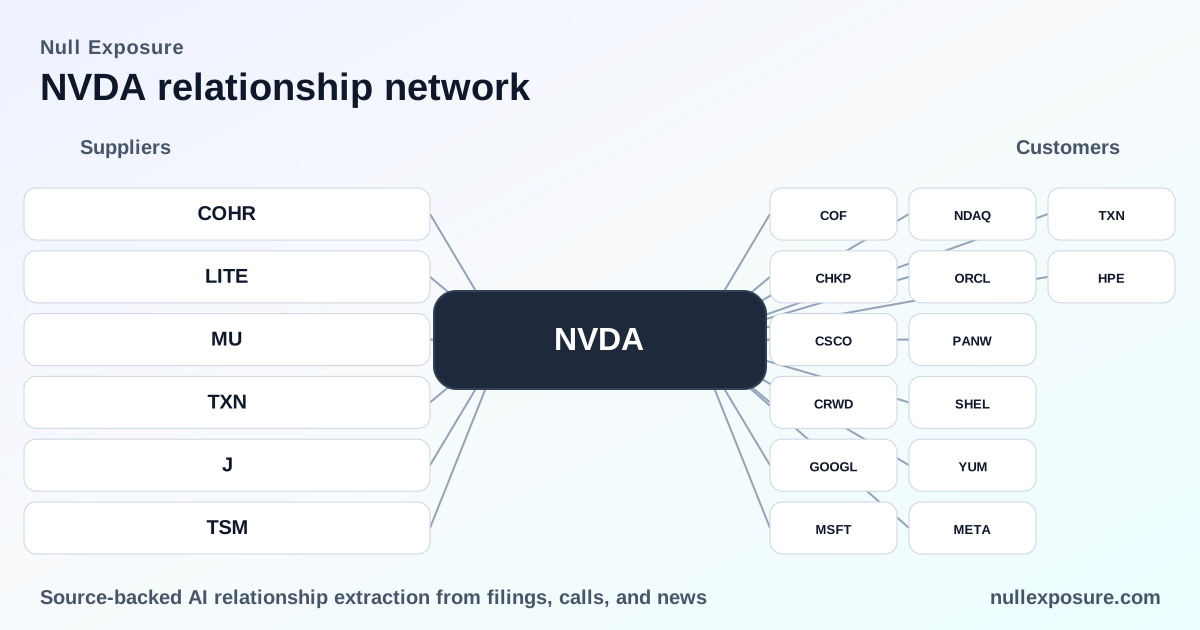
NVIDIA’s supplier map — what investors and operators should price into the story
NVIDIA designs high-performance GPUs and system-on-chip products and monetizes them primarily through hardware sales to gaming, professional visualization and, critically, data-center customers, supplemented by software, platforms and ecosystem licensing that amplify lifetime revenue per device. The company secures production capacity and component supply through large, often long-term commercial commitments and selective strategic investments that trade higher near-term cost for latency and volume certainty across its compute roadmap.
For a focused supplier signal service that tracks these commercial commitments and supply exposures, visit https://nullexposure.com/.
How NVIDIA runs procurement when the market demands scale
NVIDIA’s commercial posture is enterprise-grade: it locks capacity ahead of demand. Public snippets show the company has paid premiums, made deposits and executed long-term supply agreements to secure advanced components and manufacturing capacity. This contracting posture converts supply risk into counterparty and capital allocation risk — a deliberate trade for market leadership in AI compute.
The supply chain is concentrated in the Asia‑Pacific region, which increases geopolitical and export-control sensitivity and constrains the ability to shift production quickly. NVIDIA also relies on external manufacturers — explicitly naming foundries such as TSMC and Samsung in filings — underscoring that wafer production is outsourced and therefore dependent on third‑party manufacturing schedules and capacity allocation. Finally, NVIDIA treats certain suppliers as strategic partners, combining purchase commitments with direct investments to secure priority access to scarce optical and laser components.
Supplier-by-supplier breakdown (FY2026 reporting window)
Below are the supplier relationships uncovered in the FY2026 reporting window, with plain-English summaries and source context.
-
Coherent (COHR) — NVIDIA committed large investments and multi‑billion dollar purchase commitments to secure advanced laser and optical components, effectively tying Coherent’s capacity to NVIDIA’s roadmap for optics. Source: analyst note reported by Intellectia (news, Mar 10, 2026).
-
Lumentum (LITE) — NVIDIA has a roughly $2 billion investment commitment and multi‑billion dollar purchase arrangement that elevated Lumentum’s order backlog and underpinned analyst upgrades and price-target increases; management cited a >$400M optical circuit switch backlog linked to AI demand. Source: Intellectia report and subsequent coverage summarizing Lumentum’s Q2 results and NVIDIA commitment (MarketBeat and StocksToTrade, Mar 9–10, 2026).
-
Micron Technology (MU) — Micron is already sampling 16‑layer HBM4 memory for NVIDIA’s “Vera Rubin” architecture and is positioning HBM4E to ramp into Vera Rubin platforms in the second half of 2026; this places Micron as a critical memory supplier for next‑gen NVIDIA accelerators. Source: Markets FinancialContent and multiple trading commentary pieces (Mar 9–10, 2026).
-
Texas Instruments (TXN) — TI is working with NVIDIA on next‑generation physical AI initiatives, including efforts to accelerate safe deployment of humanoid robots, positioning TI as a systems and analog partner supporting robotics and edge implementations tied to NVIDIA compute. Source: EE Times Asia coverage of the partnership (Mar 2026).
-
Jacobs Solutions (J) — Jacobs serves as a primary design partner for large semiconductor fabs built for customers including NVIDIA, indicating Jacobs’ role in facility engineering and capital project delivery that enable NVIDIA’s manufacturing footprint expansion. Source: Markets FinancialContent piece on engineering firm pivots (Mar 9, 2026).
-
Taiwan Semiconductor Manufacturing Company (TSMC / TSM) — Reporting indicates NVIDIA reprioritized TSMC capacity from China‑targeted H200 production toward next‑generation Vera Rubin wafers, implying a strategic redirection of foundry allocation and a pullback from certain China‑focused production. Source: commentary reported via MarketBeat summarizing Reuters/FT reporting (Mar 2026).
What the constraints reveal about NVIDIA’s operating model
The supplier evidence and constraint excerpts together form a coherent signal set about NVIDIA’s operating model:
-
Contracting posture: long-term and capital intensive. NVIDIA executes long-term supply agreements and provides deposits to secure capacity, converting short-term scarcity into contractual commitments that increase near-term product cost but guarantee throughput for product launches.
-
Geographic concentration: Asia‑Pacific dependence. Supply-chain concentration in APAC is a structural constraint; export controls or geopolitical escalation directly reduce flexibility to re‑route production and increase the cost of alternatives.
-
Manufacturer reliance: foundry outsourcing is an operational lever. NVIDIA depends on third‑party manufacturers such as TSMC and Samsung for wafer fabrication; this improves scale and unit economics but cedes execution control and subjects NVIDIA to foundry allocation decisions.
-
Vendor governance: formalized risk and cybersecurity screening. NVIDIA operates a vendor risk assessment process for suppliers that access sensitive data, indicating an institutionalized vendor‑management program designed to reduce operational and cyber risk.
These characteristics combine into a corporate posture that is highly strategic, centralized in APAC, and dependent on a narrow set of manufacturing and component partners. That posture supports rapid scaling and product leadership but raises concentrated counterparty and geopolitical risk.
For a deeper assessment of counterparty exposure across NVIDIA’s supplier set, explore our supplier intelligence at https://nullexposure.com/.
What investors should price and monitor right now
-
Capacity commitments are both a moat and a leverage point. Long-term purchase commitments lock in supply but create balance‑sheet and revenue‑allocation exposure if product cycles shift.
-
APAC concentration is a headline risk. Export-control shifts or cross‑strait tensions would pressure supply continuity and could force costly re‑sourcing.
-
Foundry allocation drives cadence. Watch TSMC’s capacity prioritization statements and production mix — changes materially affect NVIDIA’s ability to deliver new architectures on schedule.
-
Optics and memory suppliers are strategic. Direct investments and large purchase orders with Lumentum, Coherent and Micron reveal where NVIDIA is insourcing certainty rather than relying on spot markets.
Actionable next steps for operators and investors
- Track quarterly updates from Lumentum, Coherent and Micron for backlog, sampling and ramp commentary; those metrics lead NVIDIA shipment and ASP outcomes.
- Monitor TSMC capacity guidance and China‑production reports for any shifts that would affect NVIDIA’s product cadence.
- Evaluate counterparties for balance-sheet strength when NVIDIA has made deposits or equity commitments, because supplier distress converts vendor risk into execution risk.
If your investment or operational decision depends on precise supplier exposures and contractual posture, get the supplier signal view at https://nullexposure.com/.
Closing: NVIDIA’s supplier model is deliberately aggressive — it trades cost for prioritized capacity and product timing. That approach accelerates market share in AI compute but concentrates geopolitical and counterparty exposure; investors should underwrite both the upside of prioritized supply and the downside of concentrated execution risk.