Navigator Holdings (NVGS) — supplier relationships and operational implications
Navigator Holdings Ltd operates and monetizes a global fleet of liquefied gas carriers by combining asset ownership with contracted shipping revenue from time and voyage charters and selective joint ventures. The company converts fleet utilization into recurring cash flow — Revenue TTM of $586.96M and EBITDA of $251.57M (latest quarter 2025-12-31) — while selectively investing in newbuilds to capture higher-value cargoes such as ammonia. For investors and operators, supplier relationships tied to newbuild construction and heavy maintenance are a direct lever on growth, capex timing and execution risk. Explore more supplier intelligence at the NullExposure homepage.
Why supplier relationships matter for a shipping operator like Navigator
Builder and repair yards are not incidental vendors for Navigator; they are strategic counterparties that determine delivery schedules, capital intensity and the earning profile of new assets. Navigator’s economics — operating margin 26.2% and return on equity ~8.46% — are highly sensitive to fleet composition and the timing of new deliveries. Shipyards influence all three:
- Delivery lead times drive when Navigator can earn on new, higher-margin ammonia and LPG trades.
- Contract terms determine capex certainty and any price escalation exposure.
- Yard capacity and track record determine execution and warranty risk.
From a contracting posture perspective, Navigator operates in a capital-intensive sector with long-cycle procurement and concentrated supplier markets. These characteristics make yard relationships both critical and persistent: they are routinely multi-year, capital-heavy and difficult to re-route on short notice.
Publicly surfaced supplier relationships: the complete list
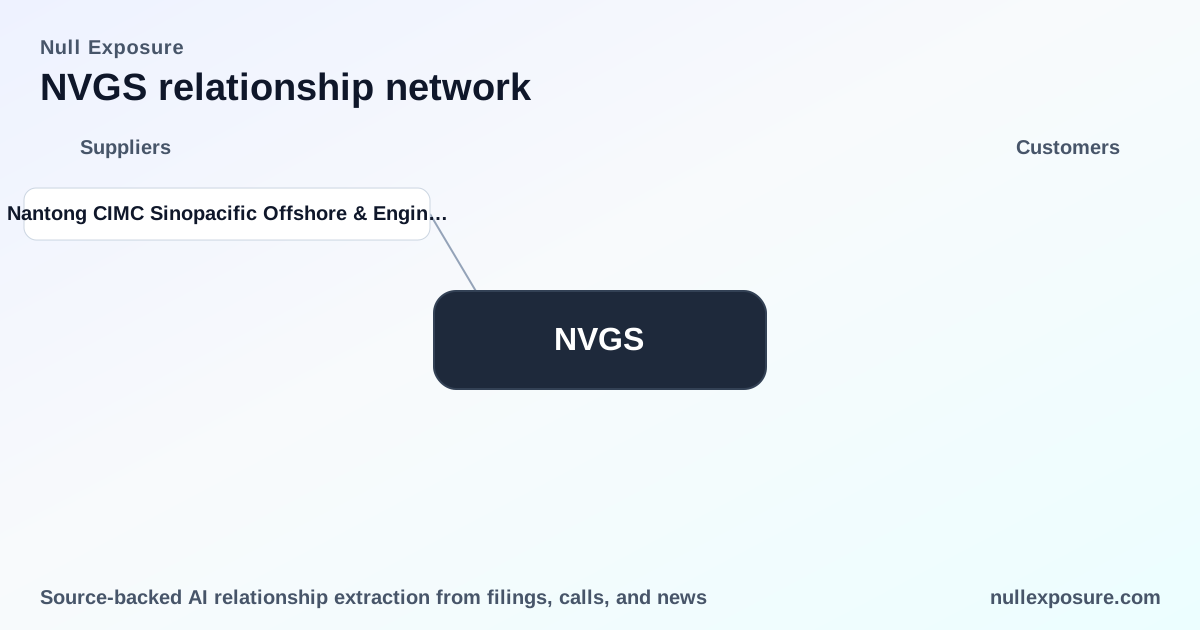
Navigational review of supplier relationships for Navigator in the supplier scope returned a single documented counterparty.
Nantong CIMC Sinopacific Offshore & Engineering Co., Ltd.
- Navigator and Amon Maritime launched a joint venture to build two ammonia carriers; the construction contracts for those ships were awarded to Nantong CIMC Sinopacific Offshore & Engineering, a major Chinese shipbuilder. The award was publicly reported in March 2026 and recorded with FY2025 context in the relationship record. A news report from ChemAnalyst covered the announcement on March 10, 2026: https://www.chemanalyst.com/NewsAndDeals/NewsDetails/navigator-gas-and-amon-maritime-launch-joint-venture-to-build-two-ammonia-carriers-38136.
What the Nantong contract signals for NVGS investors
This single publicly noted award carries several actionable implications for investors:
- Strategic product move. Committing to two ammonia carriers signals that Navigator is positioning for ammonia cargo flows — a high-growth niche with long-term offtake prospects and potentially higher charter rates relative to legacy LPG trades.
- Execution and delivery risk. Building at a major Chinese yard reduces per-vessel cost but concentrates delivery risk in a geographic cluster; schedule slippage or yard insolvency would directly affect Navigator’s near‑term earnings and capital deployment.
- Capital and timeline transparency. Because the contract is a newbuild award tied to a JV between Navigator and Amon Maritime, capex obligations and delivery timing are structurally clearer than opportunistic secondhand purchases, improving predictability of when new earnings will hit the P&L.
The award was reported by ChemAnalyst on March 10, 2026 and is listed under the FY2025 relationship footprint: https://www.chemanalyst.com/NewsAndDeals/NewsDetails/navigator-gas-and-amon-maritime-launch-joint-venture-to-build-two-ammonia-carriers-38136.
Portfolio-level constraints and company-level signals
There are no explicit supplier constraint excerpts attached to the relationship record; at the company level, several signals matter when assessing supplier concentration and contracting posture:
- Ownership concentration is high: insiders control ~56.9% of shares while institutions hold ~32.7%, producing a shareholder base that supports long-term capital decisions.
- Balance-sheet and valuation stance: market cap stands at about $1.21B, EV/EBITDA is 6.49, and Price-to-Book is ~0.98, indicating a capital-intensive business valued at near book.
- Business maturity and volatility: Navigator’s beta is 0.416, suggesting lower equity volatility than the broader market — consistent with long-term contract revenues — while ROA (~3.93%) and ROE (~8.46%) confirm a mid-stage capital deployment profile rather than hyper-growth.
- Cash return and capital allocation: the company pays a small dividend (yield ~1.52%) and posts solid operating margins (26.2%), reinforcing a model that prioritizes steady cash flow and selective reinvestment in newbuilds.
These company-level signals indicate a mature, capital-intensive contracting posture: Navigator will continue to rely on a small set of strategic shipyards for large-ticket newbuilds, with careful oversight of delivery schedules and contractual protections.
Visit the NullExposure homepage to see how supplier intelligence maps to capex timelines and counterparty risk.
Risk map and what to monitor next
For investors and operators, the key monitoring points are straightforward and measurable:
- Delivery schedule updates and yard performance. Any slippage on the two ammonia carriers will shift expected yield accretion windows.
- JV disclosures and capex commitments. Track the JV terms between Navigator and Amon to understand pro rata capex obligations and priority of earnings.
- Charter market direction. Ammonia trade lanes are nascent; charter rate trajectories will determine whether the newbuilds materially lift margins.
- Supplier concentration. Continued reliance on a limited set of large Chinese yards raises geopolitical and supply-chain concentration risk; diversify exposure or secure stronger contractual protections where possible.
These are actionable items that feed directly into NAV sensitivity and near-term cash flow forecasts. Keep an eye on quarterly filings (latest quarter: 2025-12-31) for formal capex disclosures.
Bottom line and next steps
Navigator is monetizing fleet growth and niche cargo exposure by contracting newbuilds with established yards; the publicly documented award to Nantong CIMC Sinopacific for two ammonia carriers is the clearest supplier signal available today. For investors, the story reduces to execution: if yard delivery and charter markets align, the newbuilds should convert into enhanced earnings; if not, concentrated supplier risk and capex timing will compress returns.
To map supplier contracts to cash-flow timing and counterparty risk in your model, review Navigator’s latest filings and the supplier press reports linked above, then align delivery milestones with your revenue forecast. For structured supplier intelligence and visibility into counterparties and capex timing, return to the NullExposure homepage and incorporate these supplier signals into your investment checklist.