NVNO supplier map: what investors need to know before underwriting enVVeno
enVVeno Medical Corp develops biocompatible vascular-access devices for dialysis patients and monetizes by commercializing those devices to hospitals and dialysis providers once regulatory clearance and market rollout scale. The company currently reports no product revenue and negative operating results, so supplier relationships are central to the near-term execution risk: manufacturing inputs (porcine tissue), short-term purchasing, and outsourced investor/PR services determine both operational continuity and market perception. Learn more about tracking supplier and supplier-adjacent risk at https://nullexposure.com/.
The company snapshot investors should keep front of mind
enVVeno positions itself as an engineering and clinical-stage medical device company focused on vascular access. Public filings and the company profile show no trailing revenue, negative EBITDA, and a small market capitalization (~$7.0M), which places a premium on stable supplier access and efficient capital deployment. The corporate communications and capital-markets functions are outsourced, and the firm relies on a very small set of vendors for biologic inputs, which increases concentration risk.
What the public record shows about who enVVeno works with
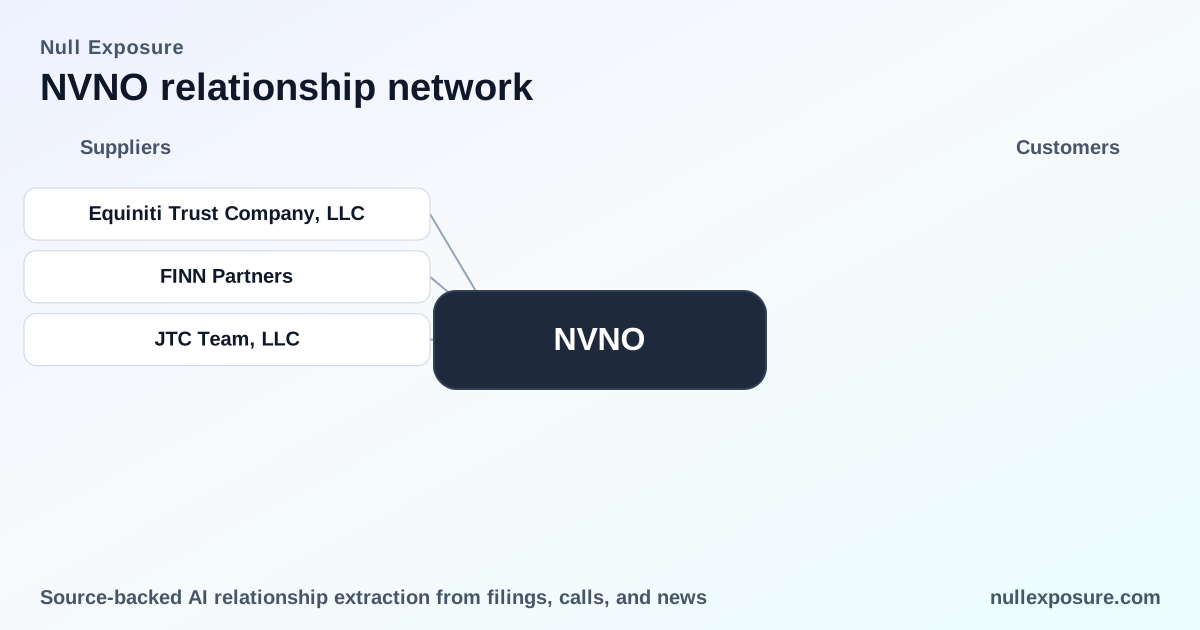
Below I list every supplier- or supplier-adjacent relationship surfaced in the public notices captured in the record. For each counterparty I give a concise, plain-English description and the underlying source.
Equiniti Trust Company, LLC
Equiniti is acting as enVVeno’s transfer agent, responsible for processing the exchange of pre-split share certificates and sending letters of transmittal to effected stockholders in connection with a reverse stock split. According to press releases distributed in March 2026 on Chieftain and other outlets, Equiniti will provide instructions and exchange mechanics to holders of pre-split certificates (Mar 2026). Source: company press release distributed via Chieftain/PressConnects (Mar 10, 2026).
FINN Partners
FINN Partners is the company’s retained media/PR contact for investor and media outreach; Glenn Silver is listed as the media contact on multiple corporate press releases covering financial results and Nasdaq compliance updates. The role is documented in press releases about Q3 2025 results and a Nasdaq compliance announcement distributed in March 2026. Source: corporate press releases distributed via Green Bay Press Gazette and MetroWest Daily News (Mar 2026).
JTC Team, LLC
JTC Team, LLC appears as the investor relations contact for enVVeno, with Jenene Thomas listed for investor inquiries on several press releases announcing financial results, investor events, and NASDAQ-related communications. These investor-contact details are published across multiple March 2026 release distributions. Source: company press releases via HTRnews and Green Bay Press Gazette (Mar 2026).
What the supplier constraints say about the operating model
The constraint excerpts in the corporate record are company-level signals about procurement posture and supply risk. Read together, they form a clear operating profile.
- Contracting posture is short-term and transactional. The company explicitly states it does not have long-term supply agreements for most inputs and frequently buys on a purchase-order basis, which implies limited supplier lock-in and higher execution risk during demand spikes or supplier disruption.
- Geographic concentration is domestic for critical biologic inputs. The company relies on two domestic third-party vendors for porcine tissue, which concentrates physical supply within North America and reduces international sourcing complexity but creates single-region exposure.
- Materiality and concentration are high. The company confirms it uses only a few suppliers for porcine tissue and acknowledges that losing a supplier could have an adverse impact, which signals high supplier criticality and low redundancy in manufacturing inputs.
- Seller relationship posture. The wording frames suppliers as sellers of critical tissue and components to enVVeno rather than strategic joint-development partners, implying limited upstream integration and less supplier-funded development.
These constraints together create an operating model where production readiness depends on a small set of short-term vendors for critical biologic material and where commercial communications are outsourced to PR/IR firms. That combination places a premium on supplier continuity, regulatory control of the biologic chain, and cash available to secure urgent supply when needed.
Investment implications — how these relationships and constraints map to risk and value
- Operational risk is concentrated. With reliance on a few domestic tissue suppliers and purchase-order buying, supply interruptions can directly halt product manufacturing and clinical workstreams, slowing any commercialization timeline.
- Negotiating leverage is limited. Short-term contracts and small purchase volumes typically reduce the company’s bargaining power on price and priority, which can inflate cost of goods as volumes scale.
- Perception and capital markets exposure are outsourced. Using FINN Partners for media and JTC Team for investor relations centralizes message control but also places reputational dependence on external advisers; transfer-agent operations with Equiniti are procedural but important for corporate actions that affect shareholder liquidity (e.g., reverse splits).
- Regulatory and chain-of-custody demands are significant. Biologic inputs (porcine tissue) demand tight quality control and traceability; supplier concentration amplifies regulatory and compliance risk for these critical materials.
If you underwrite NVNO, position sizing should reflect both the small market cap and the operational fragility implied by short-term supplier contracts and limited supplier redundancy. For more supplier-level insight and a continuous monitoring framework for SMB medical-device suppliers, visit https://nullexposure.com/.
Practical due-diligence checklist for underwriters and operators
- Confirm the full list of tissue suppliers, their qualified sites, and contingency plans for substitution.
- Request copies of any purchase-order templates and ask whether volume commitments, minimums, or exclusivity clauses exist.
- Verify chain-of-custody documentation and regulatory approvals for the porcine tissue sources.
- Validate the scope and terms of the PR/IR engagements to understand timing and control of investor communications.
- Monitor corporate actions handled by the transfer agent for potential shareholder friction (e.g., certificate exchanges after corporate reorganizations).
Conclusion and next steps
Key takeaway: enVVeno’s supplier profile combines short-term purchasing, a small set of domestic biologic suppliers, and outsourced capital-markets functions — a configuration that increases execution risk in the run-up to commercialization but is straightforward to monitor through targeted diligence on suppliers and contractual terms.
If you’re modeling NVNO’s path to revenue or assessing counterparty risk across the vascular-access supply chain, start with the supplier contingency documents and the transfer-agent notices. For tools and research that track supplier concentration and corporate communications exposure, visit https://nullexposure.com/.
For hands-on support mapping supplier risk and building a mitigation playbook for small-cap medical device investments, explore our resources at https://nullexposure.com/ and contact our team.