NVR Inc.: Supplier relationships, contracting posture, and what operators should price for
NVR is a vertically integrated homebuilder that monetizes through home sales, ancillary mortgage banking and title services, and disciplined lot acquisition under fixed-price lot purchase agreements (LPAs). The company outsources construction work to independent subcontractors under fixed-price contracts and secures future inventory via deposits and letters of credit on LPAs; revenue comes when homes close, with mortgage/title units contributing incremental fee income. For investors and operations teams evaluating supplier counterparty risk, the crucial signals are NVR’s low dependence on any single subcontractor, meaningful contracted land payment obligations, and the long-standing use of specialized third‑party services such as surveying and drone operators. Learn more at https://nullexposure.com/.
How NVR runs the business, in plain terms
NVR operates as a high-margin homebuilder concentrated on the U.S. East Coast with significant scale: TTM revenue of $10.44 billion and a market capitalization near $18.6 billion, delivering an operating margin around 17.4% and a profit margin of 12.8%. The company’s commercial model rests on three pillars:
- Build-and-sell economics: NVR contracts construction work to independent subcontractors under fixed-price agreements, preserving cost predictability and transferring some execution risk off balance sheet.
- Lot control via LPAs: NVR acquires finished lots under LPAs that require deposits; these contracts create committed future cash outflows and optionality to exercise lots as markets and development milestones allow.
- Ancillary financial services: Mortgage banking and title services capture additional margin per closing and help control channel economics.
According to the company’s year‑end disclosures as of December 31, 2025, NVR controlled approximately 169,250 lots under LPAs with deposits of roughly $920,100 in cash and $4,600 in letters of credit. The filing also discloses contract land deposit risk of about $962,416, and payment obligations under existing LPAs totaling approximately $733,900, most of which management expects to pay within three years. These figures define the company’s forward liquidity and counterparty exposure profile.
What the record shows about supplier relationships
Below is every supplier-related relationship surfaced in our review and what it means for operators and investors.
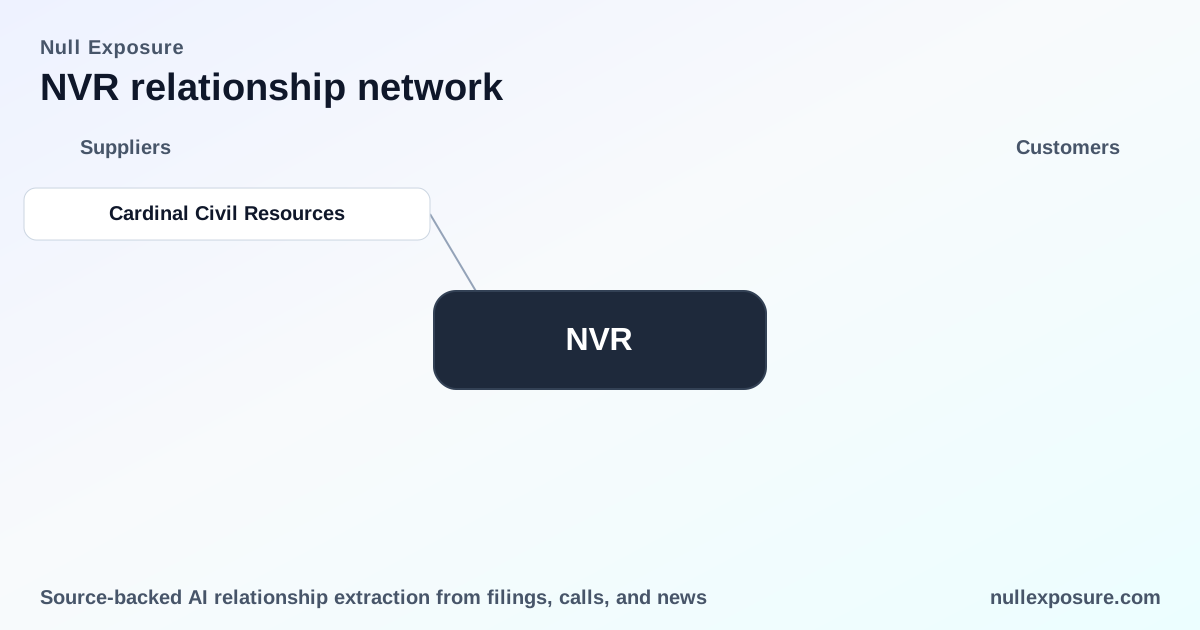
- Cardinal Civil Resources — Cardinal Civil Resources was acquired by ZenaTech’s Drone as a Service business in 2025 and has operated as a drone-driven surveying launchpad across Virginia, North Carolina, and South Carolina; the firm has supported major homebuilders including Ryan Homes (NVR) in a relationship spanning more than 15 years, according to a press release republished on The Globe and Mail in March 2026. This is a long-tenured services relationship that evidences NVR’s use of specialized third‑party field services. (Source: The Globe and Mail press release, March 10, 2026.)
Contracting posture and what the constraints imply for vendor risk
NVR’s public disclosures and constraint excerpts establish a clear contracting posture and risk profile for supplier relationships:
- Fixed-price subcontracting and LPAs: NVR uses fixed-price contracts for construction work and fixed-price LPAs to acquire finished lots, which standardizes unit economics and limits upside or downside variability from subcontractor labor costs — but transfers on-the-ground execution and schedule risk to derivative contractors.
- Low supplier concentration: The company states it is not dependent on any single subcontractor or a small number of subcontractors, signaling diversified vendor sourcing across markets, which reduces single-counterparty operational risk.
- Materiality and spend profile: Company-level signals categorize subcontractor relationships as immaterial in isolation, yet there are large aggregate funding commitments to land developers: excerpts show payment obligations totaling roughly $733,900 under LPAs and total contract land deposits reported at $962,416. For procurement and treasury teams, this means individual subcontractor failures are manageable, but land-developer counterparty failure or development delays are systemically material to lot inventory and cash flow timing.
- Role flexibility: NVR acts as buyer, seller and service consumer in different contractual contexts — it buys lots, sells homes, and uses third-party services — which increases the number and type of counterparty relationships to monitor.
- Active portfolio management: The company’s control of a large lot inventory (169,250 lots as of Dec 31, 2025) indicates an active forward pipeline that creates predictable demand for construction services and specialty vendors, while also creating timing risk if market absorption slows.
These constraints combine into a practical vendor-risk framework: diversify subcontractors, stress-test developer counterparties and milestone delivery, and align payment terms and letters of credit to reduce forfeiture or stranded deposit exposure.
Operational implications for operators and procurement
For operators negotiating with or onboarding suppliers to support NVR workstreams, the commercial picture is straightforward and prescriptive:
- Prioritize vendors who can deliver under fixed-price, schedule-driven contracts and who carry robust insurance and performance bonds; this aligns incentives and reduces downstream schedule slippage.
- For specialty services such as drone surveying or civil resources (e.g., Cardinal Civil), longevity of relationship matters — legacy suppliers with 10–15+ years of delivery on residential projects reduce onboarding friction and field coordination risk.
- Treasury and legal should monitor LPA milestone covenants and the timeline for deposit payments; a significant portion of contractual lot obligations are scheduled within the next three years and will drive working capital needs during cycles.
If you are evaluating partnerships, integrate those commercial protections into contracts: milestone-based payments, LC-backed deposits, and explicit remedies for missed development milestones.
Discover how our supplier analytics map to commercial risk and treasury exposure at https://nullexposure.com/.
Practical next steps for investors and operators
- Investors should focus on lot pipeline quality and the balance between controlled lots and market absorption rates; lots under LPAs are a leading indicator of future closings and cash requirements.
- Operators should stress vendor performance on schedule and compliance, and price fixed‑price subcontract scopes to reflect labor and materials volatility.
- Procurement teams must verify third-party balance sheet health for major development partners and require adequate collateral on LPAs.
For a deeper look at NVR’s contractual exposure and supplier mapping, visit our homepage: https://nullexposure.com/.
Bottom line
NVR’s supplier ecosystem is structured around fixed-price contracting, broad subcontractor diversification, and significant forward lot commitments via LPAs. That mix delivers predictable unit economics when field execution runs smoothly, but it also concentrates risk into developer milestone delivery and large aggregated deposit obligations. Cardinal Civil Resources — now part of ZenaTech’s Drone as a Service network — exemplifies the long-tenured specialty vendors NVR relies on for site surveying and field services. Investors and operators should price for execution risk at the site level while recognizing the mitigation offered by NVR’s diversified subcontractor posture. Learn more about supplier exposure and strategic mitigants at https://nullexposure.com/.