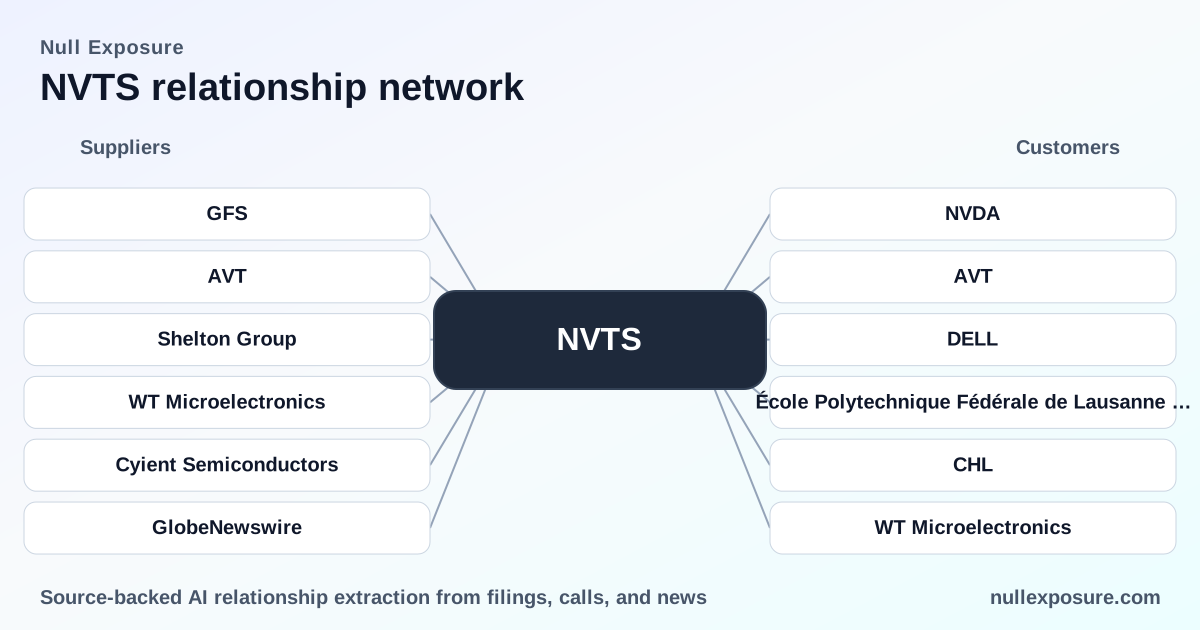
Navitas Semiconductor (NVTS): Supplier Map and What It Means for Investors
Navitas Semiconductor monetizes proprietary gallium nitride (GaN) and SiC power IC designs by selling finished power converters and licensing design wins across consumer electronics, data center power and electrified transportation. The company operates as a design-led semiconductor supplier that contracts manufacturing and packaging to third-party foundries and distributors, capturing margin on IP, design and system-level integration while outsourcing capital‑intensive fabrication. For investors, the thesis is straightforward: revenue and margin expansion depend on design traction and the firm’s ability to secure reliable, scalable wafer supply and distributor channels. Learn more at https://nullexposure.com/.
How Navitas runs its supply chain—and why it matters to returns
Navitas is a classic fabless model: product innovation and IP ownership in-house, manufacturing outsourced. That posture gives the company capital efficiency but creates outsized operational dependency on external wafer fabs and regional distributors. Public disclosures and press coverage identify both short‑term contractual exposure and geographic concentration in APAC suppliers, making wafer supply a critical operational lever for revenue continuity and margin normalization.
Key company-level signals drawn from recent disclosures:
- Contracting posture: short-term supplier commitments. Management explicitly states it does not have long-term contractual supply commitments for wafer fabrication services, which puts pricing and capacity at risk during demand swings.
- Geographic concentration: APAC exposure, notably Taiwan. A significant share of third‑party subcontractors and the primary foundry footprint sit in APAC, creating geopolitical and logistics sensitivity.
- Materiality: supplier relationships are critical. The company relies on single third‑party wafer fabricators for GaN and for SiC, meaning supplier disruption would have a substantial effect on operations.
- Role definition: manufacturer outsourced. Navitas operates as a design house that contracts chip and packaging manufacturing to partners, so supplier performance directly affects time-to-revenue.
Those characteristics create asymmetric operational risk: low capital intensity for Navitas but high dependency on a small number of external manufacturers and distributors.
The supplier and partner relationships investors should track
GlobalFoundries — long‑term foundry and U.S. manufacturing partner
Navitas announced a long‑term strategic foundry and technology partnership with GlobalFoundries to accelerate U.S.-based GaN manufacturing, with development slated for early 2026 and production later in the year, supporting domestic scale-up of GaN power devices. Source: company press releases and media coverage, including The Globe and Mail and Finviz reporting in March 2026 (https://www.theglobeandmail.com/investing/... and https://finviz.com/news/269568/...).
Avnet — distribution and technical/commercial support
Under a recent agreement, Avnet will provide technical and commercial support for Navitas’ GaN and SiC products across regions, effectively serving as a global channel and applications partner to accelerate customer adoption. Source: Finviz coverage summarizing Navitas announcements (March 2026) (https://finviz.com/news/269568/...).
WT Microelectronics — Asia distribution lead for logistics and customer engagement
Navitas is consolidating distributor coverage in Asia with WT Microelectronics taking the lead for customer engagement and logistics, an explicit move to streamline APAC go‑to‑market execution. Source: Finviz summary of Navitas’ partner strategy (March 2026) (https://finviz.com/news/269568/...).
Cyient Semiconductors — India co‑development and local ecosystem build
Navitas forged a strategic partnership with Cyient Semiconductors to co‑develop GaN products and build a local manufacturing and design ecosystem in India, aligning with “Make in India” industrial initiatives to accelerate regional adoption. Source: the company’s Q4/FY2025 announcement and related coverage in The Globe and Mail and StockTwits (Jan–Mar 2026) (https://www.theglobeandmail.com/... and https://stocktwits.com/news-articles/...).
Shelton Group — investor relations and PR support
Shelton Group is listed as Navitas’ investor relations contact and PR advisor, indicating an outsourced communications function that manages Wall Street and media engagement for earnings and conference communications. Source: company press release distributions and conference notices in January–March 2026 (GlobeNewswire, Barchart, Markets Insider) (https://finance.yahoo.com/news/... and https://www.barchart.com/story/...).
GlobeNewswire — press distribution channel (public‑facing dissemination)
Navitas uses GlobeNewswire for its official press releases, which serves as the public distribution channel for earnings and corporate announcements. The January 28, 2026 release announcing Q4 and full‑year results was posted via GlobeNewswire. Source: GlobeNewswire press release (Jan 28, 2026) distributed on Yahoo Finance and other outlets (https://finance.yahoo.com/news/...).
What these relationships imply for revenue and risk
- Revenue leverage comes from design wins and channel scale; manufacturers and distributors convert design traction into sales. GlobalFoundries and Avnet are primary enablers of scale in production and go‑to‑market respectively.
- Concentration equals critical operational risk. Reliance on single foundries for GaN and SiC is a material single‑point-of-failure; any interruption in wafer supply would meaningfully disrupt shipments and short‑term revenue.
- Contract tenor compresses negotiating power. Short‑term supply commitments reduce Navitas’ ability to lock favorable capacity or pricing, transferring inventory and capacity risk upstream to the company.
- Geopolitical and logistics exposure is explicit. APAC/Taiwan fabrication dependence, until U.S. capacity is realized with GlobalFoundries, leaves Navitas exposed to transport, tariff and geopolitical shocks.
Investors should treat supply relationships as a core value driver, not an ancillary detail. A successful transition to diversified and U.S.-based manufacturing would materially de‑risk the revenue outlook and improve gross margin stability.
Learn more about tactical supplier analysis and exposure modeling at https://nullexposure.com/.
Practical guidance for operators and procurement teams
- Negotiate multi‑year capacity or minimum‑purchase agreements where feasible to convert short‑term commitments into predictable supply.
- Prioritize qualification of secondary foundries and regional packaging partners to reduce single‑point dependency.
- Strengthen distributor SLAs with Avnet and WT Microelectronics to protect lead times and customs/logistics resilience in APAC.
- Leverage the GlobalFoundries relationship to accelerate on‑shore capacity while maintaining APAC backups.
Bottom line and next actions for investors
Navitas’ business model is highly scalable if manufacturing and channel execution track to plan, but the current structure embeds material supply concentration and short-term contractual exposure that directly affects topline predictability. Monitor execution milestones at GlobalFoundries, the scale-up of Avnet/W T Microelectronics distribution in Asia, and progress on Cyient Semiconductors’ India co‑development program as the primary operational catalysts.
For deeper exposure mapping and monitored supplier intelligence, visit https://nullexposure.com/ — the right partner for investor-grade supplier risk analysis.