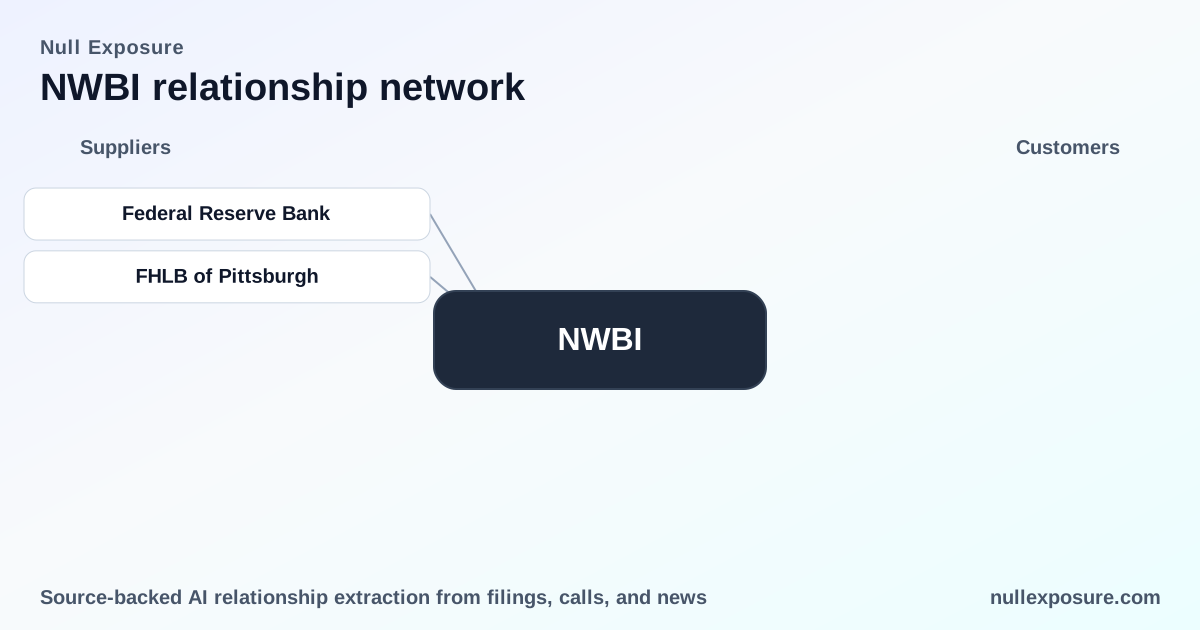
Northwest Bancshares (NWBI): Liquidity relationships that underwrite a regional bank’s balance sheet
Northwest Bancshares operates as the holding company for Northwest Bank, monetizing through traditional regional banking activities — net interest income from lending and securities, fee income from deposit and payment services, and capital management through subordinated debt and dividend policy. The core economic model is simple: maintain deposit and wholesale funding to fund loan growth while harvesting margins on interest-earning assets. Capital and liquidity access from the Federal Home Loan Bank system and the Federal Reserve are central operational inputs that reduce funding volatility and support lending capacity. For decision-makers evaluating supplier and counterparty risk, these liquidity relationships are more strategic than transactional: they function as standing backstops that shape funding cost, maturity mix, and balance-sheet resiliency. Learn more about supplier intelligence at the Null Exposure homepage: https://nullexposure.com/
Why funding counterparties matter for NWBI investors
Regional banks compete on the margin between loan yields and funding cost. Access to committed wholesale lines and central bank facilities compresses tail funding risk, lowers volatility in loan origination, and improves capital planning. NWBI’s disclosed borrowing capacity with the FHLB of Pittsburgh and the Federal Reserve is a direct lever on its liquidity runway and interest rate risk posture. That dynamic influences dividend policy, capital allocation, and the effective cost of holding liquidity buffers.
How Northwest contracts and funds itself — operating model characteristics
- Contracting posture: NWBI uses a mix of short-term secured borrowing (FHLB advances and Federal Reserve lines) and longer-term subordinated debt to shape interest-rate exposure and regulatory capital — the company issued fixed-to-floating subordinated notes in 2020 that mature in 2030, reflecting active maturity ladder management (company-level disclosure).
- Maturity profile and criticality: Short-term lines underpin day-to-day liquidity, while subordinated notes support capital structure and regulatory ratios; both are operationally critical because they reduce the need for stress asset sales in liquidity events.
- Concentration and counterparty type: NWBI’s available capacity is concentrated in government-linked counterparties (FHLB and Federal Reserve) and a small set of correspondent banks, which reduces counterparty credit risk while creating dependence on a narrow set of wholesale providers.
- Practical implication for operators and investors: The combination of sizeable standby capacity with central institutions and explicit long-term subordinated capital produces a predictable funding runway, but also ties NWBI’s operational resilience to the terms and availability of those government-linked facilities.
Supplier relationships in the filing and news coverage
Federal Reserve Bank
NWBI discloses $555 million of borrowing capacity available with the Federal Reserve Bank as part of its liquidity toolkit, used to provide immediate funding and to reduce interest-rate risk when appropriate. According to a TradingView summary of NWBI’s FY2026 10‑K filing (published March 10, 2026), the Federal Reserve capacity is presented alongside other standby facilities as part of the company’s liquidity management. (Source: TradingView coverage of NWBI FY2026 10‑K, Mar 10, 2026 — https://www.tradingview.com/news/tradingview:6886bb779de3e:0-northwest-bancshares-inc-sec-10-k-report/)
FHLB of Pittsburgh
NWBI reports significant borrowing capacity with the FHLB of Pittsburgh — approximately $3.2 billion available (including a $250 million overnight line of credit that had no balance at year-end 2024), and NWBI uses term notes payable to the FHLB for short-term funding needs. The same TradingView summary of the FY2026 10‑K highlights the FHLB relationship as a primary source of secured liquidity for liquidity management and interest-rate risk mitigation. (Source: TradingView coverage of NWBI FY2026 10‑K, Mar 10, 2026 — https://www.tradingview.com/news/tradingview:6886bb779de3e:0-northwest-bancshares-inc-sec-10-k-report/)
How these relationships function in practice and what to watch
- Liquidity backstop, not primary funding: The disclosed lines with FHLB and the Federal Reserve are standing liquidity backstops that allow NWBI to smooth funding cost and avoid forced balance-sheet actions in stress scenarios.
- Short-term usage and long-term capital are distinct: NWBI’s short-term payables to the FHLB (line items for amounts due within one year) coexist with the company’s longer-term subordinated notes (issued in 2020, maturing in 2030). This mix reduces rollover risk while preserving capital flexibility.
- Concentration trade-off: Reliance on government-linked sources reduces counterparty credit risk but increases operational dependence on those markets’ access terms; monitoring facility availability and pricing is essential for forward-looking liquidity risk assessment.
- Operational signal: NWBI’s explicit statement — “We borrow from these sources to reduce interest rate risk and to provide liquidity when necessary” — frames these relationships as deliberate hedges and liquidity management tools rather than opportunistic borrowing.
Explore a structured review of supplier relationships and contractual signals at Null Exposure: https://nullexposure.com/
Risk implications for investors and operators
- Funding stability: High available capacity with FHLB and the Federal Reserve materially lowers short-term funding risk compared with peers that lack centralized-system access.
- Cost and optionality: While access exists, the cost of tapping these facilities and the terms (e.g., haircuts, collateral requirements) determine whether NWBI will run higher liquidity buffers or opt for more aggressive loan growth.
- Capital structure rigidity: The existence of subordinated notes maturing in 2030 is a positive for regulatory capital, but it also represents a fixed claim that constrains optionality in certain capital transactions until maturity.
- Concentration vulnerability: Dependence on a narrow set of counterparties is efficient but creates an operational single point of failure if market access were to tighten for regional banks.
Bottom line and recommended next steps
NWBI runs a deliberately conservative liquidity strategy, anchored by FHLB and Federal Reserve capacity and supplemented by long-term subordinated debt — a configuration that reduces tail funding risk and supports predictable dividend and lending behavior. For investors and operators, the priorities are monitoring facility availability, collateral adequacy, and the cost of borrowing under different stress scenarios.
For a deeper supplier-risk profile and continuous monitoring tools, visit Null Exposure: https://nullexposure.com/ — register for alerts and structured relationship analysis to track changes in counterparty capacity and terms.
Key takeaway: The FHLB and Federal Reserve lines are strategic assets for NWBI — they do the heavy lifting on liquidity and allow the bank to manage interest-rate and rollover risk while pursuing steady regional lending.