Norwood Financial (NWFL) — supplier relationships, vendor signals, and what investors should price in
Norwood Financial Corp (operating as Wayne Bank) is a small regional bank that primarily monetizes through net interest income, fee income from deposit and lending services, and a modest dividend distribution. The franchise generates steady cash flow from a conservative loan book, preserves capital through a >12% ROE and a 4.4% dividend yield, and operates with a compact public-market footprint (market cap ≈ $266M). This profile positions NWFL as a reliable, income-oriented regional player that offsets slower growth with margin stability and shareholder distributions. For a concise view of how this supplier intelligence translates to counterparty risk and vendor concentration, visit https://nullexposure.com/.
What the headlines tell investors about NWFL's external footprint
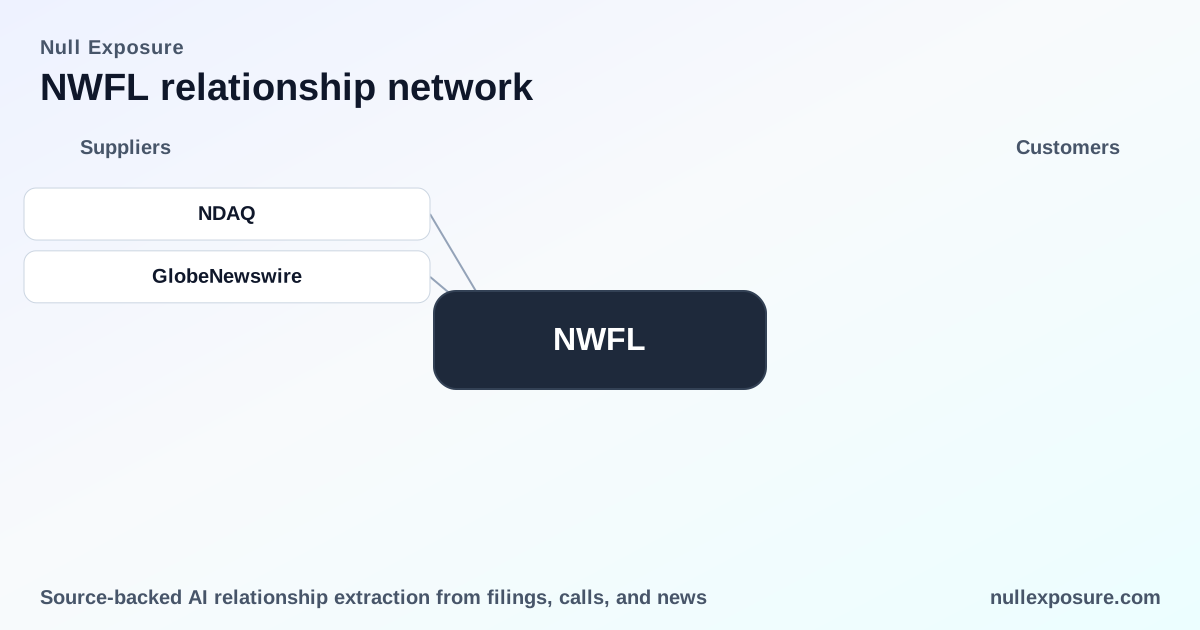
Norwood’s public-facing supplier signals are limited but concrete: recent press activity confirms exchange listing details and a company press release distribution channel. These items are not operational vendors in the traditional sense, but they matter for market access and investor communications — two essential elements of corporate liquidity and reputation management.
- Exchange connectivity is routine and clear. NWFL trades on the Nasdaq Global Market under the ticker NWFL, which ensures institutional access and continuous price discovery. According to a March 10, 2026 QuiverQuant news item summarizing the company announcement, the stock is listed on Nasdaq Global Market.
- Company communications are routed through major disclosure channels. A press release distributed via GlobeNewswire was summarized and republished, with QuiverQuant noting its origin and summarization approach (March 10, 2026). That distribution pathway is the bank’s channel for dividend and investor notices.
For a deeper supplier-risk picture and to compare NWFL to peers, start here: https://nullexposure.com/.
Relationship rundown — single-paragraph summaries, source-first
- Nasdaq Global Market: NWFL’s listing on the Nasdaq Global Market provides the primary trading venue and institutional visibility; the listing was cited explicitly in a March 10, 2026 press note about a cash dividend. (QuiverQuant news item, March 10, 2026).
- GlobeNewswire: The company used GlobeNewswire to distribute a press release (a Q3 2025 cash dividend announcement), and QuiverQuant flagged the distributed content as an AI-generated summary of that GlobeNewswire release. (QuiverQuant summary referencing GlobeNewswire, March 10, 2026).
Why these relationships matter to investors
Exchange access and disclosure channels are fundamental inputs to liquidity, compliance, and reputation. For a small regional bank like Norwood, Nasdaq listing ensures continued institutional access and a baseline of regulatory and reporting rigor; a major wire service such as GlobeNewswire guarantees uniform distribution of corporate actions and reduces the chance of asymmetric information shocks. Both relationships reduce frictions in capital markets and support stable valuation multiples.
Constraints and what the vendor signals say about NWFL’s operating model
Norwood’s published vendor-related disclosure includes a specific cyber-incident notification tied to a third-party information service provider (October 2023). The company explicitly stated that it “does not currently believe this incident will have a material adverse effect on our business, operations, or financial results.” This statement serves as a company-level signal about supplier risk posture and maturity:
- Contracting posture — conservative and defensive. The company’s public mitigation language signals a vendor governance framework that includes notification protocols and executive-level assessment of impact, consistent with a prudent contracting posture for a regulated regional bank.
- Concentration — low to moderate at the company level. Because the vendor was not named and the company characterized the incident as immaterial, the evidence leans toward a diversified supplier base or effective redundancy for that service function rather than single-source dependency.
- Criticality — limited for reported incident. The bank’s own assessment that the incident is not materially adverse implies the affected vendor did not provide mission-critical, single-point-of-failure infrastructure — or that compensating controls and backups contained exposure.
- Maturity — established risk management practices. The combination of disclosure, public assessment of impact, and continued dividend policy indicates an operationally mature institution with routine vendor oversight embedded in governance and compliance processes.
These are company-level signals drawn from the firm’s disclosure about the October 2023 event and its public investor communications; the constraint excerpt does not attribute the incident to a named supplier.
Financial context that frames supplier risk
Norwood’s financials underscore why vendor continuity and disclosure channels matter for equityholders: a P/E around 9.4, Price-to-Book near 1.09, and a profit margin above 32% imply a compact balance sheet with limited room for large, unanticipated operational losses. The bank pays a steady dividend (recently $0.31 per share for the quarter and a full-year dividend per share of $1.25) and exhibits solid profitability metrics (ROE ≈ 12.2%). These characteristics make operational resilience and reputational continuity disproportionately important — a small adverse vendor event could have outsized effect relative to the firm’s market cap.
Investment implications — what to price and what to watch
- Price stability anchored in yield and earnings: With a meaningful dividend yield and below-market P/E, NWFL should trade as an income-first regional name; the principal risks to that thesis are loan portfolio deterioration and operational shocks that could impair earnings or capital.
- Vendor incidents are headline risks but have been treated as immaterial by management: Continue to monitor vendor-related disclosures for named counterparties and impact assessments, since the bank’s size amplifies the materiality threshold.
- Disclosure and market access are strong mitigants: Nasdaq listing and use of GlobeNewswire provide transparent channels that reduce the likelihood of mispriced surprises.
In the middle of your review process, if you want a consolidated view of supplier risk and public disclosures, check the platform at https://nullexposure.com/.
Practical watchlist for the next 12 months
- Any vendor-specific naming in future disclosures (read actual vendor names, not just incident descriptions).
- Changes to dividend policy or unexpected reserve builds that indicate operational losses or reputational damage.
- Material changes to Nasdaq listing status or any notices related to compliance with exchange rules.
Bottom line and next step
Norwood Financial operates a low-complexity regional banking model monetized through interest and fees, with stable distribution policy and conservative public communications infrastructure. The limited supplier signals available — Nasdaq listing and GlobeNewswire distribution — are positive for market access and transparency, while the October 2023 vendor incident disclosure indicates functional vendor governance without current material impact. For investors and operators evaluating counterparty exposure to NWFL, focus on any future vendor naming, reserve behavior, and disclosure cadence.
For a direct comparison across small regional banks and their supplier disclosures, visit https://nullexposure.com/ and explore our supplier intelligence offerings.