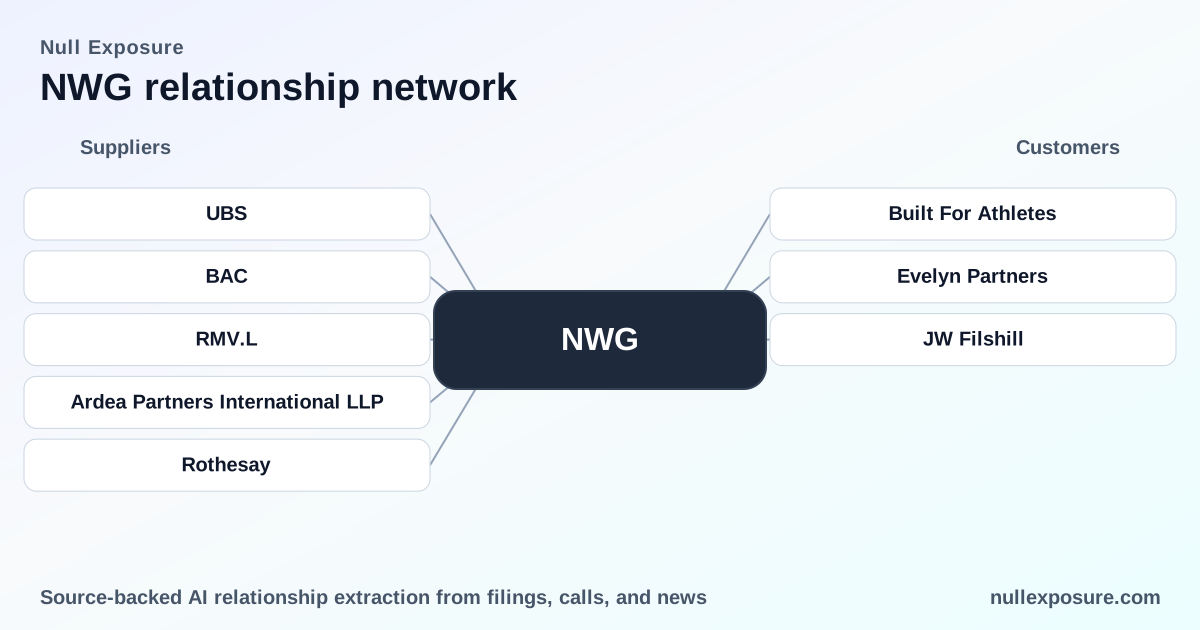
NatWest Group (NWG) — Supplier relationships and strategic counterparties
NatWest Group is a UK-headquartered retail and commercial bank that monetizes customer balances, lending, fee income and wealth-management fees while deploying capital through buybacks and targeted acquisitions. The firm runs a classic banking model with growing non-interest income from advisory and mortgage distribution partnerships, and it uses third-party advisers and brokers to execute capital actions and strategic deals. For investors evaluating counterparty and supplier exposure, the pattern is clear: NatWest relies on global banks for capital markets execution, specialist insurers to shed long-term liabilities, and consumer-facing platforms to scale mortgage originations. For the full supplier map, see https://nullexposure.com/.
Key takeaways
- Execution and capital-market relationships are concentrated among large global brokers — NatWest uses UBS and BofA/Merrill for buybacks and advisory work.
- Risk transfer is institutional and material — the group has transferred a meaningful slice of pension risk to a specialist insurer.
- Distribution is digital-first — partnerships with property portals highlight a shift toward third-party lead generation for mortgages.
For more on counterparties and how they change capital allocation, visit https://nullexposure.com/ to review provider-level detail.
Why these partnerships matter to investors
NatWest’s supplier relationships reveal the firm’s contracting posture, counterparty concentration, and operational maturity. The bank contracts out high-frequency market execution and complex M&A advisory work to large investment banks, while transferring structural liabilities to insurance specialists and outsourcing customer acquisition to digital platforms. This mix reduces in-house execution risk but concentrates operational dependence on a handful of sophisticated counterparties — an important consideration for scenario analysis around trading continuity and reputational events.
From a capital-management perspective, the use of external brokers for share buybacks and advisers for acquisitions signals a preference for flexible, third-party execution rather than expanding internal corporate finance capacity. These choices reflect a mature operating model that prioritizes speed and specialist expertise over internal build.
If you want a deeper breakdown of counterparties and their impact on NatWest’s financials, consult the supplier intelligence at https://nullexposure.com/.
Counterparty roll call — each relationship explained
-
UBS AG, London Branch — share sale counterparty (Feb 2026)
NatWest repurchased ordinary shares that were previously held by UBS AG, London Branch as disclosed in a Reuters notice; the transaction was part of ongoing buyback activity. According to a Reuters item republished by TradingView in February 2026, NatWest purchased ordinary shares from UBS AG, London Branch. -
BofA Securities — joint lead financial adviser on Evelyn Partners acquisition (FY2026)
BofA Securities served as a joint lead financial adviser to NatWest on the Evelyn Partners acquisition, supporting strategic execution and valuation work. FXNewsGroup reported in FY2026 that Ardea Partners and BofA Securities acted as joint lead advisers to NatWest. -
UBS — financial adviser role on strategic deal (FY2026)
UBS also acted in an advisory capacity to NatWest on the same transaction, providing advisory support alongside other banks. FXNewsGroup noted UBS’s role as a financial adviser to NatWest in FY2026. -
Rightmove — three‑year digital mortgage lead-generation pact (FY2026)
NatWest signed a three-year agreement with Rightmove to scale digital mortgage lead generation, reflecting a shift toward platform-led customer acquisition. A tech and markets report on TS2 in FY2026 covered the three-year pact with Rightmove for mortgage lead generation. -
Ardea Partners International LLP — joint lead adviser (FY2026)
Ardea Partners was co-lead adviser to NatWest on the Evelyn Partners deal alongside BofA, providing boutique advisory capabilities. FXNewsGroup’s FY2026 coverage listed Ardea Partners International LLP as a joint lead financial adviser to NatWest. -
Merrill Lynch International (BofA) — sell-side counterparty for buybacks (Jan 2026)
NatWest repurchased ordinary shares from Merrill Lynch International as part of its share buyback program, using BofA’s London arm to execute the trade on the LSE. A January 2026 Reuters notice republished by TradingView disclosed purchases of ordinary shares from Merrill Lynch International. -
Rothesay — pension risk transfer counterparty (company-level legacy, 2024 agreement)
NatWest transferred risks linked to roughly a third of its pension liabilities to Rothesay under a 2024 agreement, materially reshaping the bank’s long-term liability profile. Market commentary in a 2026 roundup referenced the 2024 deal with insurer Rothesay and its impact on liability management. -
Merrill Lynch International — transaction execution on London Stock Exchange (FY2026 commentary)
Merrill Lynch International handled London Stock Exchange execution for NatWest’s share transactions, reinforcing the use of major broker-dealers for on-exchange activity. TS2’s FY2026 coverage noted Merrill Lynch International handled the transactions on the LSE. -
UBS — broker execution performed independently (FY2026 reporting)
Reporting indicates UBS executed certain trades on its own without direction from NatWest, consistent with broker-led liquidity provision and execution autonomy. A FY2026 market note on Bez-Kabli reported that UBS handled trades independently.
What the relationships imply for concentration, criticality and execution risk
NatWest’s counterparty map is dominated by large, globally systemically important banks for capital markets execution and advisory services, and by specialist firms for liability management and customer distribution. Contracting posture: externalize execution and advisory functions to reduce internal complexity and accelerate deal timelines.
Concentration: reliance on a small set of global brokers increases single‑counterparty exposure for trade execution and block‑share transactions.
Criticality: the Rothesay pension transfer is strategically critical — it materially reduces legacy pension volatility and shifts actuarial risk to an insurer.
Maturity: the mix of household-name banks and established platforms signals a fully developed supplier network rather than an emergent ecosystem.
Investment implications and next steps
For investors, the supplier footprint supports a view of NatWest as a bank that delegates capital markets execution to tier‑one brokers, purchases advisory horsepower for transformational deals, and uses platform partners to scale retail distribution. That posture supports operational efficiency but requires active monitoring of counterparty operational continuity and reputational risk.
If you want a supplier‑level diligence package, explore our provider dossiers and historical counterparty activity at https://nullexposure.com/.
NatWest’s public filings and the market coverage cited above document these relationships; incorporate them into stress tests on execution risk and into governance checks on third‑party oversight to ensure counterparties align to your thesis on capital deployment and liability management.