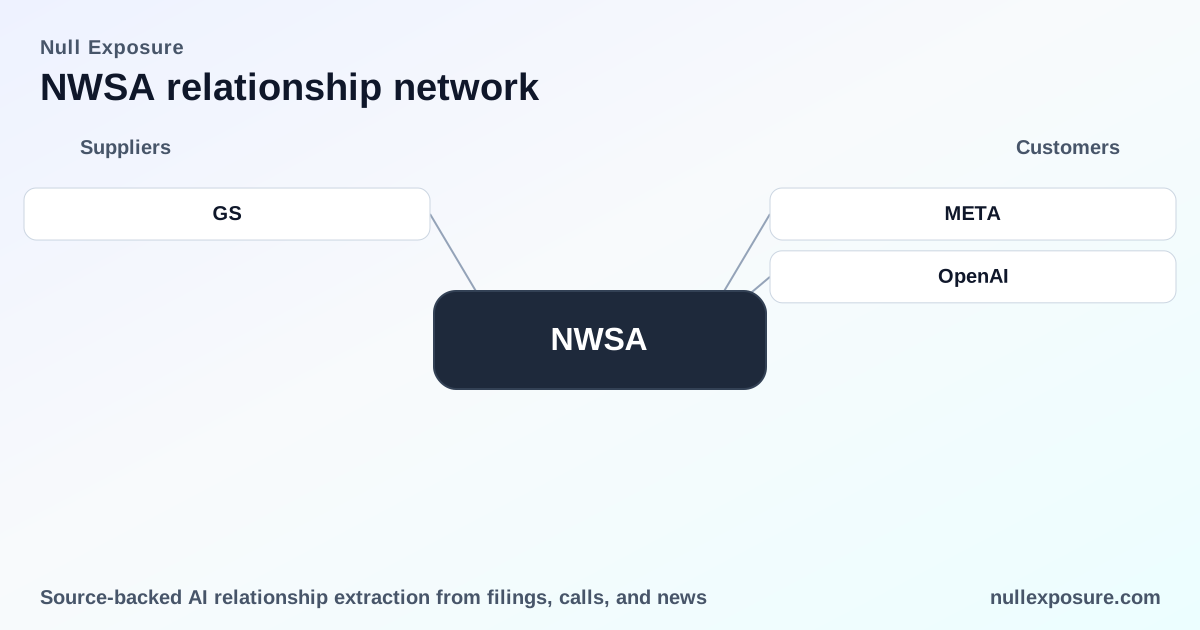
News Corp (NWSA) — supplier relationships and what they mean for investors
News Corp operates and monetizes through digital real estate information, news media, book publishing and cable television, generating recurring cash flow from subscription and advertising businesses while returning capital via disciplined buybacks and dividends. The company uses third-party brokers and service providers to execute strategic capital actions and to support critical operating systems and physical distribution, making supplier relationships a direct conduit to execution risk and shareholder returns. For deeper supplier-mapping and counterparty intelligence, visit NullExposure.
Quick investor thesis: how supplier interactions move the P&L and the balance sheet
News Corp’s core cash-generation is complemented by a clear capital-allocation playbook: open-market share repurchases funded in USD and brokered by major investment banks, plus ongoing reliance on third-party printing, distribution and cloud/software providers that underpin day-to-day operations. For investors, the repurchase program is the immediate lever for EPS accretion and return of capital; third-party operational suppliers are the continuity lever for revenue conversion in print-to-digital transitions. Both levers are economically meaningful and operationally interdependent.
What the documented relationships tell you — Goldman Sachs as the execution partner
The relationship set in the provided results is concentrated around a single execution counterparty: Goldman Sachs / Goldman Sachs & Co. LLC, repeatedly named as the broker for News Corp’s FY2026 $1.0 billion repurchase program. Across corporate disclosures and media notices the role is consistent: Goldman Sachs executes on-market purchases in USD, reports daily transaction activity, and is the named broker for buybacks. This is a single, high-frequency operational relationship tied directly to capital allocation and liquidity management.
- Why this matters: using a major bank broker for buybacks lowers execution risk on large open-market repurchases and signals institutional execution capacity; it also centralizes settlement and reporting under a well-known counterparty.
For more supplier intelligence and to track counterparty exposures, see NullExposure.
Line-by-line relationship inventory (each result covered)
Below are one- to two-sentence summaries drawn from the reported items. All entries reference FY2026 communications.
- TradingView reported on March 10, 2026 that repurchases under News Corp’s program are intended to enhance shareholder value and can be executed via open-market transactions through Goldman Sachs. This notice frames Goldman Sachs as a standing execution agent for the repurchase mandate (TradingView, Mar 10, 2026).
- TradingView’s March 10, 2026 update explicitly named Goldman Sachs & Co. LLC to facilitate buy-back transactions, reiterating the bank’s operational role in administering the program (TradingView, Mar 10, 2026).
- A TradingView report on March 10, 2026 listed Goldman Sachs & Co. LLC as the broker for on-market purchases and documented example price ranges (highs US$31.40, lows US$22.20), highlighting active execution across price points (TradingView, Mar 10, 2026).
- The Globe and Mail press release (reported March 10, 2026) reiterated that the 2025 Repurchase Program (authorized July 15, 2025) is intended to enhance shareholder value and that Goldman Sachs & Co. LLC is engaged as broker for transactions paid in U.S. dollars (The Globe and Mail press release, Mar 10, 2026).
- The Globe and Mail reported on March 10, 2026 that News Corp disclosed 369,105,463 Class A shares outstanding and that repurchases can be of Class A and Class B up to the $1 billion cap, with Goldman Sachs executing transactions in USD (The Globe and Mail, Mar 10, 2026).
- TradingView’s daily disclosure update (Mar 10, 2026) noted purchases paid in USD, executed subject to market conditions, and named Goldman Sachs & Co. LLC as the broker — confirming operational settlement mechanics (TradingView, Mar 10, 2026).
- TradingView’s March 10, 2026 release again described Goldman Sachs & Co. LLC as the facilitator for buy-back transactions, reinforcing repeated confirmations across filings and press notices (TradingView, Mar 10, 2026).
- Another TradingView item (Mar 10, 2026) restated Goldman Sachs & Co. LLC is the broker for buy-back transactions, consistent with other contemporaneous disclosures (TradingView, Mar 10, 2026).
- TradingView reported on March 10, 2026 that repurchases to date totaled US$92.1m under the $1bn program and that buybacks are executed via brokers including Goldman Sachs & Co. LLC, underlining active use of the bank (TradingView, Mar 10, 2026).
- TradingView’s March 10, 2026 disclosure indicated US$82.2m repurchased to date and cited Goldman Sachs & Co. LLC for USD-settled buybacks with reported high/low trade prices across notices (TradingView, Mar 10, 2026).
- TradingView’s March 10, 2026 update reported buybacks through Goldman Sachs & Co. LLC and reiterated the USD settlement and price-range reporting across notifications (TradingView, Mar 10, 2026).
Key relationship takeaway: Goldman Sachs is the singular, repeated execution broker for News Corp’s FY2026 repurchase activity, making the bank a primary supplier for capital deployment operations.
Company-level constraints and what they reveal about operating posture
The constraint excerpts provide actionable signals about News Corp’s supplier strategy and operational maturity:
- Long-term contracting posture: operating leases running into fiscal 2048 for office, warehouse, and printing plants indicate long-duration fixed commitments that anchor real-estate exposure and limit short-term flexibility. This is a structural element of the cost base and capital allocation calculus.
- Critical third-party dependence: News Corp explicitly relies on third-party software, cloud systems and services that support a variety of critical business operations; this positions certain suppliers as single points of failure for revenue continuity and cybersecurity posture.
- Distribution concentration risk: The Dow Jones segment depends on external printers and distributors for physical product circulation; with secular print-to-digital transition and strained labor markets, distribution partners are operationally critical and financially sensitive.
- Service-provider role clarity: multiple references to service providers for technology and leased facilities indicate an established outsourcing model for non-core infrastructure — a mature approach that delivers scale but concentrates counterparty service risk.
Collectively these signals show a business with structured long-term commitments, concentrated operational dependencies, and a capital-allocation process that relies on a major bank for execution. These characteristics determine how investors should stress-test liquidity, continuity plans and counterparty exposure.
Investment implications and risk checklist
- Upside driver: active buybacks executed through Goldman Sachs accelerate EPS and signal management confidence in capital allocation.
- Operational risk: dependence on third-party technology and printing/distribution suppliers creates execution risk that can affect revenue conversion if a supplier interruption occurs.
- Balance-sheet rigidity: long-term leases to 2048 increase fixed-cost rigidity and reduce near-term optionality during demand shocks.
- Concentration: repeated use of a single broker concentrates execution risk but also centralizes reporting and settlement efficiency.
For portfolio managers and operators who need a deeper counterparty scan or live supplier monitoring, visit NullExposure for supplier mapping and exposure analytics.
Bottom line and next steps for investors
News Corp’s FY2026 disclosures document a clear, repeatable relationship with Goldman Sachs & Co. LLC for repurchase execution and reveal company-level supplier constraints that are material to operations and capital allocation. Investors should treat the broker relationship as strategically positive for buyback execution while actively stress-testing supplier continuity and long-term lease obligations when modeling downside scenarios.
To explore comprehensive supplier profiles and to instrument counterparty risk into your valuation models, go to NullExposure.