Quanex (NX) — Supplier relationships and what they mean for investors
Quanex Building Products operates and monetizes by manufacturing and selling engineered materials and components—principally energy‑efficient window and door systems and engineered wood products—to OEMs and builders, and by selectively acquiring capability to internalize critical inputs (notably a 2022 acquisition that added polymer mixing and rubber compound production). The company generates revenue through product sales across residential and commercial markets and manages margin through vertical integration and procurement of raw materials. For a concise supplier-risk view and supplier-tracking tools, visit https://nullexposure.com/.
Quick read for investors: the operating posture you need to know
Quanex runs a manufacturing‑centric supply model with a buyer posture and a procurement mix that blends short‑term market purchases and a limited set of non‑cancelable manufacturing commitments. Raw materials are sourced from multiple suppliers (PVC, epoxy, TiO2, various metals, wood and rubber compounds), while Quanex has taken steps to reduce exposure by acquiring production capabilities for some polymer and rubber inputs. These characteristics produce a cost profile that is responsive to commodity cycles, but also gives management levers—through vertical integration—to stabilize input cost and availability.
- Contracting posture: predominantly short‑term purchase exposure for many materials, increasing sensitivity to market price and supply shocks.
- Supplier role: Quanex is primarily a buyer, not a captive seller to a narrow upstream partner base.
- Spend concentration: the company reports mid‑range non‑cancelable obligations in the $1M–$10M band, indicating meaningful but not single‑supplier‑dominating commitments.
The formal supplier ties disclosed in FY2025
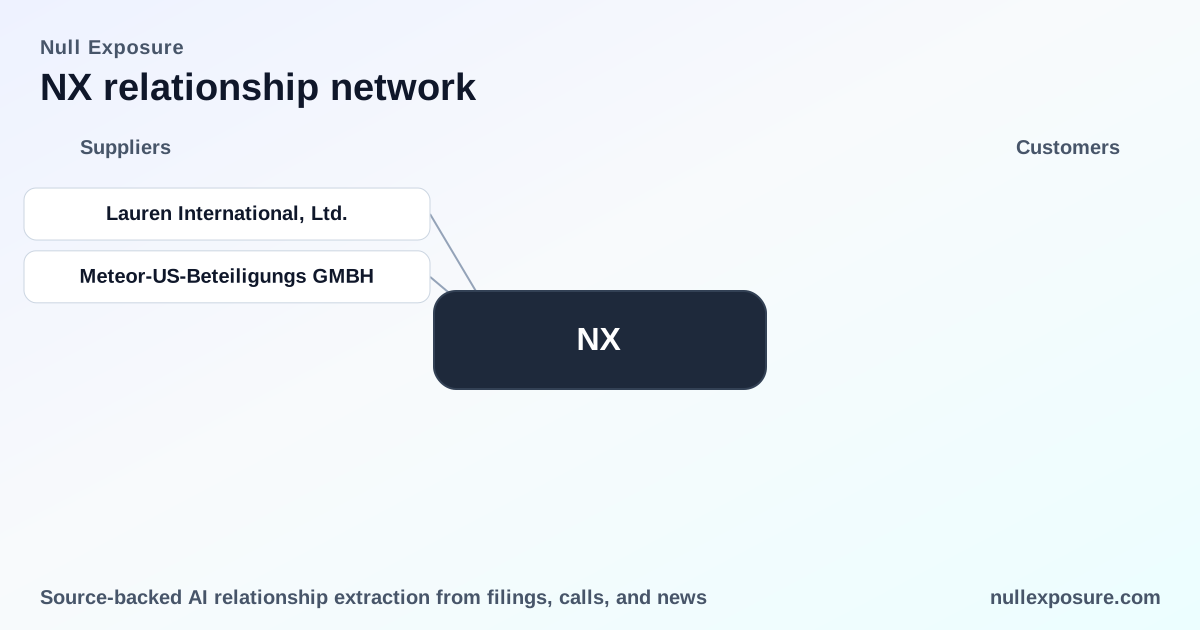
Quanex’s FY2025 Form 10‑K discloses two entities connected to a prior asset acquisition; both entries are linked to the same transaction that expanded Quanex’s in‑house polymer and rubber compound manufacturing capabilities.
Lauren International, Ltd.
On November 1, 2022, Quanex executed an Asset Purchase Agreement to acquire substantially all operating assets of LMI’s polymer mixing and rubber compound production business and assumed certain liabilities associated with those operations, according to the company’s FY2025 10‑K. (Quanex FY2025 Form 10‑K, filed for the fiscal year ended October 31, 2025.)
Meteor‑US‑Beteiligungs GMBH
Meteor‑US‑Beteiligungs GMBH is identified in the same disclosure as an equity owner of LMI; Quanex’s November 1, 2022 asset acquisition included assets previously controlled by equity holders that included Meteor, per the FY2025 10‑K. (Quanex FY2025 Form 10‑K, filed for the fiscal year ended October 31, 2025.)
These two entries describe the same strategic acquisition event: Quanex bought operating assets from LMI and, in doing so, neutralized a third‑party supplier relationship by bringing polymer mixing and rubber compound production in‑house.
Why the LMI transaction matters for supplier risk and margins
Bringing polymer mixing and rubber compound production onto Quanex’s balance sheet is a clear signal of vertical integration intended to reduce exposure to volatile third‑party rubber and polymer markets. That integration accomplishes two investor‑relevant objectives:
- Cost control and margin protection: manufacturing critical compounds internally reduces direct purchase exposure to spot resin and rubber pricing, which is important given the company’s otherwise short‑term contracting posture for many materials.
- Supply continuity and operational control: owning the production assets reduces the risk of supplier failures for a component used across Quanex’s window, door and sealing systems.
Quanex’s 10‑K also documents existing non‑cancelable purchase obligations for door hardware, primary and secondary steel and aluminum used in manufacturing, and capital projects. The company paid $9.5 million and $4.5 million under these arrangements in fiscal 2025 and 2024, respectively, and reported obligations totaling $8.3 million at October 31, 2025 that extend through fiscal 2027. (Quanex FY2025 Form 10‑K.)
For a practical supplier‑risk dashboard tied to disclosures like these, consider a deeper dive at https://nullexposure.com/.
Constraints as company‑level signals — what they tell investors
From Quanex’s disclosures, several company‑level constraints are evident and should shape investment due diligence:
- Short‑term contract exposure: Quanex does not maintain long‑term contracts for many raw materials, which leaves mix‑ and margin‑sensitivity to commodity price swings. This is a structural procurement characteristic, not a one‑off. (Quanex FY2025 10‑K.)
- Buyer posture and diversification: The company purchases a wide range of raw materials from several suppliers—PVC resin, epoxy, butyl, TiO2, silicone, EPDM rubber compounds, polypropylene, coated/uncoated aluminum, steel, stainless, zinc and wood—indicating diversified sources for inputs and limited reliance on a single raw material vendor. (Quanex FY2025 10‑K.)
- Active supplier relationships in a manufacturing segment: Quanex’s supplier relationships are operationally critical and active, reflecting the ongoing needs of its manufacturing footprint rather than passive or project‑only ties. (Quanex FY2025 10‑K.)
- Spend scale and maturity: The disclosed non‑cancelable obligations fall in the $1M–$10M band, which signifies material but manageable committed spend levels extending into fiscal 2027. These obligations are mature, documented and linked to ongoing manufacturing inputs and capital projects. (Quanex FY2025 10‑K.)
These constraints mean Quanex’s procurement strategy must balance flexibility (to take advantage of lower spot prices) with targeted integration (to lock in availability and margin for critical compounds)—a duality reflected in the LMI acquisition.
Risk profile and watchlist for operators and investors
- Commodity volatility risk is real and measurable given short‑term contracting for many inputs; monitor resin, steel and aluminum markets.
- Execution risk on integration: the benefits of the LMI acquisition depend on operational integration and cost synergies; track production ramp, margin realization and any retained liabilities.
- Capital and contractual commitments: the company’s non‑cancelable obligations (reported $8.3M at Oct 31, 2025) are concentrated in manufacturing inputs and capital projects—important for working‑capital planning. (Quanex FY2025 10‑K.)
If you evaluate supplier exposure across a portfolio of industrials, NullExposure offers tools and reporting tailored to these disclosure patterns: https://nullexposure.com/.
Bottom line — what investors should take away
Quanex’s supplier disclosures in FY2025 show a manufacturing company that balances market purchases with selective vertical integration to secure critical polymer and rubber inputs. The LMI asset acquisition converted a supplier dependency into an owned capability, reducing certain supply risks while leaving the company exposed to commodity swings through its short‑term contracting posture and mid‑range committed spend. Monitor integration execution, commodity cost trends, and the evolution of non‑cancelable purchase obligations as primary drivers of near‑term margin and cash‑flow variability.
For additional supplier relationship analytics and ongoing monitoring tied to SEC disclosures, visit https://nullexposure.com/.