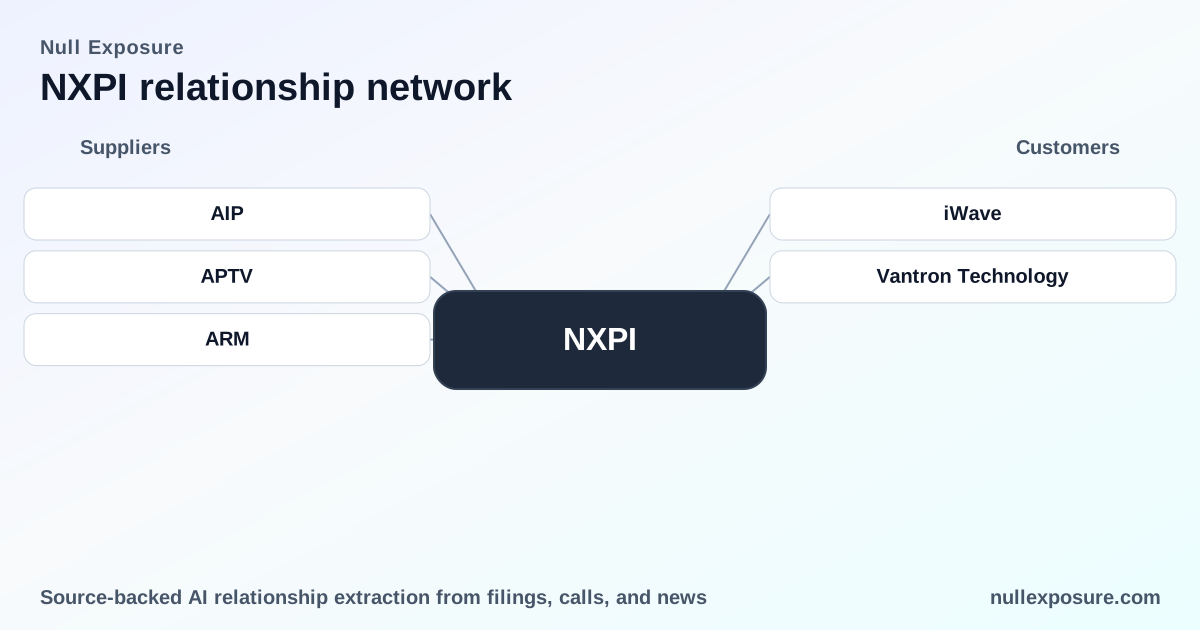
NXP Semiconductors (NXPI): Supplier relationships and operational constraints investors need to price in
NXP operates as a global semiconductor designer and manufacturer that monetizes by selling integrated circuits and related software/IP into automotive, industrial, and consumer end markets. The company runs a hybrid manufacturing model—owned fabs, joint-venture facilities and third‑party foundries—while licensing and integrating third‑party IP to accelerate product development. NXP’s economics show $12.27B revenue, $4.05B EBITDA and operating margins near 26%, reflecting a high-value product mix and durable end-market demand. For a concise supply‑chain risk snapshot and ongoing monitoring, visit https://nullexposure.com/.
Why supplier relationships matter for valuation and risk
NXP’s supplier relationships are not peripheral procurement notes; they are core to product roadmaps, time‑to‑market for AI and automotive features, and continuity of supply. The sourcing posture is hybrid and strategic: NXP outsources wafer production when economical but retains owned capacity and joint ventures to protect critical production. That posture reduces capital intensity while preserving control on high-value nodes, and it exposes the company to concentrated purchase commitments that investors must underwrite against revenue visibility and margin resilience.
Key company-level signals: the firm discloses purchase commitments of $3,046M as of December 31, 2024 (with $936M due in the next 12 months), an explicit indicator of material contracted spend; the 10‑K also documents a mix of owned, JV and third‑party manufacturing; and external audits (EY Accountants B.V.) confirm governance and control maturity. These are not theoretical: they are operational constraints that shape sourcing leverage, capex cadence, and supplier negotiation power.
For a deeper supplier-risk score and relationship map, check https://nullexposure.com/.
Arteris — interconnect IP embedded in NXP’s AI-enabled silicon
Arteris announced in February 2026 that NXP expanded use of Arteris products across its AI‑enabled silicon for intelligent vehicles, advanced industrial systems and consumer electronics, signaling NXP’s push to integrate specialized on‑chip interconnect fabric as it scales physical AI features. The Arteris disclosure confirms NXP’s strategy of incorporating third‑party silicon IP to accelerate complex SoC designs (GlobeNewswire via The Manila Times, Feb 2026).
Takeaway: NXP is buying modular IP to shorten development cycles for AI-capable SoCs, reducing internal development burden but increasing dependency on specialized IP vendors.
Aptiv / TTTech Auto — automotive systems and strategic M&A
Simply Wall St reported that Dutch NXP B.V. completed acquisition of TTTech Auto AG from Aptiv and others (noted Jun 18), indicating NXP’s willingness to use M&A to gain deterministic networking and safety‑certified automotive software/hardware capabilities. This transaction aligns with NXP’s goal to deepen system-level control in automotive safety and real‑time networking (SimplyWallSt, 2026).
Takeaway: M&A is an explicit strategic lever for NXP to internalize critical automotive capabilities; this reduces reliance on external integrators but raises integration and cash‑deployment considerations.
Arm — CPU and NPU IP underpinning i.MX products
Markets Business Insider covered NXP’s i.MX 93W, noting it features a dual‑core Arm Cortex‑A55 applications processor with a dedicated Arm Ethos NPU capable of up to 1.8 eTOPs, demonstrating that NXP integrates Arm CPU and NPU architectures into its edge compute and secure wireless product lines (Markets Business Insider, 2026).
Takeaway: NXP’s product stack depends on Arm IP for core compute and NPU capability, creating a strategic technology dependence that feeds both product competitiveness and licensing exposure.
What these relationships imply for investors: concentration, criticality and upside
Together, the three relationships above illustrate a clear pattern: NXP combines internal design with third‑party IP and selective acquisitions to accelerate capability in AI and automotive systems. That model produces several investment‑relevant implications:
- Concentration of committed spend is material. The company reported $3.046B of purchase commitments as of December 31, 2024 with $936M due within 12 months; that magnitude of contracted obligations underwrites production but reduces short‑term flexibility.
- Supply criticality is high but diversified by design. NXP deliberately uses third‑party foundries and IP suppliers when economical, while keeping owned and joint‑venture capacity for strategic control—this hybrid approach balances cost and resilience.
- Technology dependence is explicit. NXP’s use of Arm and specialized IP (Arteris) speeds product launches but creates vendor‑concentration risks for key subsystems.
- Strategic M&A is an active tool. The TTTech Auto acquisition from Aptiv signals a willingness to internalize vertically important capabilities rather than rely solely on supplier relationships.
These dynamics justify applying a premium to growth expectations while discounting for supplier concentration and integration risk. NXP’s forward P/E of ~13.8 and analyst target price of $262 reflect that tradeoff alongside strong margins and high institutional ownership.
For an investor-ready supplier risk profile and continuous monitoring, go to https://nullexposure.com/.
Operational constraints: how they shape execution and downside
The firm’s public disclosures and governance evidence surface several operational constraints that are company‑level rather than tied to an individual supplier:
- Contracting posture: NXP explicitly outsources wafer manufacturing where economical but preserves capacity through owned facilities and joint ventures, producing a hybrid manufacturing model with predictable procurement cycles.
- Spend concentration: Material purchase commitments (>$3B) create a fixed-cost backbone that supports volume forecasting but reduces nimbleness if end markets reprice.
- Criticality of suppliers: Third‑party foundries and assembly/test subcontractors are operationally critical to fulfill demand spikes; reliance on specialized IP vendors (Arm, Arteris) is central to product differentiation.
- Maturity and controls: An external audit on internal control over financial reporting and structured JV arrangements indicate sophisticated governance and operational maturity.
Investors should price the business as one with high operational leverage and defined vendor dependencies, but also with governance and financial scale to manage those dependencies.
Bottom line: monitor vendor concentration and strategic integration
NXP’s supplier relationships underscore a deliberate strategy: buy critical IP, use targeted acquisitions to internalize system capabilities, and outsource commoditized manufacturing while retaining control where economics and risk demand it. Key focus areas for investors are purchase‑commitment cadence, integration progress on TTTech Auto, and continued reliance on Arm for compute/IP.
If you evaluate supplier risk as part of investment due diligence, start here: https://nullexposure.com/. For a tailored supplier exposure brief or ongoing monitoring of NXPI counterparties, visit https://nullexposure.com/ and engage the team to convert these relationship signals into actionable risk-adjusted inputs.