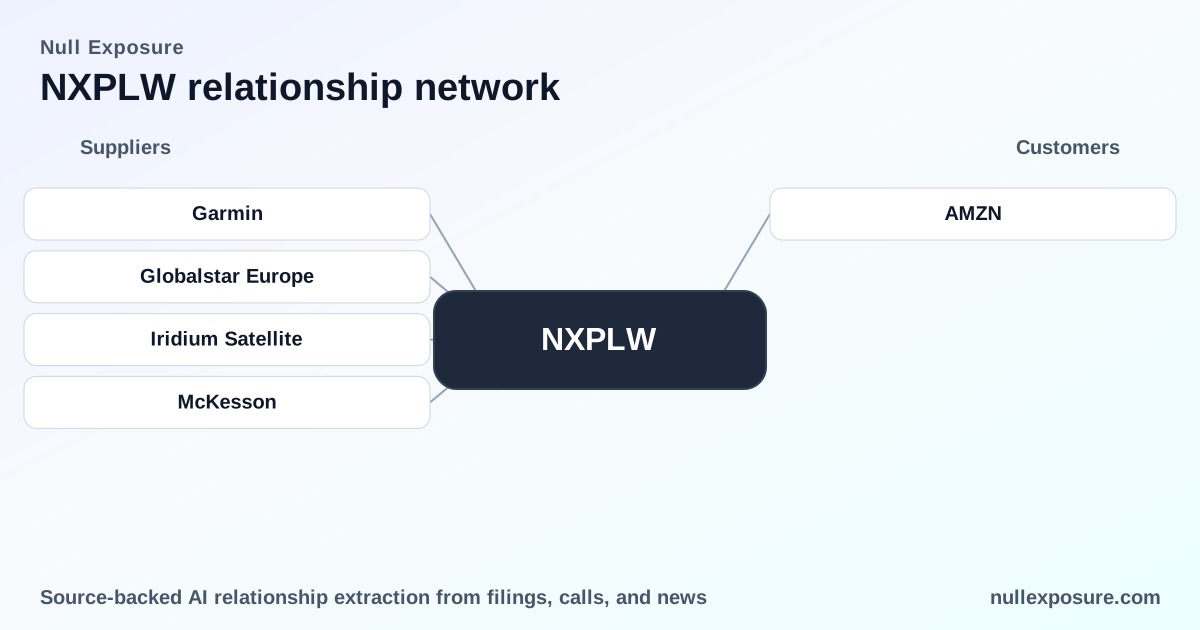
NextPlat (NXPLW) — Supplier Map and What It Means for Investors
NextPlat operates a hybrid digital commerce and financial-services platform and monetizes through direct product sales, resale of third‑party telecommunications services, and the distribution of pharmaceutical products sourced from wholesale partners. The company’s operating model blends platform revenue with merchant margins and reseller commissions; supplier relationships therefore translate directly into cost of goods sold, service availability and negotiating leverage. For investors evaluating counterparty and operational risk, supplier concentration and supplier/competitor overlap are the two dominant themes to watch.
Visit the research portal for deeper supplier analytics: https://nullexposure.com/
Why supplier relationships matter to NextPlat’s economics
NextPlat’s FY2024 disclosures frame suppliers as a core driver of gross margin and service continuity. Two structural features jump out: a high concentration in pharmaceutical sourcing and a multi‑vendor approach for satellite services where vendors are also market competitors. Those dynamics create asymmetric risk — concentrated suppliers create short‑term procurement risk and leverage exposure, while overlapping supplier/competitor roles in satellite services compress pricing power and product differentiation.
- Concentration risk is pronounced: the company reports one primary supplier that supplied the vast majority of pharmaceutical purchases in FY2024. That supplier relationship is a principal operational dependence for inventory-heavy lines.
- Supplier/competitor overlap reduces capture: NextPlat re‑resells satellite telecommunications from whole network vendors that also compete as resellers and technology vendors; this constrains margin expansion and product exclusivity.
The company’s public filings also document a multiyear office lease, signaling a fixed‑cost commitment and a mid‑term operating posture (lease runs through 2027). These elements — concentration, mixed supplier/competitor relationships, and fixed overhead — define NextPlat’s contracting posture and maturity profile as a scaling platform with embedded single‑vendor risk. Learn more about supplier risk scoring at https://nullexposure.com/
What the filings name — supplier-by-supplier summaries investors need
McKesson
NextPlat discloses a relationship with McKesson that accounted for approximately 98% of pharmaceutical purchases for the year ended December 31, 2024, identifying McKesson as the company’s primary wholesale drug supplier for pharmacy inventory. This level of concentration establishes a single‑vendor dependence for pharmaceutical throughput and purchasing economics. (Source: NextPlat FY2024 Form 10‑K filing, nxplw-2024-12-31.)
Iridium Satellite
NextPlat lists Iridium among the leading satellite networks it resells and competes alongside, noting that some network operators are both suppliers and competitive resellers for its satellite telecommunications services. That dual role constrains product uniqueness and pricing power for NextPlat’s satellite offerings. (Source: NextPlat FY2024 Form 10‑K, nxplw-2024-12-31.)
Globalstar Europe
The company references Globalstar Europe in the same category of leading satellite networks that are available to resellers and sometimes serve as suppliers. Globalstar’s position in NextPlat’s disclosures highlights the industry‑level choice set for satellite connectivity but also underscores vendor interchangeability and limited exclusivity. (Source: NextPlat FY2024 Form 10‑K, nxplw-2024-12-31.)
Garmin
NextPlat’s filing cites Garmin within its competitive and supplier landscape for satellite telecommunications services; Garmin sits among the ecosystem of device and service vendors that overlap with reseller channels and upstream network providers. This indicates NextPlat operates in a complex partner market where hardware, software and network companies intersect. (Source: NextPlat FY2024 Form 10‑K, nxplw-2024-12-31.)
Constraints and operating model signals you must internalize
NextPlat’s supplier disclosures and constraint excerpts reveal company‑level operating characteristics that influence risk and valuation.
- Contracting posture — fixed, mid‑term commitments. The company entered a 62‑month lease for 4,141 square feet in Florida, commencing June 13, 2022 and expiring August 31, 2027, with annual rent around $186,000 and 3% annual increases; this evidences material fixed cost and a mid‑term operating footprint. (Company filing evidence.)
- Materiality — single‑vendor criticality. Filings indicate a primary supplier accounted for roughly 98% of pharmaceutical purchases for FY2024, a company‑level concentration that creates outsized procurement and continuity risk for inventory-based revenue. (Company filing evidence.)
- Relationship role — distributor reliance. NextPlat sources pharmaceutical and other products from wholesale drug distributors, confirming that the company’s product margin and fulfillment depend on distributor channels rather than vertically integrated manufacturing. (Company filing evidence.)
Together, these constraints shape negotiating leverage, cash‑flow predictability and operational resilience. High supplier concentration elevates the probability of procurement disruption and price shocks; distributor‑based sourcing limits margin control and product differentiation.
For a quick vendor risk checklist, investors should prioritize: alternative supplier availability, contract termination and renewal terms, inventory buffers, and receivables exposure to the same channels.
Learn how to operationalize these supplier checks for capital allocation decisions at https://nullexposure.com/
Investor implications and practical recommendations
NextPlat’s supplier map yields clear tactical conclusions for both equity investors and operating managers.
- Primary risk — McKesson concentration. With McKesson supplying the lion’s share of pharmaceuticals in FY2024, any interruption, price re‑pricing or contract non‑renewal would materially affect COGS and inventory flow. Investors should model scenarios where procurement terms shift unfavorably by 10–30% and assess cash conversion impact.
- Margin ceiling in satellite resale. Selling satellite connectivity sourced from major networks that are also resellers compresses margin upside; differentiation requires value‑added services or proprietary integrations rather than pure resale economics.
- Governance and disclosure focus. Board and management should disclose contingency plans for supplier interruptions, progress on supplier diversification, and metrics on back‑up inventory and alternative sourcing timelines.
Actionable items for investors and operators:
- Demand clarity on contract terms with McKesson (length, renewal, exclusivity) and any signed commitments with satellite network providers.
- Track KPI disclosures for supplier concentration (percent of purchases by supplier) and inventory days to quantify disruption exposure.
- For operators, prioritize supplier diversification or negotiating volume‑based safeguards to protect margins.
Final takeaway and next steps
NextPlat runs a mixed model: platform revenue plus product resale — and that mix is materially shaped by supplier relationships. The combination of a dominant pharmaceutical supplier, reseller exposure to major satellite networks that also compete, and mid‑term fixed overhead creates a risk profile that is measurable and actionable. Investors should treat supplier disclosures as first‑order inputs to margin sensitivity and operational resilience analysis.
For a systematic supplier risk review and to integrate these vendor signals into your investment workflow, visit https://nullexposure.com/ — the homepage provides tools and scoring for supplier concentration and counterparty criticality.