NexPoint Residential Trust (NXRT): Supplier relationships that shape operating leverage and risk
NexPoint Residential Trust acquires, owns and operates middle‑income multifamily properties and monetizes through rental income, value‑add repositioning and an externally managed fee structure. Revenue is rental-driven while recurring adviser and property‑management contracts create an outsized operating dependency on external partners; debt facilities and hedges provide financial flexibility but also concentrate counterparty risk. If you evaluate NXRT as a landlord or counterparty, focus on the adviser and manager relationships, the corporate credit facility, and the profile of interest‑rate hedging that stabilize cash flows. For a quick look at how these relationships map to supplier risk, visit https://nullexposure.com/.
What the model looks like in practice: fees, management, and leverage
NexPoint runs an externally managed REIT model. It collects rental revenue from properties while paying an external adviser an advisory fee (1.00% of Average Real Estate Assets) and an administrative fee (0.20% of Average Real Estate Assets), and it pays a property manager a management fee (approximately 3% of monthly gross income). That fee layering makes the adviser and manager functionally critical service providers for day‑to‑day operations and value creation.
At the same time, NXRT carries meaningful mortgage debt (roughly $1.5 billion of floating-rate mortgage debt as of year‑end 2024) and operates with credit facilities that supply corporate liquidity; these financing arrangements shift strategic control and operational resilience toward counterparties that provide capital and hedging.
The operating constraints that matter to investors and counterparties
NexPoint’s public filings and press materials provide several actionable signals about the company’s contracting posture and vendor concentration:
- Contracting posture is mixed: The Advisory Agreement with NexPoint Real Estate Advisors, L.P. is renewed on a one‑year basis (short‑term renewal cadence), while interest‑rate swaps and caps used to stabilize debt have multi‑year tenors (three to five years), indicating long‑dated financial hedges coexisting with annually renewable management contracts.
- Concentration and criticality are high: The Adviser and BH Management Services, LLC perform core operating functions; the Adviser’s right to resign on short notice is explicitly flagged as a material operational risk, making these suppliers critical to operations.
- Maturity and spend profile: Fee levels are material but fall in different bands — advisory fees historically register in the low‑single‑million range annually, while balance‑sheet exposure to lenders and credit facilities is in the tens to hundreds of millions. This creates a dual risk: vendor replacement risk at the service level and counterparty/credit risk at the financing level.
These constraints position NXRT as a REIT whose operational continuity depends on a small number of external suppliers while its balance sheet is meaningfully leveraged and hedged.
The supplier relationships investors need to know about
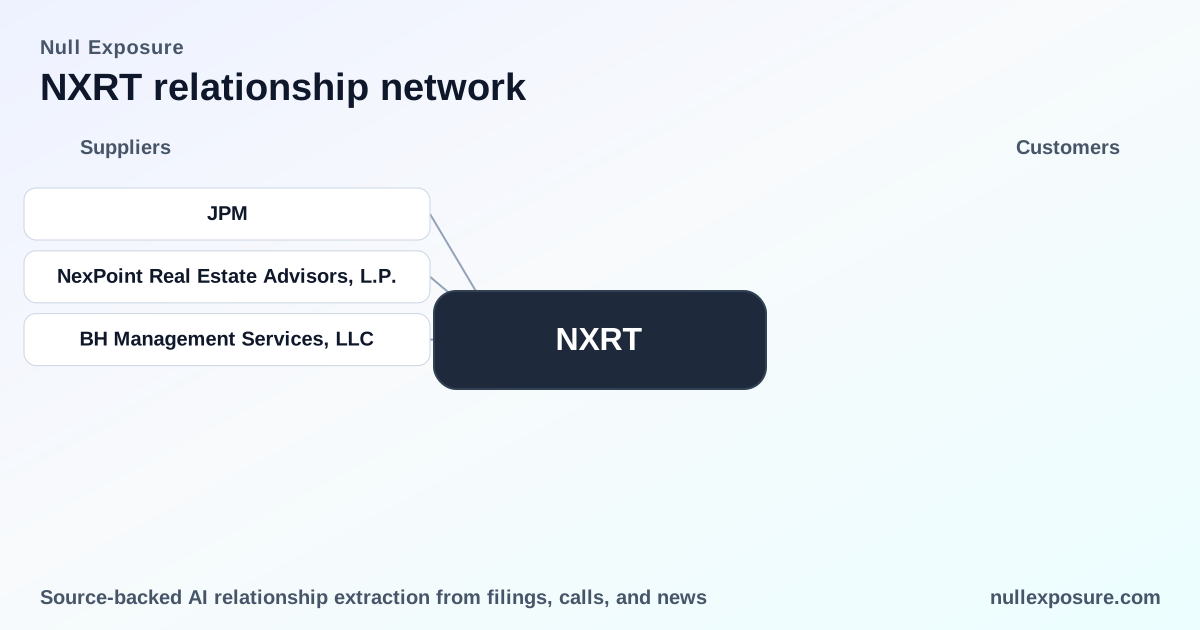
NexPoint Real Estate Advisors, L.P.
NXRT is externally advised by NexPoint Real Estate Advisors, L.P., which conducts substantially all of the company’s operations and provides asset management services; advisory and administrative fees are contractually specified and the Advisory Agreement was renewed for a one‑year term in February 2025. According to multiple investor releases and filings in FY2026, the Adviser’s role is core to NXRT’s operating model and fee expense. Source: company filings and press releases summarized in FY2026 reporting (see PR Newswire and Finviz coverage, March 2026).
BH Management Services, LLC
BH Management Services currently manages all of NXRT’s properties, supervising the company’s value‑add program and charging property management fees of approximately 3% of monthly gross income; the manager provides scale benefits for renovations and sourcing. The company’s SEC filings and public reporting in FY2026 identify BH as the operational property manager. Source: SEC 10‑K commentary summarized by TradingView’s FY2026 coverage.
JPMorgan / JPMorgan Chase Bank
NexPoint entered into a $200 million revolving credit facility with JPMorgan Chase Bank and the lenders party thereto, which augments corporate liquidity and financial flexibility. The credit facility was announced in FY2025 / reported in March 2026 materials and is a central piece of NXRT’s short‑term funding strategy. Source: The Globe and Mail press release and earnings materials citing the July 2025 facility (reported March 2026), and transcript summaries (InsiderMonkey).
How those relationships translate into investor risk and opportunity
The adviser and manager relationships create operational leverage: NXRT outsources core functions but pays for continuity and expertise. That structure is efficient for capital allocation, but it is also a single‑point dependency — the Advisory Agreement explicitly allows the Adviser to resign on relatively short notice, which the company identifies as a material risk to operations and distributions. Because the Adviser conducts substantially all operations, vendor continuity and personnel retention are principal operating risks.
On the balance‑sheet side, levered assets are supported by bank financing and derivative hedges. The company hedges floating‑rate mortgage exposure (interest‑rate swaps covering a majority of floating debt and caps with three‑to‑four year terms), while holding a $200 million corporate revolver with JPMorgan plus borrowing capacity under existing facilities. That profile stabilizes cash flows but concentrates counterparty exposure in lenders and derivatives counterparties.
Practical takeaways for counterparties and investors
- Service dependency is high. If you are evaluating a vendor or counterparty contract with NXRT, prioritize operational continuity terms and exit/transition protections because replacing the Adviser or BH would be disruptive.
- Funding relationships are meaningful. Lenders such as JPMorgan provide corporate liquidity that underwrites growth and draws on the balance sheet; monitor covenant terms and revolver utilization.
- Hedging reduces interest volatility but adds counterparty concentration. The company’s multi‑year hedges lower refinancing risk while locking exposure to financial counterparties.
If you want a structured supplier risk view for NXRT—covering fee schedules, contract terms and counterparty exposure—see our supplier risk pages at https://nullexposure.com/.
Bottom line and next steps
NexPoint’s externally‑managed structure and concentrated property management create clear operating efficiency and corresponding vendor concentration risk. Its leverage is managed through credit facilities and multi‑year hedges, which provide financial flexibility while centralizing counterparty risk with lenders and derivatives counterparties. For investors and operators assessing supplier relationships, the Adviser, BH Management, and major lenders are the critical counterparties to underwrite.
For a deeper supplier‑level briefing, register for an NXRT supplier risk profile at https://nullexposure.com/. If you need bespoke due‑diligence or want a comparative view across REIT suppliers, visit https://nullexposure.com/ for analyst services and briefings.