Nextracker (NXT): Supplier Relationships and What They Mean for Investors
Nextracker builds and sells solar tracker systems and software, operating a capital-light manufacturing model in which the company outsources production of most components to contract manufacturers and steel partners while monetizing through hardware sales, recurring software/maintenance, and project-level deployments. The company leverages a global supply base to scale projects rapidly, with revenues driven by tracker deployments, service contracts, and geographic expansion into high-growth markets. Investors should view Nextracker as a tech-enabled OEM that trades scale and software margins for lower capital intensity and supply-chain exposure.
Explore deeper supplier intelligence at https://nullexposure.com/.
Why supplier relationships are central to the investment thesis
Nextracker’s operating model is explicitly “capex-light”: the firm does not carry large-scale fabrication in-house and instead relies on a network of contract manufacturers and steel suppliers to produce torque tubes, fasteners, and structural components. That posture accelerates geographic reach and working-capital efficiency but concentrates operational risk in third parties. The company reported contract manufacturing across 90+ facilities in 19 countries, which supports scale but also creates a distributed exposure to regulatory, quality, and ESG compliance risks. At the company level, the constraints signal are clear:
- Global footprint and manufacturing scale — suppliers span five continents, enabling quick regional deployment but increasing coordination and compliance complexity.
- Material supplier risk — Nextracker explicitly warns supplier failures could have a material adverse effect on the business, underscoring reputational and legal downside.
- Manufacturer role and active stage — the relationships are operational and production-oriented (not exploratory), consistent with an active sourcing and manufacturing strategy.
- Spend concentration — prior to separation from Flex, Nextracker purchased roughly $67.1 million of components and services from Flex affiliates in FY2023, denoting meaningful related-party spend exposure.
These characteristics make supplier diligence a core part of any investment or partnership due diligence on Nextracker.
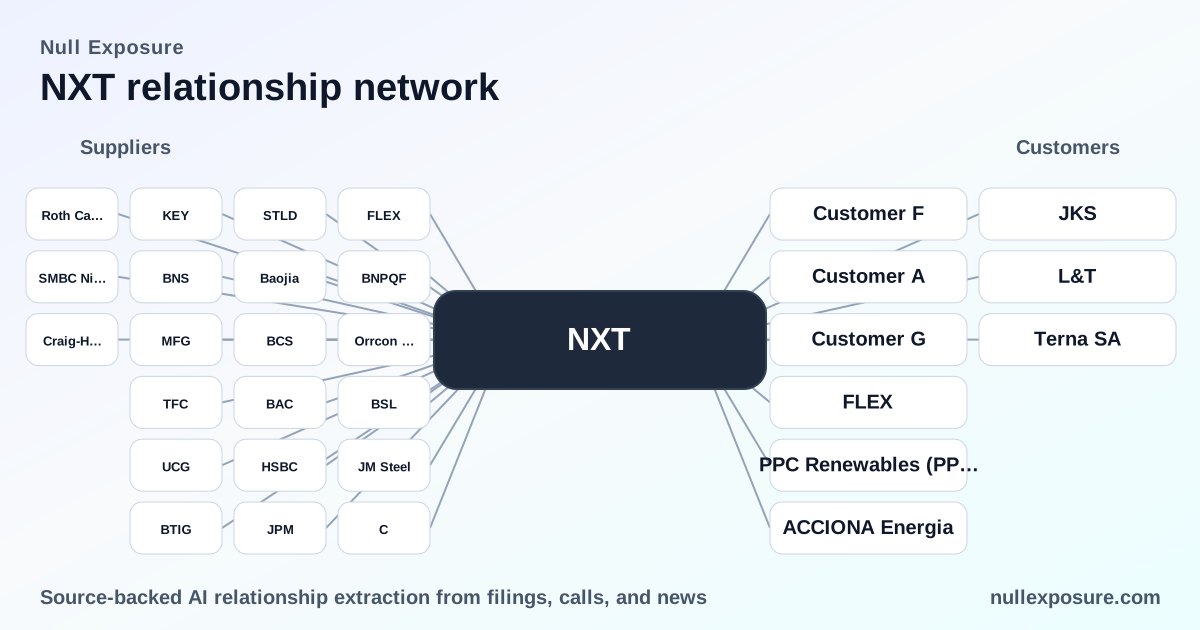
The supplier and financing roster investors should know
Below I catalogue every relationship surfaced in corporate releases and news items, with a concise plain-English summary and source reference for each.
-
Flex Ltd. — Nextracker used IPO proceeds to purchase 30,590,000 LLC common units from a Flex subsidiary, reflecting a legacy commercial and capital relationship with its former parent. Source: Nextracker investor release, 2023 (https://investors.nextracker.com/news/news-details/2023/Nextracker-Announces-Full-Exercise-of-Underwriters-Option-to-Purchase-Additional-Shares-in-Upsized-Initial-Public-Offering/default.aspx).
-
BNP Paribas — BNP Paribas acted as a joint book-running manager on Nextracker’s offering, indicating a role in underwriting and capital markets distribution. Source: Nextracker investor release, 2023 (same as above).
-
Citigroup — Citi served as a joint lead book-running manager for Nextracker’s offering, positioning it among the primary underwriters for the company’s equity issuance. Source: Nextracker investor release, 2023 (same URL).
-
Barclays — Barclays participated as a joint lead book-running manager on the equity offering, supporting Nextracker’s capital market execution. Source: Nextracker investor release, 2023.
-
BofA Securities — BofA was a joint lead book-running manager on the offering, reinforcing a top-tier banking syndicate behind the IPO. Source: Nextracker investor release, 2023.
-
J.P. Morgan — J.P. Morgan acted as a joint lead book-running manager for Nextracker’s offering, a signal of strong investment-bank backing. Source: Nextracker investor release, 2023.
-
KeyBanc Capital Markets — KeyBanc participated as a manager on the underwriting syndicate, supporting distribution to institutional investors. Source: Nextracker investor release, 2023.
-
Scotiabank — Scotiabank served as a manager on the offering, representing international distribution capability for the deal. Source: Nextracker investor release, 2023.
-
HSBC — HSBC acted as a joint book-running manager for the equity transaction, indicating engagement with global banking partners. Source: Nextracker investor release, 2023.
-
Mizuho — Mizuho was listed among the joint managers on the offering, adding Asian investment-bank coverage to the syndicate. Source: Nextracker investor release, 2023.
-
Truist Securities — Truist was included among joint managers for the offering, representing regional capital markets support. Source: Nextracker investor release, 2023.
-
UniCredit — UniCredit served as a co-manager on the offering, providing European distribution capacity to the syndicate. Source: Nextracker investor release, 2023.
-
BTIG — BTIG acted as a co-manager in the offering syndicate, supporting mid-market institutional placement. Source: Nextracker investor release, 2023.
-
Roth Capital Partners — Roth Capital participated as a co-manager on the equity offering, adding boutique distribution to the book. Source: Nextracker investor release, 2023.
-
Craig-Hallum — Craig-Hallum is listed as a co-manager for the offering, representing regional/boutique underwriting coverage. Source: Nextracker investor release, 2023.
-
SMBC Nikko — SMBC Nikko served as a co-manager for the offering, contributing Asian distribution expertise. Source: Nextracker investor release, 2023.
-
Orrcon Steel — Nextracker contracted Orrcon Steel to manufacture critical steel components in Australia, establishing a local, sovereign-capability manufacturing relationship for the Australian market. Source: Nextracker investor release, 2024 (https://investors.nextracker.com/news/news-details/2024/Nextracker-and-Orrcon-Steel-to-Deliver-Sovereign-Capability-in-Australia/default.aspx).
-
BlueScope Steel — BlueScope provided steel coil for components produced for Nextracker in Australia, integrating upstream domestic steel supply into Nextracker’s local manufacturing strategy. Source: Nextracker investor release, 2024.
-
Baojia — Baojia, identified as Nextracker’s global manufacturing partner, completed finishing work on Australian-made components, showing the company’s reliance on global OEM partners for final assembly and delivery to EPCs. Source: Nextracker investor release, 2024.
-
JM Steel — Nextracker opened a manufacturing facility with JM Steel in Texas to produce low-carbon tracker components for the southern U.S. market, highlighting regionalization of production and emissions-focused sourcing. Source: PR Newswire release, 2022 (https://www.prnewswire.com/news-releases/nextracker-commissions-new-manufacturing-plant-with-jm-steel-in-texas-to-serve-southern-usa-solar-power-market-301528714.html).
-
Steel Dynamics, Inc. — Steel Dynamics supplied environmentally preferred low-carbon steel and endorsed the new Texas manufacturing footprint, confirming strategic upstream supplier relationships in the U.S. Source: PR Newswire release, 2022.
(Each of the banking and manufacturing entries above references the company press and investor releases cited.)
What these relationships imply for portfolio risk and upside
The roster is a blend of capital-market partners (banks that underwrote the IPO) and manufacturing partners (steel producers and finishers). That bifurcation matters for investors: underwriting relationships are transactional and one-time, while manufacturing partners are operational and ongoing. The company-level constraints confirm a manufacturing-heavy, global supply posture that is active and material to operations. Because Nextracker relies on third parties for critical components, supply continuity, quality control, and ESG compliance are principal investment risks; conversely, local manufacturing initiatives (JM Steel, Orrcon/BlueScope) are strategic mitigants that reduce logistics and tariff exposure.
For investors focused on risk-adjusted returns, these dynamics point to two levers: (1) monitor Nextracker’s progress in onshoring/nearshoring to reduce geopolitical and transport risk, and (2) track related-party concentration with Flex given the FY2023 spend footprint. For structured diligence and supplier scoring visit https://nullexposure.com/ to access supplier relationship signals and filings.
Practical takeaways and next steps
- Supply risk is meaningful but managed: Nextracker’s capex-light model trades capital intensity for supplier concentration risk, mitigated by regional manufacturing partnerships in the U.S. and Australia.
- Underwriting roster shows clean capital-market access: top-tier banks supported the IPO, improving market liquidity for equity issuance when needed.
- Watch related-party exposure: historical $67.1M purchases from Flex affiliates (FY2023) warrant ongoing monitoring for concentration or governance implications.
For a deeper supplier risk scorecard and to see how these relationships evolve in filings and press releases, check https://nullexposure.com/ — it’s the fastest way to integrate supplier intelligence into investment models.
Conclusion: Nextracker’s model delivers scalability and margin through outsourcing and software monetization, but investors must price supplier concentration, regional execution, and compliance risk into valuation. The company’s active moves to regionalize manufacturing are positive operational hedges; continued disclosure on supplier spend and quality performance will be the primary catalyst set for de-risking the name.