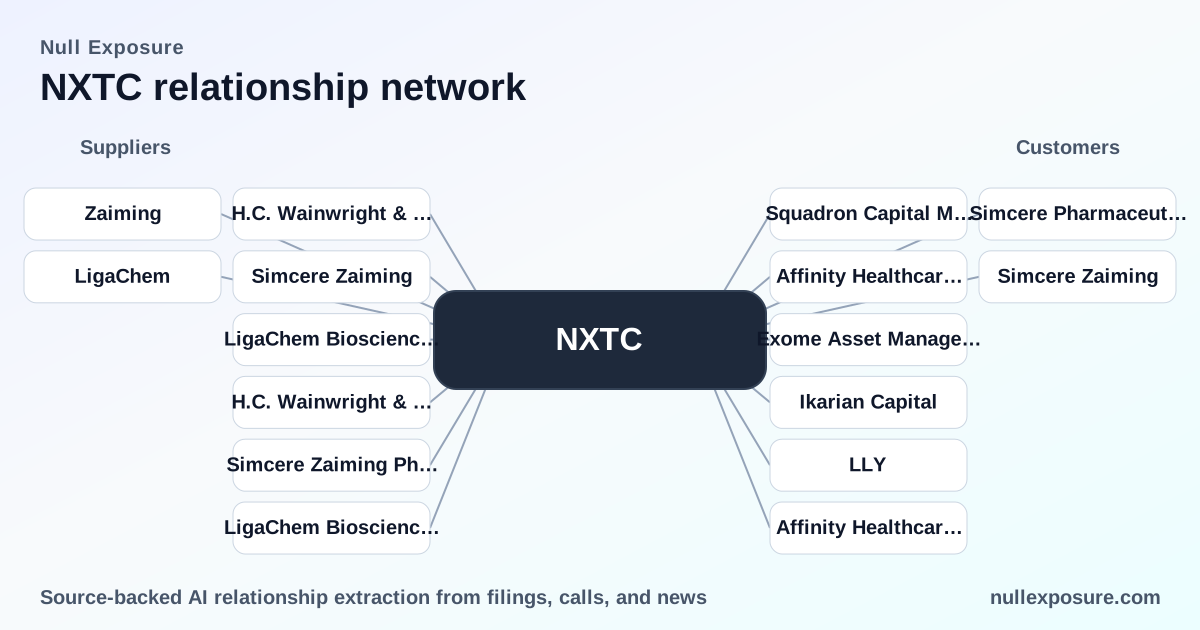
NextCure (NXTC) — supplier relationships that drive a clinical-stage immunomedicine strategy
NextCure is a clinical-stage biotechnology company that discovers and develops immunomedicines for cancer and immune disorders. The company monetizes through licensing deals, co-development cost‑share arrangements, and periodic equity raises, while outsourcing manufacturing and clinical execution to third parties; licensing receipts, milestone structures and capital markets activity collectively fund R&D and operations.
If you evaluate supplier and partner exposure for investment or operations decisions, this profile isolates each named relationship in public reporting and explains how those relationships influence NextCure’s liquidity, program progress, and operational risk. For an investor-focused view across suppliers and partners, see https://nullexposure.com/.
What these supplier and partner relationships reveal about NextCure’s operating model
NextCure runs a classic asset-light, partnership-driven biotech model: internal discovery and early development, externalized manufacturing and clinical execution, and monetization through licensing and equity markets. Public disclosures and press releases show several consistent characteristics:
- Contracting posture: the company executes upfront license agreements, co‑development cost‑share arrangements, and placement/ATM equity facilities as primary contractual levers.
- Concentration and criticality: NextCure relies on a handful of strategic partners for program rights and clinical advancement, and on third‑party CMOs and CROs for manufacturing and trial execution; loss or interruption of a single key supplier could materially disrupt development timelines.
- Maturity: relationships range from newly executed license deals (SIM0505) to long-term facility leases (corporate headquarters through March 2030), reflecting a mix of transaction-driven and longer-term operational commitments.
- Outsourcing posture: the company explicitly outsources Master Cell Bank production, fill-finish and many clinical trial services to qualified third parties, establishing service-provider dependency on contract manufacturing organizations and CROs.
NextCure also maintains an exclusive license with Yale granted in December 2015, showing a long-standing IP licensing foundation that underpins its S15 and related programs. That Yale license remains a company-level signal of intellectual property sourcing and ongoing royalty obligations.
Explore more supplier intelligence for action-oriented decision making: https://nullexposure.com/.
Relationship map — each disclosed supplier and partner (public sources)
Below are every relationship mentioned in the provided results, with a concise statement and the primary public reference.
H.C. Wainwright & Co. — exclusive placement agent for $21.5M private placement (GlobeNewswire, Nov 12, 2025)
H.C. Wainwright acted as the exclusive placement agent for a $21.5 million private placement of NextCure common stock, providing capital ahead of expected Phase 1 proof‑of‑concept readouts; the arrangement underscores NextCure’s reliance on boutique investment banks for equity financing. Source: GlobeNewswire press release, November 12, 2025.
H.C. Wainwright & Co. — acted as exclusive placement agent on closing (GlobeNewswire, Nov 17, 2025)
The firm was again cited as the exclusive placement agent when NextCure closed the $21.5 million PIPE financing, confirming the completed capital injection that partially funded operations and partner obligations. Source: GlobeNewswire press release, November 17, 2025.
H.C. Wainwright & Co. — at‑the‑market offering agreement (TradingView report, Dec 2025)
NextCure entered an at‑the‑market (ATM) offering agreement with H.C. Wainwright, enabling up to $14.5 million of common stock sales through the agent at prevailing or negotiated prices, with a 3% commission on gross proceeds. This expands the company’s on‑demand financing toolkit beyond private placements. Source: TradingView report summarizing the ATM filing (December 19, 2025).
H.C. Wainwright & Co., LLC — ATM program disclosure (The Globe and Mail reprint, Dec 2025)
A press release reprinted in The Globe and Mail detailed the ATM terms and commission structure, reinforcing that H.C. Wainwright is NextCure’s chosen execution agent for both PIPE and ATM equity programs in late 2025. Source: The Globe and Mail press release (December 19, 2025).
Simcere Zaiming — exclusive global license (QuiverQuant, FY2025 disclosure)
NextCure acquired an exclusive global license (excluding Greater China) to SIM0505 from Simcere Zaiming, enabling U.S. and ex‑China clinical development and positioning the company to capture global economic upside beyond Greater China. Source: QuiverQuant report on the SIM0505 Phase 1 dosing announcement (FY2025).
Simcere Zaiming — upfront license fee reported as cash use (The Globe and Mail press release, FY2025)
Company financial updates list a $12.0 million upfront license fee to Simcere Zaiming as a primary driver of cash outflow during the year, highlighting the near-term cash impact of in‑licensing strategic assets. Source: The Globe and Mail press release reporting NextCure business update and Q3 2025 results.
Simcere Zaiming Pharmaceutical Co., Ltd. — aggregate upfronts and milestone payments cited in FY2026 summary (ManilaTimes/GlobeNewswire, Mar 2026)
NextCure’s FY2025–2026 cash flow commentary attributes $13.5 million of upfront license fees and milestone payments to Simcere Zaiming Pharmaceutical Co., Ltd., partially offset by $22.3 million of proceeds from equity sales including the $21.5 million private placement. This frames the SIM0505 license as a material use of capital. Source: ManilaTimes reprint of GlobeNewswire full‑year 2025 financial results (March 6, 2026).
LigaChem Biosciences Inc. — 50/50 co‑development cost share (The Globe and Mail press release, FY2025)
NextCure co‑develops a program with LigaChem under a 50/50 cost share arrangement, aligning economic interests for LNCB74 and reducing NextCure’s unilateral cash burden while creating shared technical and regulatory risk. Source: The Globe and Mail business update and Q3 2025 results.
LigaChem Biosciences, Inc. — global co‑development rights reiterated (ManilaTimes/GlobeNewswire, Mar 2026)
The full‑year results reiterated that NextCure shares global co‑development rights with LigaChem in a 50/50 cost share, confirming the arrangement’s continued operational significance into FY2026 planning. Source: ManilaTimes reprint of GlobeNewswire full‑year 2025 financial results (March 2026).
Zaiming — ex‑China rights acquisition for SIM0505 noted in 10‑K summary (TradingView FY2026 report)
Public reporting summarized that NextCure acquired ex‑China rights to SIM0505 from Zaiming, which isolates Greater China commercialization back to the original licensor and leaves global rights (outside China) with NextCure. Source: TradingView summary of NextCure 10‑K and related disclosures (FY2026).
LigaChem — co‑development of LNCB74 cited in 10‑K summary (TradingView FY2026 report)
NextCure is co‑developing LNCB74 with LigaChem, reinforcing the multiple program-level collaborations that spread development cost and program risk across partners. Source: TradingView summary of NextCure 10‑K and press materials (FY2026).
What investors and operators should take away
- Capital strategy is partner- and market-driven. NextCure funds development with licensing upfronts and equity placements; H.C. Wainwright is the clear execution partner for late‑2025 financings. Equity reliance increases dilution risk if programs require further capital before value inflection.
- Program risk is concentrated but mitigated by co‑development. In‑licensing SIM0505 and a 50/50 cost share with LigaChem reduce single‑party cash burden while dividing technical risk; however, outsourced manufacturing and sole‑sourced raw materials represent critical single points of failure that will affect timeline execution.
- Contracting mix is mature and multifaceted. The company holds long‑term facility leases through 2030 and maintains IP licensed from Yale, demonstrating both long‑dated operational commitments and legacy IP foundations that support program pipelines.
- Operational dependencies matter to valuation. Clinical and manufacturing outsourcing creates execution exposure; any CMO, CRO or licensor dispute or delay directly affects time to milestone payments and potential commercial upside.
For operational due diligence and supplier exposure benchmarking across biotech partners, visit https://nullexposure.com/.
Final recommendation
NextCure’s supplier and partner disclosures show a capital‑intensive development path financed through targeted licensing deals and repeat equity placements, with meaningful reliance on external manufacturers and service providers. Investors should price in potential dilution and execution risk tied to single‑source manufacturing and milestone timing, and operators should prioritize contingency planning for CMO/CRO substitutions. For deeper analysis on supplier concentration and contract terms across the sector, consult our platform at https://nullexposure.com/.