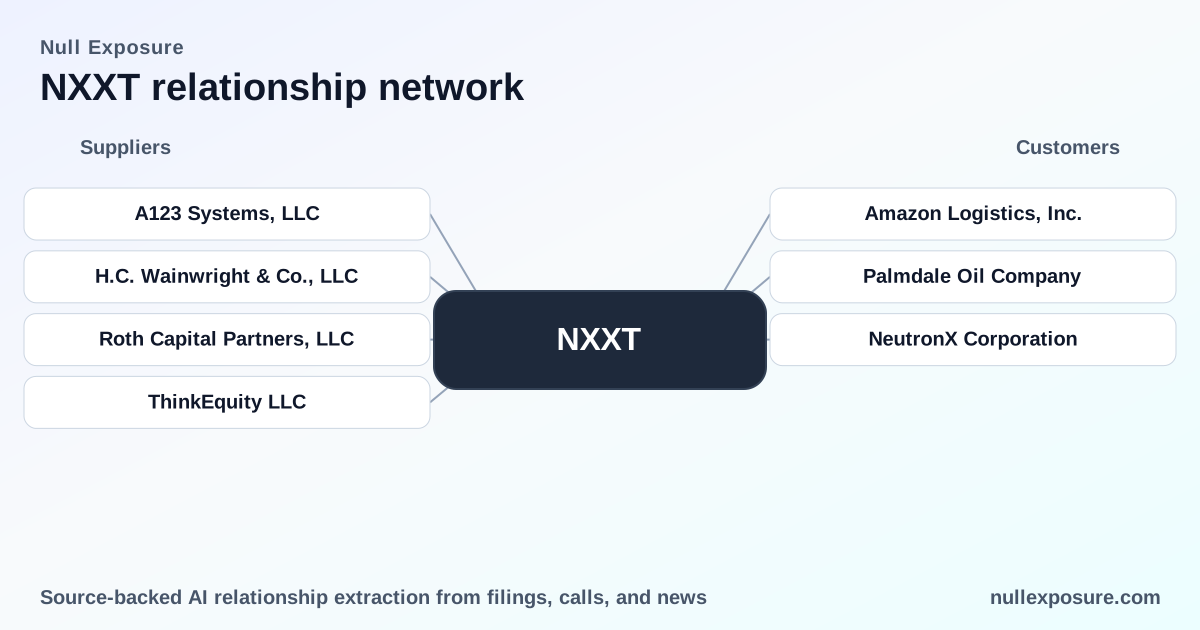
NextNRG (NXXT) supplier map: what investors need to know
NextNRG operates a mobile fueling and energy-services platform primarily in Florida, monetizing through on-demand fuel delivery, equipment and vehicle asset ownership, and deployments of battery energy storage systems (BESS). The company reported $37.45M revenue TTM and a negative EBITDA of $9.78M, while pursuing both asset purchases and supplier partnerships to scale capacity. Revenue comes from operations and contracted services; balance-sheet moves (asset purchases, receivables financing, lease assumptions) and supplier contracts materially shape liquidity and execution risk. For a concise supplier-risk dashboard and primary-source reporting, visit https://nullexposure.com/.
Executive takeaway: concentrated suppliers and active re-contracting
NextNRG’s supplier footprint shows two clear vectors of risk and opportunity: strategic BESS vendor relationships and capital-markets counterparties. The company is actively restructuring its capital facilitation (termination of an ATM sales arrangement) while expanding vendor options for storage technology (an MOU with a battery supplier). Operationally, vendor concentration for fuel purchases and large, multi-million dollar asset acquisitions create cash-flow and counterpart risk that investors must price into valuation models.
- Concentration risk: two principal fuel suppliers still supply the majority of fuel spend, indicating high operational sensitivity to supplier disruption.
- Capital-market posture: management is unwinding an at-the-market (ATM) sales facility with its distribution partners, changing near-term equity-liquidity channels.
- Vendor diversification: the company is adding storage suppliers to support project pipeline and potential in-house manufacturing partnerships.
For more detailed supplier analytics and primary documents, see https://nullexposure.com/.
Supplier-by-supplier: what the record shows
A123 Systems, LLC
NextNRG signed a memorandum of understanding positioning A123 as one of several key storage-technology suppliers as NextNRG advances U.S. battery energy storage projects. According to a GlobeNewswire release dated December 29, 2025, A123 is being integrated into NextNRG’s storage supplier ecosystem to support project deployments. (GlobeNewswire, Dec 29, 2025)
H.C. Wainwright & Co., LLC
NextNRG terminated its At-the-Market (ATM) Sales Agreement, as amended, which listed H.C. Wainwright as a participating broker-dealer; this ends that specific equity-distribution channel effective in FY2026. The termination was disclosed in a GlobeNewswire company announcement on January 23, 2026. (GlobeNewswire, Jan 23, 2026)
Roth Capital Partners, LLC
Roth Capital Partners was similarly a named participant in the terminated ATM arrangement; NextNRG has formally ended the agreement with Roth as of the January 23, 2026 disclosure. This removes Roth’s role in future ATM share placements under that agreement. (GlobeNewswire, Jan 23, 2026)
ThinkEquity LLC
ThinkEquity was the third broker-dealer named in the ATM facility that NextNRG terminated in January 2026, signaling a deliberate shift away from that particular equity-liquidity mechanism. The termination was announced by the company on January 23, 2026. (GlobeNewswire, Jan 23, 2026)
Constraints and company-level signals investors must price
NextNRG’s documented constraints reveal a mixed contracting posture and concentrated operating exposures that affect supplier selection, cash flow, and execution timelines.
- Contract duration profile: the company has both short-term financing arrangements and multi-year leases. Receivable financing agreements are structured to amortize quickly (the company expects financing to be repaid in approximately six months), while several office lease commitments extend 36–48 months. These dual horizons create overlapping working-capital and fixed-cost obligations that must be managed concurrently. (Company disclosures)
- Concentration and criticality: NextNRG reports reliance on a limited number of vendors for fuel—two principal suppliers provide almost all fuel needs—creating critical operational concentration that directly affects service continuity. Vendor purchase breakdowns show very heavy reliance on a small number of suppliers in 2024. (Company disclosures)
- Spend profile: the company documents both mid-size operating commitments ($100k–$1M band for leases and receivables facilities) and larger strategic outlays ($1M–$10M band exemplified by a $5.22M asset purchase from Shell for vehicles and storage tanks). These scale differences mean procurement and vendor selection processes must support both frequent, smaller cash needs and infrequent, large-capex transactions. (Company disclosures)
- Relationship roles and manufacturing strategy: NextNRG has an agreement with Midwest to establish a greenfield BESS manufacturing facility and to source interim products and services—this positions Midwest as a manufacturing partner in the company’s supply chain and reduces dependence on third-party module imports over time. (Company disclosures)
- Lifecycle signals: certain lines and leases have been terminated historically (e.g., a repaid line of credit and terminated leases), showing that management will both exit and assume contracts as strategic priorities shift; the recent termination of the ATM facility is consistent with active contracting-stage management. (Company disclosures)
These constraints indicate a company executing simultaneous growth and rebalancing: scale-up capex and supplier expansion coincide with refinement of capital-raising channels and legacy lease/credit exits.
For a deeper supplier risk scorecard and document links, explore https://nullexposure.com/.
What this means for valuation and operational risk
- Liquidity sensitivity: the mix of short-term receivables financing and large asset purchases increases near-term cash volatility. Investors should model several scenarios for receivables-advance rollovers and sublease income (the company sublets certain properties).
- Counterparty risk to watch: fuel-supplier concentration and the onboarding of a small set of storage vendors make single-counterparty failure a credible scenario with outsized operational impact.
- Execution upside: the A123 MOU and the Midwest manufacturing relationship are value-accretive if they accelerate project delivery and reduce unit costs for BESS deployments; these are optional-growth levers to watch.
Recommended investor actions
- Monitor quarterly disclosures for vendor concentration metrics and any formal multi-vendor sourcing programs that reduce the two-supplier concentration. Request vendor diversification timelines from management in the next earnings call.
- Track working-capital facilities and receivables financing rollovers; stress-test liquidity under slower-than-expected asset deployment. Validate sublease assumptions and receivables financing amortization schedules against cash-flow forecasts.
- Evaluate counterparties named in capital markets agreements and follow any new ATM or placement arrangements; the January 2026 termination of the broker-dealer ATM group materially changes equity-liquidity optionality. (GlobeNewswire, Jan 23, 2026)
For a practical supplier-contract playbook tailored to energy suppliers, visit https://nullexposure.com/ and request the supplier-risk briefing.
Bottom line
NextNRG’s supplier picture is a mix of critical concentration and purposeful diversification. The company is reducing certain capital-market relationships while adding strategic BESS partners and pursuing manufacturing options—moves that reshape both risk and optionality. Investors should weigh near-term liquidity dynamics and concentrated fuel sourcing against the long-term upside from storage-technology partnerships.
To examine primary filings and the latest supplier announcements in one place, go to https://nullexposure.com/.