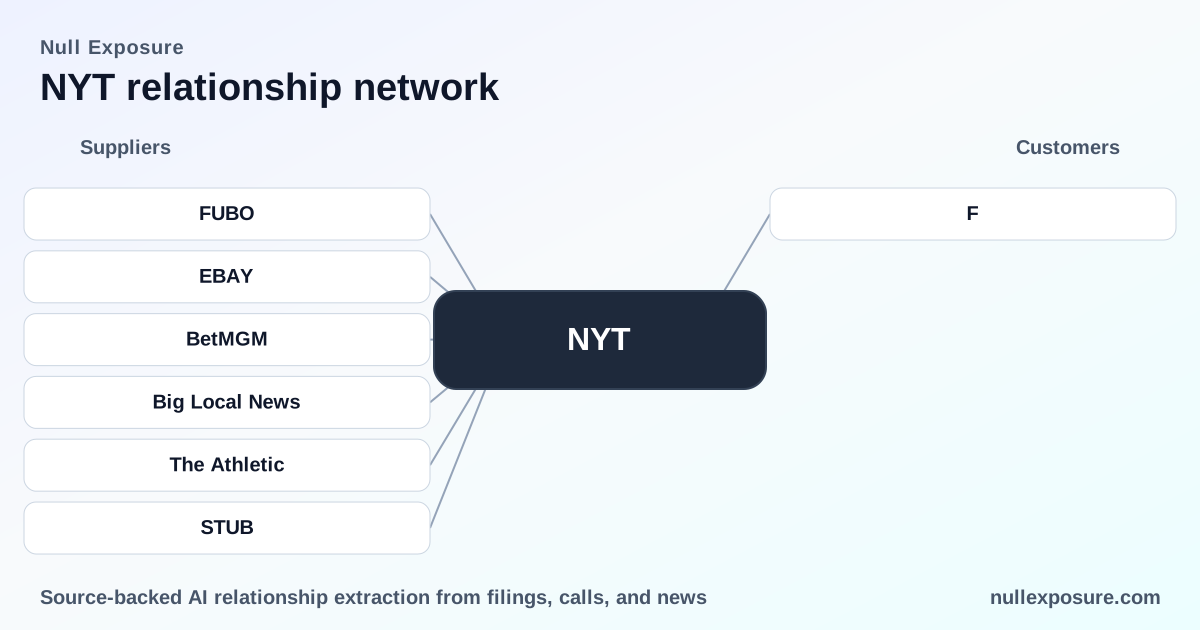
New York Times Company: supplier footprint and strategic implications for investors
Thesis: The New York Times Company operates as a subscription-first global publisher that monetizes through paid digital and print subscriptions, advertising and licensing, and selective content acquisitions. Its supplier relationships split into two operational categories: traditional industrial suppliers that underpin the print product (newsprint, coated paper, delivery contractors) and content or platform partners that extend distribution and commercial reach (streaming partners, collectibles, ticketing and sports content). Investors should evaluate supplier risk through the lens of supply criticality, contracting posture, and the strategic role each partner plays in audience monetization.
For a structured supplier overview and interactive mapping of counterparties, visit Null Exposure homepage.
How to read the Times’ supplier map — what matters for value
The New York Times runs a dual operating model: a content-first business with legacy print logistics. That creates distinct supplier dynamics:
- Contracting posture: Procurement of raw materials is managed through arm’s-length contracts with annual purchase commitments referenced to market rates. That posture limits price hedging but preserves flexibility to source across multiple suppliers.
- Concentration and geography: The company purchases newsprint and coated paper from a range of North American and European producers, giving regional diversification while leaving exposure to global pulp and paper cycles. Evidence in company disclosures cites both North American and European sources for primary raw materials.
- Criticality: Newsprint and third‑party delivery are operationally critical for the print product; interruptions translate directly to circulation and advertising revenue risk. The company also relies on commercial partners (streaming, tickets, odds, collectibles) for audience reach and ancillary revenue.
- Maturity: Relationships span mature manufacturing supply chains (paper, distribution) and fluid commercial partnerships (digital streaming, betting, ticketing) that are more transitory and commercially negotiated.
These operating constraints inform cash flow sensitivity to commodity cycles (paper inflation), logistical risk, and reputational/regulatory exposure from commercial partners.
Supplier relationships, one-by-one (what to know)
Below are every supplier relationship reported in the available results, with a concise investor-ready takeaway and source reference.
-
Fubo — The Times lists Fubo as a streaming partner tied to sports coverage and distribution in its Athletic reporting; this positions Fubo as a content-distribution channel rather than a core supplier of physical inputs. Source: New York Times Athletic coverage (Oct 17, 2025), https://www.nytimes.com/athletic/6726493/2025/10/17/nhl-expansion-price-cost/.
-
eBay — The Times references eBay in the context of collectibles, indicating an e‑commerce partnership for ancillary commerce around sports memorabilia and branded merchandise. This is a revenue-extension relationship rather than a manufacturing supply contract. Source: New York Times Athletic coverage (Oct 17, 2025), https://www.nytimes.com/athletic/6726493/2025/10/17/nhl-expansion-price-cost/ and Oct 16, 2025 article on WNBA moves, https://www.nytimes.com/athletic/6720985/2025/10/16/2025-wnba-free-agency-moves/.
-
BetMGM — The Times cites BetMGM in editorial listings for odds, reflecting a commercial content partnership that connects sports journalism to betting odds and potential referral or advertising economics; this partnership has regulatory and reputational dimensions given the gambling sector. Source: New York Times Athletic coverage (Oct 16–17, 2025), https://www.nytimes.com/athletic/6720985/2025/10/16/2025-wnba-free-agency-moves/ and https://www.nytimes.com/athletic/6726493/2025/10/17/nhl-expansion-price-cost/.
-
StubHub — The Times lists StubHub as the ticketing partner in sports coverage annotations, signaling a distribution/commerce relationship that channels readers to paid event tickets and likely contributes referral revenue. Source: New York Times Athletic coverage (Oct 16–17, 2025), https://www.nytimes.com/athletic/6720985/2025/10/16/2025-wnba-free-agency-moves/ and https://www.nytimes.com/athletic/6726493/2025/10/17/nhl-expansion-price-cost/.
-
Big Local News — The Times announced a collaboration with Big Local News, a Stanford-based data journalism lab, to support local investigative fellows with data access and training; this is a nonprofit academic partnership that strengthens investigative capacity and content quality. Source: NYT Company press release (introducing the 2023–24 Local Investigations Fellows), https://www.nytco.com/press/introducing-the-2023-24-local-investigations-fellows/ (FY2023).
-
The Athletic — The Times acquired The Athletic (coverage and confirmation in legacy reporting), integrating a subscription sports vertical that strengthens direct monetization of sports journalism and expands cross-sell opportunities across the Times’ subscriber base. Source: CNBC coverage of the acquisition (Feb 2022), https://www.cnbc.com/2022/02/10/the-athletic-co-founders-give-first-interview-since-sale-to-the-new-york-times.html.
Bold takeaway: These relationships split between commercial distribution/commerce partners (Fubo, eBay, StubHub, BetMGM) that extend reader monetization and academic/content partners (Big Local News, The Athletic) that increase editorial quality and subscription retention.
For a deeper supplier risk profile and visual mapping of these counterparties visit Null Exposure homepage.
Short notes on source quality and recency
The Athletic and partner mentions come from New York Times Athletic pages in October 2025 and public company press material spanning FY2022–FY2023; the mix of corporate press releases and major media coverage provides direct, verifiable signals of the partnerships and their public role.
What investors should focus on next: operational and financial signals
- Commodities sensitivity: Annual purchase commitments for newsprint — structured as the lesser of fixed tons or a percentage of total need, priced at market rates — create direct exposure of gross margins to global paper prices and input shocks. This is a structural constraint on print profitability that investors should track against revenue mix shifts to digital.
- Distribution risk: Delivery relies on a mix of in‑house drivers and third‑party contracts; any disruption to last‑mile operations directly affects circulation revenues and advertiser confidence. This is operationally critical and not easily substituted.
- Commercial partnerships as revenue amplifiers: Streaming, ticketing, collectibles and betting partners are highly visible monetization levers that scale reader engagement into ancillary revenue. These partnerships carry regulatory and reputational risk (particularly with betting partners), so governance oversight and disclosure are material.
- Diversification and maturity: The Times sources paper from North American and European producers, providing regional diversification for a critical input, and has institutionalized content partnerships via acquisitions and labs, indicating a mature strategic approach to supplier and partner management.
Bottom line and recommended actions for investors and operators
The New York Times manages a hybrid supplier set that balances legacy print inputs with modern commercial partnerships to monetize content. Key risks for investors are paper-price inflation and distribution disruption on the print side, and regulatory/reputational exposure on the commercial partnership side. Key strengths are diversified paper sourcing, a subscription-driven revenue base, and strategic integration of The Athletic and data partnerships to improve content monetization and retention.
For portfolio managers and corporate operators requesting supplier-level due diligence or counterparty exposure modeling, start with a focused review of paper-contract terms and the revenue economics of each commercial partner. For immediate access to a mapped view of these relationships, go to Null Exposure homepage.
Investors who require a tailored supplier risk brief for NYT should contact Null Exposure for a transaction‑grade report and counterparty scoring.