OAKU Supplier Relationships: What investors and operators need to know
Oak Woods Acquisition Corporation operates as a special purpose acquisition company (SPAC) that monetizes by completing a business combination and capturing sponsor economics (advisor fees, sponsor equity, and negotiated cash/share compensation tied to a closing). The company currently reports no operating revenue and relies on advisory and sponsor arrangements to advance a target transaction, making third-party relationships—especially advisors and its listing venue—central to value realization and downside risk. For deeper supplier-risk intelligence, visit https://nullexposure.com/.
Two counterparties behind the curtain — a concise map
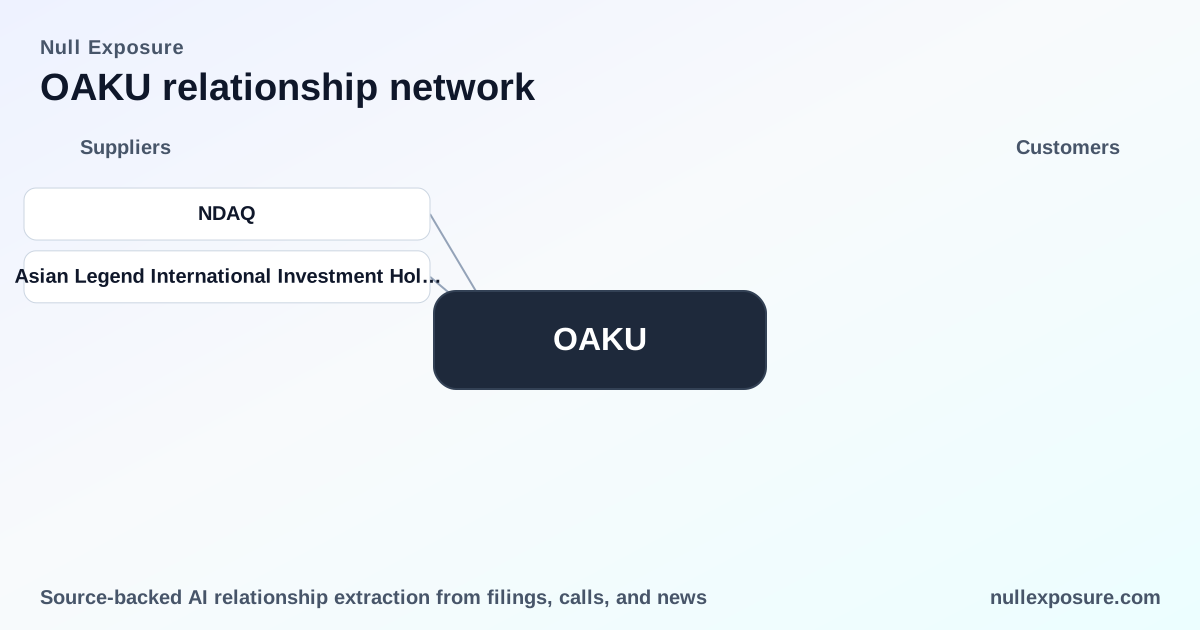
Oak Woods’ active supplier relationships are narrow but consequential: a capital-market regulator (Nasdaq) that governs listing compliance and a named advisor, Asian Legend International Investment Holding Limited, that performs critical deal advisory work. Both relationships influence deal execution timing, sponsor economics, and the firm’s liquidity profile.
Nasdaq: listing venue and compliance gatekeeper
Oak Woods is listed on the Nasdaq Capital Market under multiple ticker classes (OAKU, OAKUU, OAKUW, OAKUR), and recent reporting highlights a formal Nasdaq delisting action tied to compliance failures, a direct threat to the company’s ability to complete an accretive combination and preserve shareholder liquidity. According to The Globe and Mail coverage dated March 10, 2026, Nasdaq has moved toward a delisting process after the company failed to meet listing standards. (The Globe and Mail, March 10, 2026.)
Asian Legend International Investment Holding Limited: paid advisor for the business combination
Oak Woods engaged Asian Legend as an advisor to assist with shareholder meetings, investor introductions, public filings, and obtaining approval for a target business combination; Asian Legend is paid $100,000 per month in cash plus Class A ordinary shares upon consummation, and the company has accrued a material amount of consulting expense against the engagement. The engagement and fee structure are disclosed in the company’s SEC filings and summarized in a TradingView news item that references the SEC 10‑Q (FY2024). (TradingView reporting on the company’s SEC 10‑Q, FY2024.)
What the contractual excerpts tell investors about operating posture
-
Service-provider dependency: Oak Woods explicitly designates Asian Legend as a formal advisor with a multi‑month cash retainer and equity consideration; that structure makes Asian Legend a mission-critical supplier for closing the SPAC transaction. The filings state the advisor’s role in investor introductions and shareholder approvals, which are core to the deal execution roadmap.
-
Spend concentration at material levels: Contract language and balance-sheet footnotes show accrued consulting expenses of $1.5 million as of December 31, 2024 and monthly cash fees of $100,000 since October 2023 for Asian Legend’s services, positioning this relationship squarely in the $1M–$10M spend band disclosed in the company’s filings. (SEC 10‑Q disclosures referenced in TradingView, FY2024.)
-
Liability and liquidity signals at the company level: The company reports outstanding promissory/extension loans with a balance of $2,245,150 as of December 31, 2024, payable on demand. Additionally, the company pays an affiliate of its sponsor $10,000 per month for office and administrative services. These items are company-level financial constraints that pressure cash flexibility and extend counterparty complexity beyond just the named advisor.
Why these supplier relationships matter for valuation and risk
-
Execution risk is concentrated. Oak Woods’ ability to capture sponsor economics and create post‑combination value depends on successfully navigating Nasdaq compliance and completing a business combination—each governed by its listed-exchange status and the performance of its advisor network.
-
Counterparty economics are asymmetric. Monthly cash retainers plus equity for advisors transfer execution risk to the company while preserving upside for the advisor if a deal closes; this raises the fixed cash burn and dilutive potential ahead of any transaction.
-
Liquidity and governance pressures are visible. Promissory notes and affiliate payments indicate short-term funding dependencies and related-party service arrangements that investors must evaluate for conflicts and cash strain.
Quick checklist for investors and operators
- Confirm the status and timeline of Nasdaq compliance notices and any delisting appeals; a delisting materially changes optionality and exit pathways.
- Review the Asian Legend engagement terms in the SEC filings: monthly cash burn, equity issuance mechanics, and any exclusivity or termination provisions that affect deal flexibility.
- Stress-test the balance sheet against the reported $2.245M in demand-note obligations and recurring advisor cash fees to understand runway under realistic deal timelines.
- Investigate sponsor-affiliate service arrangements to assess related-party governance and potential dilution through off‑market pricing.
For tailored counterparty diligence and to monitor OAKU supplier signals programmatically, visit https://nullexposure.com/ for more intelligence.
Relationship-by-relationship detail (one-line investor summaries with sourcing)
- Nasdaq — Oak Woods faces a Nasdaq delisting process after failing to meet compliance standards, directly threatening the company’s listing status and ability to consummate a business combination (The Globe and Mail coverage, March 10, 2026).
- Asian Legend International Investment Holding Limited — Oak Woods retained Asian Legend as its advisor on the business combination, paying $100,000 per month in cash plus Class A shares and accruing $1.5 million in consulting expense as of December 31, 2024, reflecting a material advisory spend band (company SEC filings summarized in TradingView reporting on the company’s FY2024 10‑Q).
Bottom line and recommended next steps
Oak Woods is a SPAC where supplier dynamics—regulatory listing status and a concentrated, compensated advisory relationship—are the central drivers of near-term value and risk. The Nasdaq compliance process introduces binary downside (delisting) while the Asian Legend contract creates sustained cash obligations and dilution potential if the business combination closes. Investors should prioritize primary-source filing reviews (SEC 10‑Q/8‑K) on both the Nasdaq action and the advisor engagement, verify the structure and timing of any promissory note maturities, and demand clarity on sponsor-related services.
If you want ongoing monitoring of these supplier signals and a structured diligence workflow, start here: https://nullexposure.com/. For a bespoke supplier-risk briefing on OAKU, request an engagement via https://nullexposure.com/ and secure the counterparty intelligence your underwriting requires.