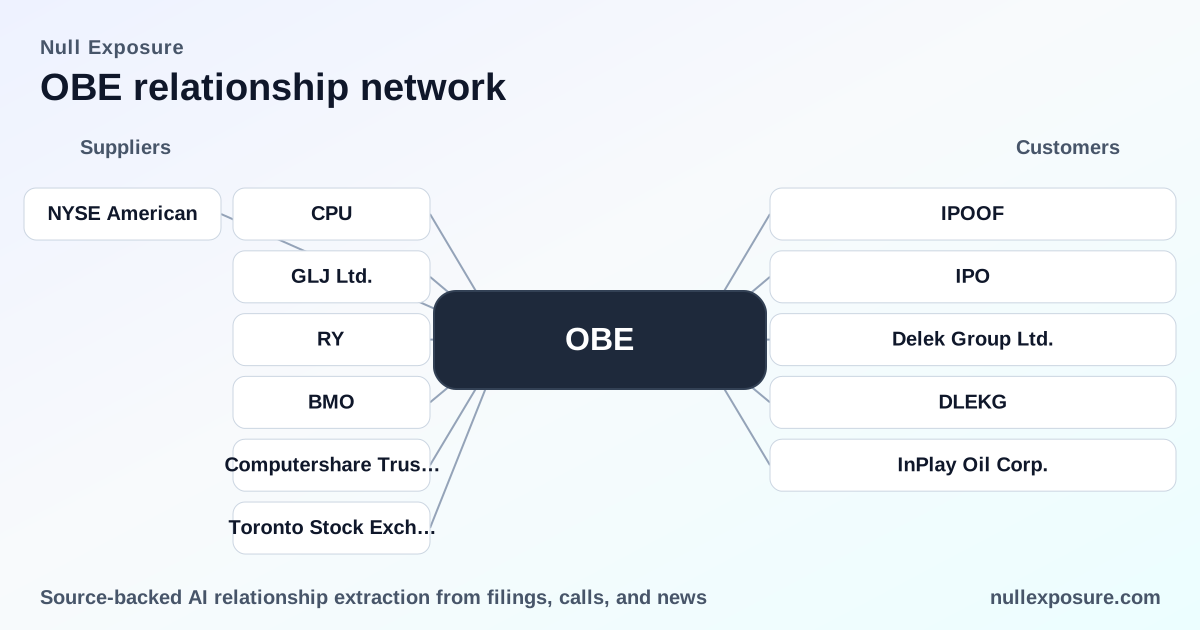
Obsidian Energy (OBE) — supplier relationships that shape financing and operations
Thesis: Obsidian Energy monetizes Western Canadian oil and gas production through operating cash flows and active capital markets management — using bank-led credit facilities, bond issuance with bookrunners, trustees for note redemptions, and independent engineering firms for reserves validation. These supplier relationships underpin liquidity, debt capacity and disclosure quality, and they materially influence near-term refinancing and capital-allocation choices.
For more structured supplier intelligence on Obsidian Energy and comparable issuers, visit https://nullexposure.com/ for a consolidated view of counterparties and contractual posture.
Why supplier relationships matter for an E&P operator
Obsidian's business model depends on two interlocked commercial pillars: commodity-driven operating cash flow from production and market access to credit and capital markets to smooth volatility and refinance maturities. The relationships in the public record show a conventional mid‑cap E&P posture: a bank‑led syndicated credit facility, active use of unsecured notes with bookrunners, trustee arrangements for indentures, and third‑party reserves certifiers that support investor disclosures and borrowing base calculations. These suppliers are not optional: they are the mechanisms that convert reserves and production into liquidity and capital-market confidence.
Explore supplier maps and relationship histories at https://nullexposure.com/ to evaluate counterparty concentration and contractual exposure.
The supplier map — direct relationships and what they mean
Below I cover each supplier relationship found in public reporting, one by one, with a plain-English summary and the primary source for verification.
Computershare Investor Services Inc.
Computershare acted as the tender agent for Obsidian’s offer to purchase a portion of its outstanding senior unsecured notes, coordinating the mechanics of holders’ elections and payments. (Newsfile release, March 2026 — https://www.newsfilecorp.com/release/262547/Obsidian-Energy-Completes-Offer-to-Purchase-1.4-Million-of-Our-Outstanding-Senior-Unsecured-Notes)
GLJ Ltd.
GLJ Ltd. prepared Obsidian’s independent reserves evaluation for the year ended December 31, 2025, which supports the company’s reserve disclosures and underpins borrowing‑base and valuation conversations with lenders and investors. (Newsfile/Boereport releases, Feb–Mar 2026 — https://www.newsfilecorp.com/release/282780/Obsidian-Energy-Announces-Strong-2025-Reserves-Results)
Royal Bank of Canada (RBC)
RBC led a syndicate of lenders in an amending agreement that confirmed a C$300 million borrowing base and adjusted permitted junior debt definitions to accommodate planned note issuance, reflecting RBC’s role in shaping covenant and borrowing‑base parameters. (The Globe and Mail summary, Nov 27, 2025 — https://www.theglobeandmail.com/investing/markets/markets-news/Tipranks/233/obsidian-energy-confirms-c300-million-borrowing-base-and-amends-credit-terms-ahead-of-2030-note-issuance/)
BMO Capital Markets
BMO Capital Markets served as a bookrunner alongside RBC on Obsidian’s US$175 million five‑year senior unsecured notes due 2030, indicating institutional placement support for Obsidian’s debt refinancing. (Newsfile/FinancialContent releases, Dec 2025 — https://www.newsfilecorp.com/release/275217/Obsidian-Energy-Announces-Offering-and-Pricing-of-175-Million-5Year-Senior-Unsecured-Notes-due-in-2030-and-Redemption-of-Existing-80.8-Million-Senior-Unsecured-Notes-due-in-2027)
RBC Capital Markets
RBC Capital Markets was co‑bookrunner on the 2030 note offering, sharing underwriting distribution and pricing responsibilities with BMO, which signals a bilateral banking relationship covering both lending and capital markets services. (Newsfile/Boereport releases, Dec 2025 — https://www.newsfilecorp.com/release/275217/Obsidian-Energy-Announces-Offering-and-Pricing-of-175-Million-5Year-Senior-Unsecured-Notes-due-in-2030-and-Redemption-of-Existing-80.8-Million-Senior-Unsecured-Notes-due-in-2027)
Computershare Trust Company of Canada
Computershare Trust Company of Canada acted as trustee under the Indenture during formal redemption notices for outstanding senior unsecured notes, executing the administrative and legal obligations associated with indenture redemptions. (Bore Report, Aug 2025 — https://boereport.com/2025/08/18/obsidian-energy-announces-notice-of-partial-redemption-for-30-million-of-our-outstanding-senior-unsecured-notes/)
Toronto Stock Exchange
Obsidian’s listing on the Toronto Stock Exchange establishes primary market access in Canada and subjecting the company to TSX listing rules and disclosure regimes; the listing also supports liquidity for Canadian holders. (Bore Report disclosure, Aug 2025 — https://boereport.com/2025/08/18/obsidian-energy-announces-notice-of-partial-redemption-for-30-million-of-our-outstanding-senior-unsecured-notes/)
NYSE American
Obsidian’s listing on NYSE American provides U.S. market access for equity investors and supports cross‑border investor coverage and pricing; this dual listing complements debt issuance in U.S. dollar markets. (Bore Report disclosure, Aug 2025 — https://boereport.com/2025/08/18/obsidian-energy-announces-notice-of-partial-redemption-for-30-million-of-our-outstanding-senior-unsecured-notes/)
What the relationship set reveals about Obsidian’s operating model
- Contracting posture: Obsidian combines traditional syndicated bank credit with public bond markets and third‑party trustees and certifiers, which is typical for mid‑sized E&P companies that need both committed bank lines and market liquidity.
- Concentration: The banking and capital markets activity is concentrated around a small set of counterparties — RBC and BMO are materially visible across borrowing base amendments and underwriting — implying counterparty risk is concentrated but with capable global institutions.
- Criticality: These relationships are mission‑critical: the borrowing base and bookrunners directly affect refinancing capacity and cost of capital, while GLJ’s reserves report is central to lender and investor confidence.
- Maturity and transactional profile: Engagements are a mix of standing arrangements (credit facility oversight by a lead bank) and transactional services (note underwriting, trustee actions, tender agent duties), indicating a mature yet active capital-management program.
If you want a breakdown of counterparty concentration, lender covenant triggers and maturity timelines, get a targeted supplier risk brief at https://nullexposure.com/.
Investment implications and risk checklist
- Liquidity management: The confirmed C$300 million borrowing base and recent 2030 note issuance reduce near‑term rollover risk but leave exposure to commodity cycles and future covenant tests if prices underperform.
- Counterparty dependency: Heavy reliance on RBC/BMO for both lending and underwriting concentrates execution risk; monitor any change in these banks’ energy sector posture.
- Disclosure quality: Independent reserves certification (GLJ) and formal trustee/tender agent use (Computershare entities) strengthen disclosure and governance around debt actions, which investors should treat as a positive governance signal.
- Market access: Dual listings (TSX, NYSE American) and successful note placement demonstrate continued market access at scale appropriate for Obsidian’s capitalization.
Bottom line and next steps
Obsidian’s supplier relationships reflect a typical, well‑orchestrated capital‑markets strategy for a Western Canada E&P: syndicated bank support, underwritten public bond financing, trustee oversight, and independent reserves validation. These relationships reduce execution risk on refinancing but concentrate counterparty exposure in a small set of large financial institutions.
For actionable counterparty exposure analysis and ongoing monitoring of Obsidian’s supplier signals, visit https://nullexposure.com/ to commission a tailored supplier-risk brief or view the full relationship map.