Orange County Bancorp (OBT): Funding relationships and supplier signals that matter to investors
Orange County Bancorp operates as a regional bank that earns net interest margin from lending and deposits and supplements fee income with wealth management and commercial banking services. The firm monetizes through core banking spreads, deposit gathering in its community markets, and selective non-interest revenue; its public disclosures show improved profitability metrics and a strong return on equity for a regional lender. For focused supplier and counterparty diligence, this piece isolates the funding and third‑party service relationships that directly influence liquidity, operational resilience, and vendor concentration. For deeper signal access on counterparties and supplier posture, visit https://nullexposure.com/.
Executive snapshot: how OBT’s commercial profile frames supplier risk
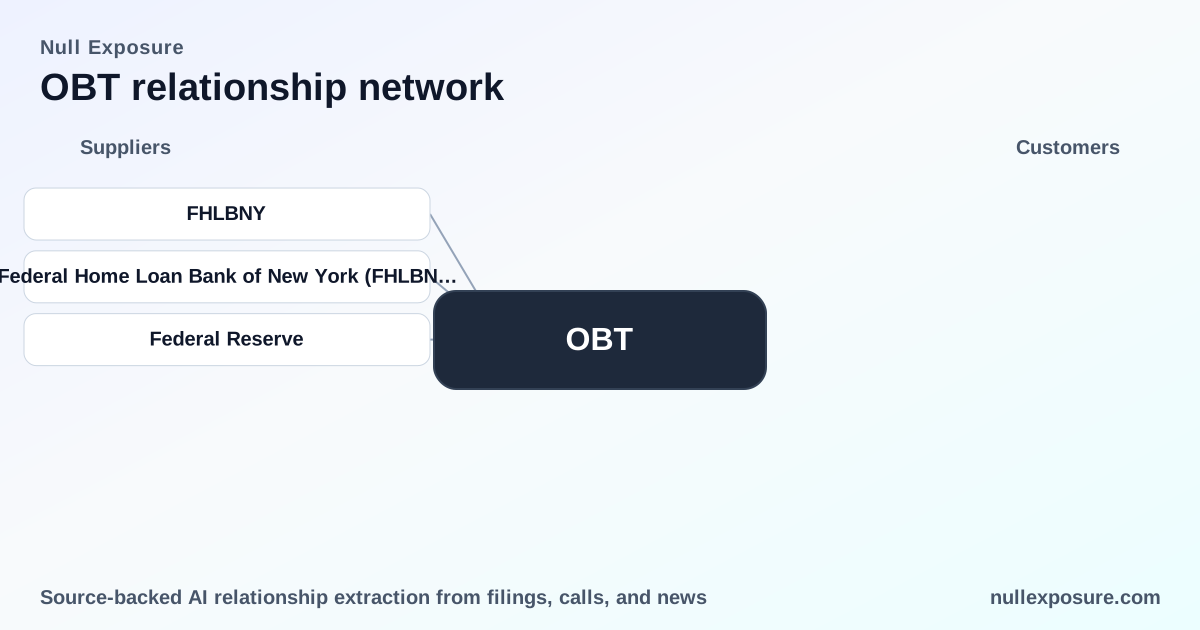
Orange County Bancorp is a NASDAQ‑listed, community-oriented bank with a market capitalization around $418 million and a trailing P/E near 9.4. Profitability and ROE (reported at roughly 17.7%) support self‑funding of operations, but the structure of external funding and outsourced technology controls remains a critical monitoring vector for investors and operators. The company’s FY2025 results and subsequent disclosures frame two supplier relationships—Federal Home Loan Bank of New York (FHLBNY) and the Federal Reserve discount window—as material to its liquidity posture, while vendor outsourcing for cybersecurity is a company‑level operational characteristic investors must price into counterparty risk models.
Funding counterparties: the two relationships you must track
Federal Home Loan Bank of New York (FHLBNY)
Orange County Bancorp disclosed that borrowings from FHLBNY fell sharply from $123.5 million at December 31, 2024 to $10.0 million at December 31, 2025, a reduction of $113.5 million. This is a material shift away from FHLB advances as a funding source and signals an improved deposit and liquidity position relative to the prior year. According to the company press release (GlobeNewswire, Feb 4, 2026), management emphasized the deliberate reduction in FHLBNY borrowings as part of fiscal 2025 results.
Federal Reserve (discount window availability)
Management also states that additional funding is available through discount window lending by the Federal Reserve, which functions as a standing liquidity backstop for depository institutions. That explicit acknowledgement of discount window access confirms an institutional contingency for short‑term liquidity management and informs stress‑testing assumptions for OBT. This point was communicated in the company announcement covered on Yahoo Finance (March 2026).
What these relationships mean for funding posture and counterparty concentration
The sharp reduction in FHLBNY borrowings is a clear signal of reduced reliance on wholesale advances, and it materially lowers counterparty concentration risk tied to the FHLB system. Simultaneously, public acknowledgement of access to the Federal Reserve discount window provides a liquidity backstop without implying active usage; investors should price the Fed as a contingency facility rather than a recurring funding source.
- Contracting posture: OBT behaves like a bank that prefers stable, core deposit funding and uses FHLB advances only as required; recent disclosures show a deliberate contraction of wholesale borrowing.
- Concentration: With FHLBNY borrowings reduced to low levels, counterparty concentration associated with FHLB exposure is diminished; deposit mix and internal liquidity substitution now carry more weight in the counterparty risk profile.
- Criticality: Both FHLBNY and the Federal Reserve remain critical to OBT as standard sector counterparties—FHLB for term and advance liquidity and the Fed for emergency discounting—so continued monitoring is required.
- Maturity and history: These are longstanding banking relationships rather than one‑off vendors; the institutional nature of FHLBNY and the Fed gives them predictable contractual terms and regulatory clarity.
For investors wanting systematic insight into how counterparties influence regional bank stability, our platform aggregates these signals—learn more at https://nullexposure.com/.
Operational supplier signals: third‑party cybersecurity and audit posture
Company disclosures describe a formal cybersecurity program that combines internal resources with third‑party vendors: monthly vulnerability scanning, annual NIST‑based risk assessments, third‑party annual penetration and vulnerability testing whose results are reported to the Tech Committee, and an outsourced internal auditor that audits the cybersecurity compliance program. This is a company‑level operational signal indicating that OBT is a buyer of security and audit services and relies on outsourced providers for key control validation, which raises vendor‑management and operational resilience considerations for investors and operators evaluating service concentration and control maturity.
- Outsourcing monthly scanning and annual penetration tests shows a mature contracting posture toward third‑party security services but also introduces supplier dependency and SLAs that need review.
- Use of an outsourced internal auditor demonstrates governance discipline but requires verification of independence, scope, and remediation follow‑through.
Practical implications for investment and operational due diligence
- Liquidity risk: The dramatic reduction in FHLBNY borrowings reduces wholesale funding vulnerability; investors should re‑weight liquidity stress tests toward deposit sensitivity and loan runoff rather than FHLB exposure.
- Backstop assessment: The Fed discount window line is a governance signal that management maintains access to official liquidity backstops; treat it as contingency capacity when modeling extreme scenarios.
- Vendor risk: Outsourced cybersecurity and internal audit services are operational dependencies that require vendor‑specific diligence in procurement, SLAs, and incident response plans.
Bold takeaway: OBT has materially reduced its FHLBNY dependence while preserving Federal Reserve backstop access and outsourcing key cybersecurity controls—this combination lowers immediate wholesale funding risk but increases the importance of vendor governance.
Quick reference: relationships covered
- FHLBNY — Borrowings decreased by $113.5 million to $10.0 million as of December 31, 2025, from $123.5 million a year earlier (company press release, GlobeNewswire, Feb 4, 2026).
- Federal Reserve — Company states that additional funding is available via the Federal Reserve discount window, confirming an institutional liquidity backstop (company announcement covered on Yahoo Finance, March 2026).
Next steps for investors and operators
Review liquidity models to reflect lower FHLB usage, validate contingency plans that rely on discount window assumptions, and request vendor governance evidence around cybersecurity and outsourced internal audit. For structured supplier-risk intelligence and ongoing monitoring tools tailored to regional banks, visit https://nullexposure.com/.
Final note: OBT’s public disclosures show a deliberate funding shift and a disciplined approach to outsourced security testing—both are measurable inputs for valuation and operational risk models going into the next fiscal cycle.