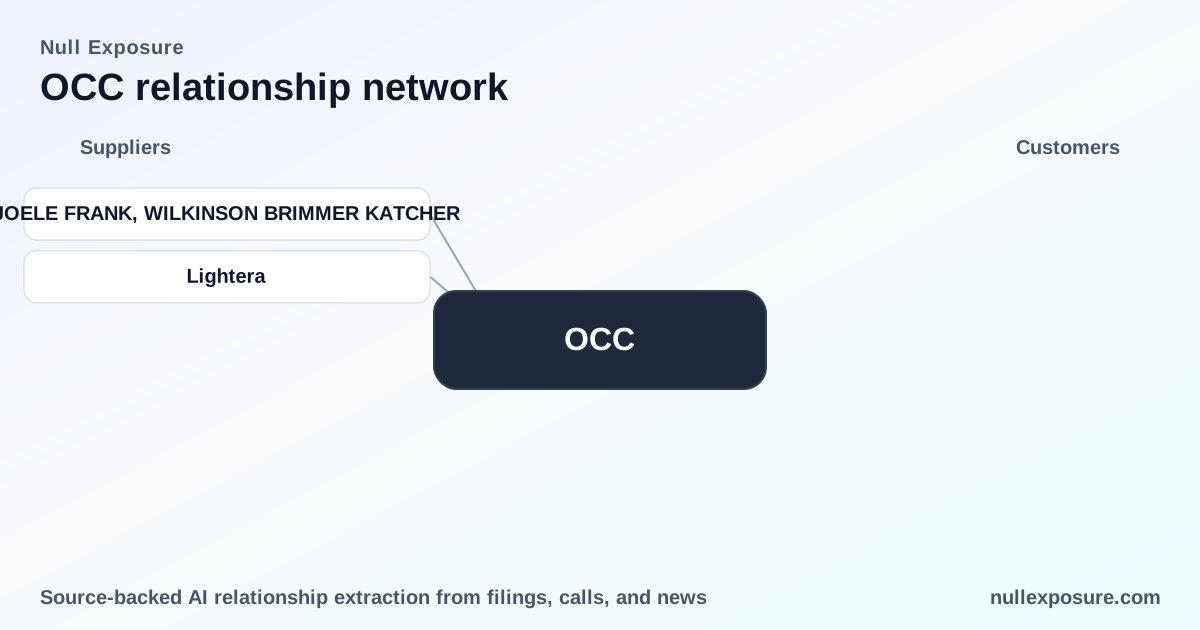
Optical Cable Corporation (OCC) — Supplier Relationship Profile and Investment Implications
Optical Cable Corporation manufactures and sells fiber-optic and copper data cabling and connectivity solutions to enterprise customers, monetizing through product sales, integrated solution bundles, and channel distribution in the U.S. and abroad. OCC’s economics are driven by product mix, margin control in cable manufacturing, and go-to-market partnerships that broaden its addressable enterprise footprint, while financials show modest scale: revenue of $72.7M, gross profit of $22.8M, EBITDA of $0.77M and a market capitalization near $64.4M (latest quarter to July 2025).
Explore supplier signals and strategic implications at https://nullexposure.com/
Why supplier relationships matter for a niche cable maker
In a capital- and asset-light manufacturing model where product breadth and supply chain execution determine win rates, supplier and partner relationships are operational levers and market levers at once. For investors and operators evaluating OCC, two relationship types matter most in the public record: product integration partnerships that expand sellable offerings, and communications/IR retainers that shape capital access and investor perception.
- Product partnerships directly affect revenue runway and technical differentiation.
- Communications suppliers affect liquidity and market pricing by managing investor outreach and disclosure cadence.
Below I map the relationships disclosed in recent public sources, translate each into plain-English implications, and summarize company-level supplier constraints observed in public filings and press.
What the public record shows about OCC’s suppliers and partners
The set of documented relationships available in the reviewed sources is compact but telling. Below are each of the relationships that are visible in public reporting, with a short plain-English summary and source citation.
Lightera — integrated product offering
OCC has combined portions of its product portfolio with Lightera to deliver integrated cabling and connectivity solutions that will be sold by OCC, signaling a product-level partnership to expand OCC’s solution set and channel-ready offerings. This arrangement strengthens OCC’s position selling integrated solutions to enterprise customers and creates potential cross-sell and margin improvement opportunities driven by broader SKU sets. (Source: earnings call transcript reported on InsiderMonkey, Q4 FY2025 / March 2026.)
Joele Frank, Wilkinson Brimmer Katcher — investor communications support
OCC engaged Joele Frank, Wilkinson Brimmer Katcher as a communications/IR contact for the FY2025 earnings call, with specific contact names and lines published in press notices. This is a standard investor relations arrangement that supports disclosure, investor outreach, and message control during earnings cycles — important for a small-cap company managing limited liquidity and information asymmetry. (Source: Barchart press notice scheduling OCC’s FY2025 earnings call, March 2026.)
Operating-model constraints and company-level signals
Our extraction returned no explicit supplier constraints (no public supply covenants, exclusivity clauses, or minimum-volume commitments surfaced in the reviewed documents). As a company-level signal, the absence of disclosed supplier constraints suggests OCC is not reporting material supplier covenants in the public notices reviewed, which has the following implications:
- Contracting posture: OCC operates with a commercial posture focused on product manufacturing and channel sales rather than on long-term, publicly disclosed, supply-side exclusivities. That gives management flexibility to re-source or adjust product mixes as customer demand shifts.
- Concentration: Publicly visible relationships are concentrated in a small number of partners; however, absence of constraints does not prove low concentration with suppliers — it only reflects limited disclosure in the reviewed sources. Investors should treat supplier concentration as an operational risk until confirmed by procurement-level disclosures.
- Criticality and maturity: The Lightera integration points to a mature product-level partner that is commercially important to OCC’s go-to-market expansion, while Joele Frank is a mature IR supplier focused on market communications rather than operations.
- Disclosure signal: Limited supplier constraint reporting is itself a signal: OCC’s public filings and press materials prioritize product and investor communications news rather than granular supplier and procurement details.
How these relationships change the investment thesis
The Lightera partnership is the operational headline: it expands OCC’s addressable offering and can lift near-term product revenue if integration and channel execution are effective. For a company with tight margins — gross margin roughly 31% on current revenue — product breadth can translate into higher top-line resilience.
Communications support from Joele Frank is a governance and capital-markets lever: consistent, professional IR reduces mispricing risk for a small-cap stock, which is notable when institutional ownership is only ~16% and insiders control ~35% of the float. Those ownership patterns make market messaging consequential to valuation.
Against upside, consider these risk items:
- Thin absolute profitability: OCC reported negative EPS (-$0.14) and modest EBITDA, so operational improvements from product partnerships have to scale quickly to shift the earnings profile.
- Scale limitations: Market cap near $64M and shares outstanding under 9 million constrain capital flexibility; product rollouts require efficient working capital management.
- Disclosure gap on supplier concentration: Absence of public supplier constraints elevates the need for direct diligence on procurement concentration and lead-time risk.
Learn more about supplier-risk and partner exposure for small caps at https://nullexposure.com/
Practical takeaways for investors and operators
- Lightera partnership is the primary operational signal — treat it as a revenue-enabling relationship that changes product mix and sales motion.
- IR spend with Joele Frank is material for valuation management — for a small-cap company, professional communications materially impact liquidity and investor access.
- No explicit supplier constraints were disclosed in the reviewed sources, which places the burden on active investors to request supplier concentration and contingency details during diligence or earnings calls.
Conclusion and next steps
For investors, OCC presents a classic small-cap manufacturing story: niche product strength and targeted partnerships offer upside, while tight profitability and limited public supplier disclosure elevate execution risk. Operators should prioritize proving integration economics with Lightera and reducing working-capital drag to convert revenue growth into sustainable EBITDA.
For deeper supplier and counterparty intelligence, visit https://nullexposure.com/ — the platform consolidates public relationship signals and provides the context needed to judge operational criticality and concentration.