OceanFirst (OCFC): Capital partners, funding posture, and vendor reliance — what investors should know
OceanFirst Financial Corp operates as a regional bank based in New Jersey, generating revenue through net interest margin, fee income and targeted M&A to expand deposit and loan franchises. The company monetizes by deploying deposit-funded lending and selectively using third‑party capital injections and long‑term FHLB advances to support acquisitions and balance‑sheet growth. For investors evaluating supplier and capital relationships, the recent Warburg Pincus equity commitment and OceanFirst’s funding and outsourcing posture are the most material dynamics to monitor. Learn more on how these relationships map to risk and opportunity at https://nullexposure.com/.
Executive snapshot: balance-sheet posture and market signals
OceanFirst is a small regional bank with a market capitalization near $1.02 billion and trailing revenue of roughly $389 million. Valuation and return metrics are mixed: a trailing P/E of 15.3 and forward P/E of about 10.5 contrast with a low return on equity (~4.2%) and modest EPS, reflecting a bank in transition after recent deal activity. The stock yields roughly 4.5% and trades at a price‑to‑book under 1.0, indicating the market is pricing in ongoing integration risk and capital dilution dynamics.
These financial characteristics frame how supplier and capital relationships affect enterprise value: capital injections and funding sources directly influence dilution, capital ratios, and the bank’s ability to execute on acquisitions.
How the Warburg Pincus relationship changes the game
According to a Globe and Mail press release in March 2026, OceanFirst agreed to a $225 million equity investment from affiliates of Warburg Pincus, structured as common stock issuance, a new non‑voting common‑equivalent stock class, and a seven‑year warrant tied to the company’s share price. This capital infusion is explicitly intended to support financing for the Flushing acquisition and to strengthen OceanFirst’s capital base. (Globe and Mail, March 2026.)
- The investment is strategically significant: it supplies near‑term cash for an acquisition and pushes a private‑equity affiliate into a material minority economic position.
- The structure (new non‑voting class plus long‑dated warrants) creates economic dilution potential without immediate governance change, which is important for incumbent management and minority shareholders.
For a direct read of the announcement, see the press release reported by The Globe and Mail (March 2026).
Supplier and funding constraints that shape execution
OceanFirst’s operating model shows two company‑level signals that are central to supplier risk and funding strategy.
- Long‑term funding reliance: company disclosures show $1.07 billion of FHLB term advances at December 31, 2024, up from $848.6 million at year‑end 2023. This indicates an established use of longer‑dated secured advances as a material funding channel. The presence of sizeable FHLB term advances signals a contracting posture that favors stable, long‑dated secured funding to back loan growth and acquisitions, but it also creates concentration in a single funding source that is critical to liquidity planning.
- Outsourced processing dependency: OceanFirst’s filings state that a majority of data processing is outsourced to third‑party providers, creating operational dependency on external service providers for transaction processing and accounting. This is a classic service‑provider relationship where outages, contract disputes, or data exchange issues could materially affect operations.
Together, these constraints mean OceanFirst runs with a hybrid model: external capital injections and long‑term secured borrowing on the funding side, and significant vendor outsourcing on operations. Investors should treat both as strategic levers — and potential single points of failure — in the near term.
(These signals are drawn from company disclosures referencing FHLB advances and outsourced data processing in its year‑end reporting.)
Relationship inventory: the relevant counterparties investors should track
Warburg Pincus (strategic capital provider)
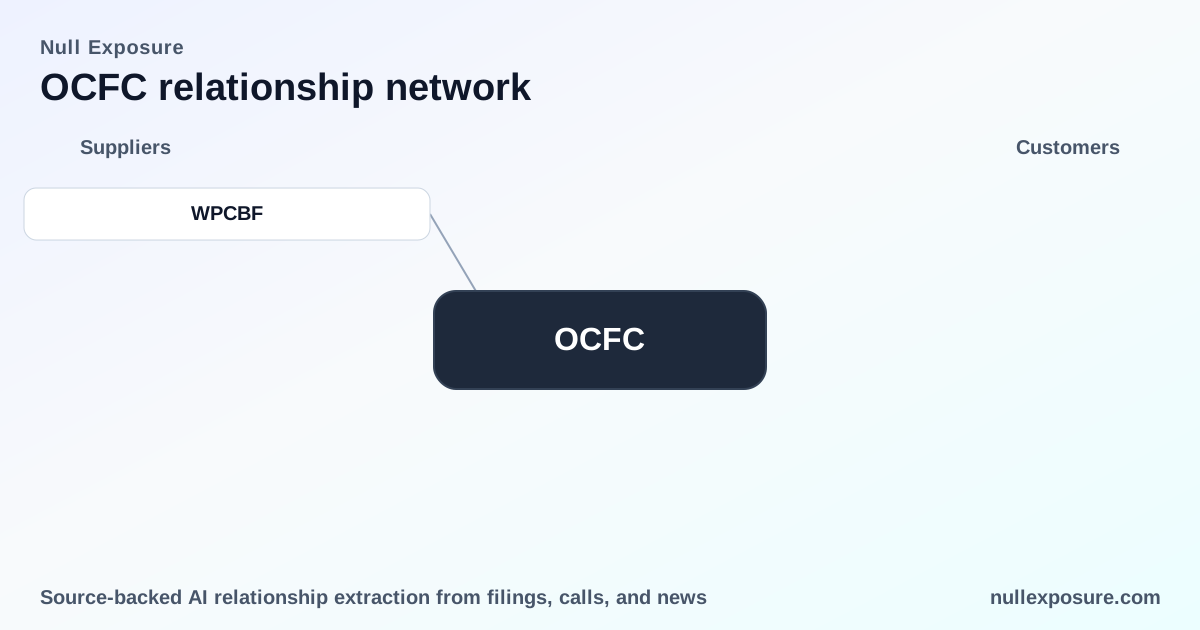
OceanFirst secured a $225 million equity investment from affiliates of Warburg Pincus, involving common stock issuance, a new non‑voting common‑equivalent stock class, and a seven‑year warrant to support the Flushing acquisition and strengthen capital. (Reported by The Globe and Mail, March 2026.)
This is the only supplier/capital relationship surfaced in the recent coverage and is the current focal point for capital structure risk and dilution.
What these relationships mean for governance, dilution, and execution
- Dilution profile: The Warburg structure separates economic upside from immediate governance by employing a non‑voting class and warrants; expect economic dilution risk for common shareholders if warrants are exercised or the new class converts under certain terms.
- Funding concentration: Heavy reliance on FHLB term advances demonstrates disciplined use of long‑term, secured funding but also creates concentration risk — any regulatory or market change that alters FHLB access or cost would be immediately consequential.
- Operational criticality: Outsourcing core data processing increases operational leverage; vendor performance and contract management are mission‑critical. A misstep here would be operational rather than balance‑sheet in nature, but could still meaningfully damage customer trust and regulatory standing.
For active investors and operators, those are the three levers that determine execution risk and upside capture: capital structure, funding sources, and vendor dependency.
Learn more about mapping counterparty risk to enterprise value at https://nullexposure.com/.
Investment implications and risk checklist
- Short term: Watch capital deployment and integration of the Flushing acquisition; the Warburg capital keeps liquidity available but raises dilution and warrant exercise scenarios.
- Medium term: Monitor FHLB advance roll‑rates and the cost of secured funding — these will drive net interest margin sensitivity and capital adequacy under stress.
- Operational: Review vendor continuity plans and third‑party SLAs tied to data processing; operational lapses are the most immediate non‑financial hazard to earnings reliability.
If you are modeling OceanFirst, explicitly include scenarios for warrant dilution, FHLB repricing, and vendor failure recovery costs. For a tailored analysis and counterparty mapping, visit https://nullexposure.com/.
Bottom line: concentrated capital and outsourced operations create a clear risk/reward profile
OceanFirst’s strategic path now combines private equity capital participation with established long‑term secured funding and a reliance on outsourced processing. That combination funds growth but concentrates risk around a few counterparties and instruments. Investors should price the trade as one where acquisition upside is real but contingent on execution across capital, funding, and vendor channels.
Key takeaway: Warburg Pincus provides meaningful capital without immediate governance control, FHLB advances supply durable liquidity at the cost of funding concentration, and third‑party processors create operational dependency — each is actionable and monitorable.