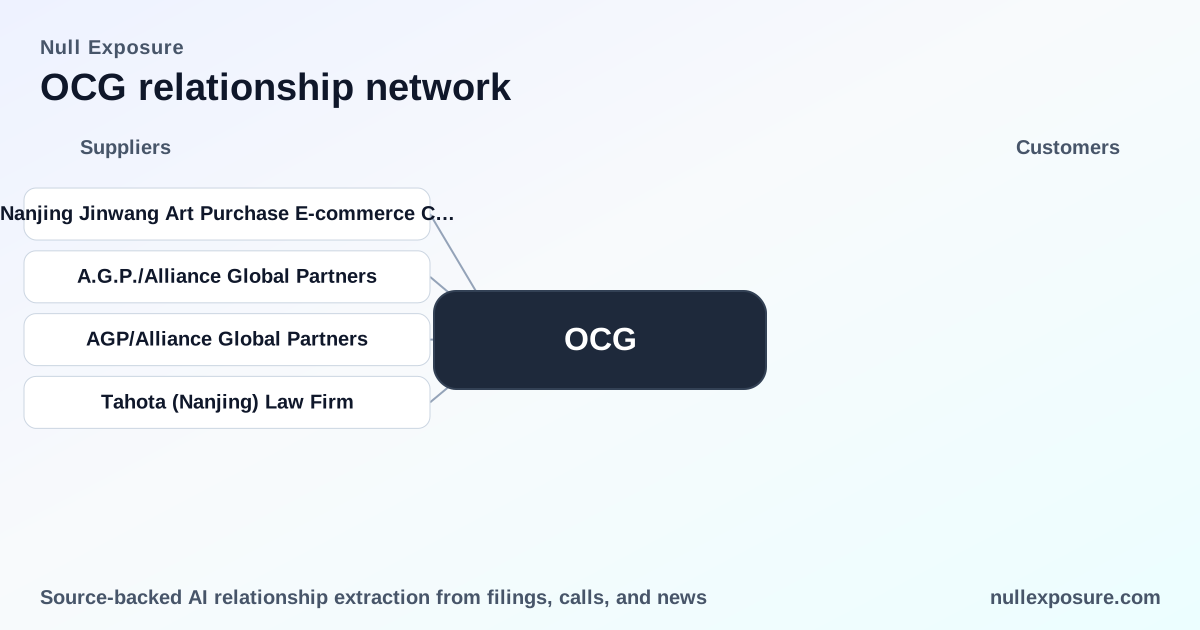
Oriental Culture Holding (OCG): supplier relationships that shape liquidity and operational risk
Oriental Culture Holding LTD operates an online platform that facilitates e‑commerce of artworks in China and generates revenue from platform transaction activity and related services. The company’s economics today are driven as much by its ability to access capital and manage escrow/settlement partners as by its top‑line art commerce volumes; supplier relationships therefore have outsized influence on valuation and operational continuity. Explore OCG’s supplier map and implications for investors — or see a broader supplier risk view at https://nullexposure.com/.
Quick economic snapshot investors need to hold in mind
OCG is a micro‑cap listed on Nasdaq with sharp operating losses and thin institutional ownership. Reported trailing revenue is roughly $316,810 with negative EBITDA and an operating margin of -31.9%, while market capitalization sits near $4.56 million and shares outstanding are small relative to price volatility. The stock exhibits an unusually high price‑to‑sales multiple (14.4) for the revenue base, combined with a very low institutional ownership (1.4%) and tight reported float, which amplifies financing and dilution dynamics. These financials underline why supplier and capital‑raising relationships are central to near‑term performance rather than organic growth alone.
The key suppliers and counterparties that matter — line by line
Below are the supplier relationships surfaced in public reporting. Each entry is a plain‑English description plus a concise source reference.
-
Nanjing Jinwang Art Purchase E‑commerce Co., Ltd. — OCG entrusted Nanjing Jinwang with escrow services for its two online trading platforms, and public reporting notes that on July 1, 2022 the bank accounts of Nanjing Jinwang were frozen by Nan County Public Safety Bureau, including the trust account used for customer security deposits. This is a direct operational dependency given the escrow function. (Source: OCG first‑half 2025 financial release as syndicated on GlobeNewswire / Manila Times; see https://www.manilatimes.net/2025/11/15/tmt-newswire/globenewswire/oriental-culture-holding-ltd-announces-first-half-year-of-2025-unaudited-financial-results/2224590 and QuiverQuant reporting.)
-
A.G.P./Alliance Global Partners — OCG entered a sales agreement with A.G.P./Alliance Global Partners to run an at‑the‑market (ATM) equity offering up to $200 million, allowing the company to sell newly issued ordinary shares from time to time at prevailing market prices; the arrangement was disclosed in a Form 6‑K filed Dec. 11, 2025. This supplier relationship is the company’s chosen pathway to access near‑term capital. (Source: Form 6‑K disclosure and market coverage, Dec. 11–13, 2025; reporting at TS2.Tech and follow‑ups at QuiverQuant.)
-
Tahota (Nanjing) Law Firm — PRC counsel Tahota (Nanjing) Law Firm is cited in OCG’s public filings as confirming that an investigation and case related to prior operational issues have been officially closed. That legal engagement and the stated closure reduce a material legal overhang. (Source: First‑half 2025 financial release and related reporting; see QuiverQuant and GlobeNewswire/Manila Times coverage dated Nov. 2025.)
Why these relationships change the investment equation
OCG’s supplier map is compact and highly consequential. Two structural implications stand out:
-
Capital access is outsourced and dilutive. The ATM engagement with A.G.P./Alliance Global Partners converts capital risk into a supplier dependency: the company can raise cash quickly, but the program creates significant dilution risk given current market pricing and the program size relative to market cap. Form 6‑K disclosure on Dec. 11, 2025 makes that arrangement explicit.
-
Operational continuity rests on third‑party escrow and legal counsel. The freezing of Nanjing Jinwang’s accounts in 2022 — including the escrow trust account for customer deposits — is a prior event that directly affected settlement mechanics and customer confidence. The firm’s reliance on an external escrow operator increases counterparty concentration and operational criticality. The company’s PRC counsel reporting that the investigation is closed is a positive legal development, but the underlying escrow failure is an operational red flag for platform reliability.
Company‑level operating constraints and posture (signals for modelers and operators)
Even where no formal constraints are listed, public disclosures convey company‑level signals that investors and operators must factor in:
-
Contracting posture: OCG demonstrates a tendency to outsource critical functions (escrow, legal, capital placement) rather than internalize them, which accelerates go‑to‑market speed but increases counterparty risk.
-
Concentration: The supplier base is highly concentrated — a single escrow provider and a single equity placement agent represent outsized points of failure.
-
Criticality: Escrow services and the ATM placement agent are mission‑critical; disruption to either can halt platform transactions or block access to capital.
-
Maturity: These relationships have mixed maturity — the ATM is a new formal program (Dec. 2025) while the escrow relationship has a history that includes a regulatory intervention in 2022 and a legal closure reported in 2025, suggesting an unresolved operational legacy that is trending toward stabilization.
If you want a deeper, structured breakdown of counterparty concentration and contingency planning for suppliers, visit https://nullexposure.com/ for additional research and templates.
Investment implications and near‑term checklist
OCG is a classic capital‑sensitive micro‑cap where supplier relationships determine survival and valuation more than organic marketplace momentum. Key investor takeaways:
-
Dilution risk is substantial. The $200 million ATM program against a market cap in the single‑digit millions creates asymmetric dilution potential if executed at depressed prices.
-
Operational risk has real history. The Nanjing Jinwang escrow freeze is a tangible event that exposes customers and the platform to settlement interruption; resolution via counsel helps, but the underlying counterparty concentration remains.
-
Legal overhang reduced but not eliminated. Tahota’s confirmation that the investigation is closed removes one immediate headline risk and is a constructive legal signal.
Practical near‑term checklist for operators and research analysts:
- Verify escrow custody arrangements and whether funds are held in segregated trust accounts under direct company control.
- Monitor ATM execution cadence and volume filed via Form 6‑Ks to measure real dilution.
- Track customer‑facing controls and platform settlement logs for evidence of resumed normal operations.
Bottom line for allocators
Oriental Culture Holding is a small, distressed online art platform where supplier contracts — particularly the ATM agent and escrow provider — dictate capital runway and operational continuity. For investors, the trade is not a pure play on marketplace growth but a bet on the company’s ability to execute capital raises without catastrophic dilution while stabilizing escrow and settlement operations. For operators and counterparties, contractual terms and remediation rights with Nanjing Jinwang and similar service providers are the most important levers to manage downside.
Learn more about supplier risk scoring and partner resilience at https://nullexposure.com/ — the right supplier map changes the valuation conversation.
Major sources referenced: OCG first‑half 2025 press release syndications via GlobeNewswire/Manila Times (Nov. 2025), Form 6‑K disclosure on Dec. 11, 2025 (ATM sales agreement reported by TS2.Tech and QuiverQuant), and QuiverQuant’s aggregation of the company’s first‑half results. Links cited above point to the primary reporting.