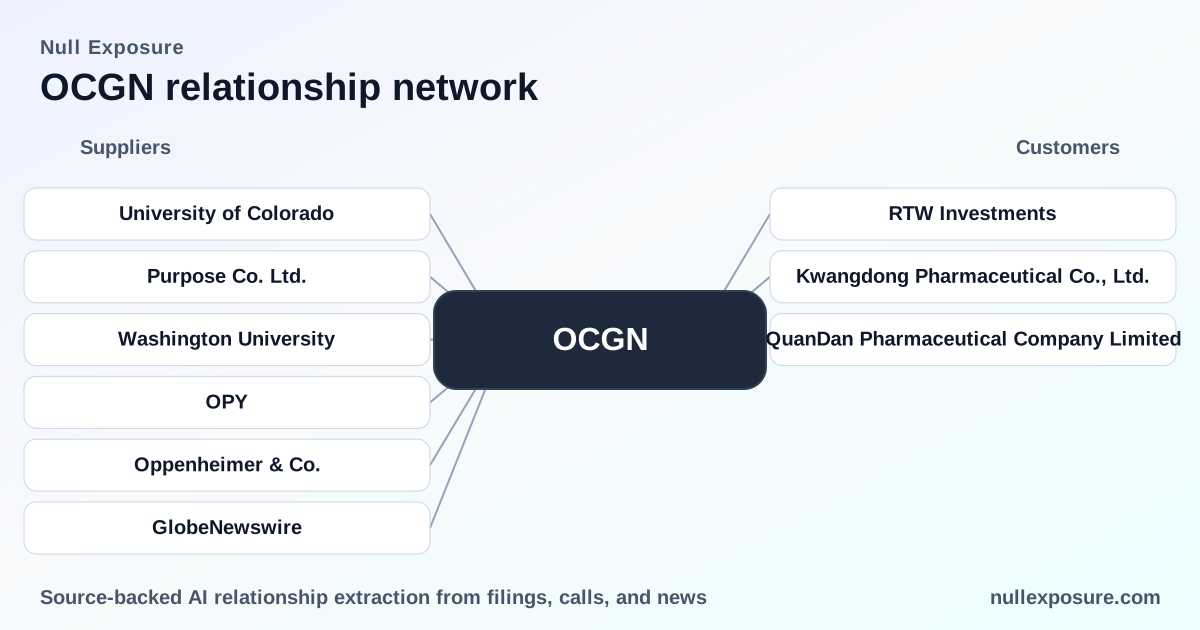
Ocugen Inc (OCGN): supplier relationships that shape commercialization and capital trajectory
Ocugen is a clinical-stage biopharmaceutical company focused on gene and biologic therapies for inherited retinal diseases and mucosal vaccine development. The company monetizes through exclusive licensing of academic IP, sublicensing, development partnerships, and ultimately product commercialization and royalty streams; short-term cash needs are funded through equity offerings. Revenue visibility today is limited and the operating model is heavily partner-dependent, so counterparty strength and manufacturing capacity are first-order investment risks. For a structured supplier-risk view and transaction-grade intelligence, visit https://nullexposure.com/.
How Ocugen’s external relationships drive value (and risk)
Ocugen runs a capital-intensive R&D model that outsources core manufacturing, clinical operations, and specialized IP while retaining licensing and development control. The company’s filings disclose long-term real estate and GMP facility leases, and repeated references to third-party contract manufacturers and clinical sites. That combination creates a predictable fixed-cost posture on the facility side and high operational concentration on vendors for CMC and trial execution.
- Contracting posture: Ocugen has multi-year leases (initial seven-year terms with extension options) for headquarters and GMP facilities, indicating a commitment to internal infrastructure alongside outsourced manufacturing (Ocugen 2024 Form 10-K).
- Operational concentration: The company explicitly relies on CDMOs to manage CMC and clinical manufacturing activities; failure of those partners directly impacts development timelines and commercialization capability (10-K).
- Service dependency: Ocugen engages third-party cybersecurity and clinical operations providers for critical services, making vendor governance and compliance controls material to operational continuity (10-K).
These factors combine into a simple investor calculus: intellectual property and regulatory progress drive upside, while single-source manufacturing and limited internal capacity drive downside and dilution risk. If you evaluate Ocugen as a supplier counterparty or as a portfolio holding, prioritize manufacturing redundancy, licensing exclusivity terms, and planned use of capital.
For more supplier-level risk scoring and contract summaries, explore https://nullexposure.com/.
What public records list as Ocugen’s named partners and service relationships
-
University of Colorado — Ocugen holds an exclusive license that originated in March 2014 and was amended in January 2017; this is foundational IP licensing for the company’s programs. According to Ocugen’s 2024 Form 10-K, the Company entered into an exclusive license agreement with the University of Colorado in March 2014, amended January 2017 (10-K, FY2024).
-
Purpose Co. Ltd. — Ocugen assumed an exclusive sublicense originally granted to Histogenics from Purpose Co. Ltd. as a component of its reverse merger with Histogenics, carrying legacy IP obligations into Ocugen’s portfolio. The 2024 Form 10-K discloses that Histogenics entered into a Purpose Agreement in December 2005 and Ocugen assumed it through the reverse merger (10-K, FY2024).
-
Washington University — Ocugen obtained an exclusive, sublicensable, royalty-bearing license to patent rights covering a mucosal COVID-19 vaccine under a September 2022 WU License Agreement, underpinning its vaccine candidate strategy. This licensing arrangement is described in Ocugen’s 2024 Form 10-K (10-K, FY2024).
-
Oppenheimer & Co. (TradingView item) — Oppenheimer acted as sole book-running manager for an underwritten offering tied to Ocugen’s January 2026 stock sale, reflecting recent capital-raising activity. TradingView reported that Oppenheimer & Co. served as the sole book-running manager for the offering (TradingView news item, Mar 10, 2026).
-
Oppenheimer & Co. (GlobeNewswire press release) — Ocugen announced the closing of a $22.5 million registered direct offering where Oppenheimer was the sole book-running manager; proceeds were expected to be approximately $20.8 million net. The GlobeNewswire press release (Jan 23, 2026) confirms Oppenheimer’s role and the offering economics (GlobeNewswire, Jan 23, 2026).
-
Oppenheimer & Co. (Sahm Capital note) — Trade and market outlets repeated that Oppenheimer ran Ocugen’s January 2026 underwritten registered direct offering as the sole book-running manager, reinforcing that the firm led the transaction. Sahm Capital’s news item mirrors the underwriting description (Sahm Capital news, Jan 23, 2026).
-
Oppenheimer & Co. Inc. (The Globe and Mail) — The Globe and Mail covered the underwriting agreement dated January 20, 2026, reporting the sale of 15 million shares at $1.50 per share to raise $22.5 million gross, with Oppenheimer as underwriter. The Globe and Mail press release (Jan 20, 2026) summarizes the transaction economics and underwriting arrangement (The Globe and Mail, Jan 20, 2026).
-
GlobeNewswire (QuiverQuant item) — A QuiverQuant news feed includes an automated summary of a GlobeNewswire press release about Ocugen’s fourth quarter and full-year 2025 financial results and conference call, noting the press release content and the use of automated summarization. The QuiverQuant notice references GlobeNewswire material and identifies a disclaimer about an AI-generated summary (QuiverQuant, FY2026).
What these relationships mean for counterparty risk and commercial execution
The combination of exclusive academic licenses and dependence on external manufacturers and service providers creates a classic biotech supplier profile: IP control is strong through licensed rights, but execution is outsourced. That structure produces three investor-grade implications:
-
Concentration risk is high. Ocugen’s development and potential commercialization hinge on a small set of third-party manufacturers and clinical vendors; loss or non-performance by a CDMO is a direct timeline and revenue risk (company 10-K disclosures on manufacturing and CDMO agreement, FY2024).
-
Contract maturity is mixed. Long-term leases for headquarters and GMP capacity show strategic commitment to operations, but the manufacturing relationships are operational rather than ownership-based, so scalability depends on vendor capacity and regulatory compliance (10-K lease and CDMO excerpts).
-
Financing and dilution are active levers. The January 2026 registered direct offering underwritten by Oppenheimer demonstrates reliance on equity markets for near-term funding; investors must evaluate the use of proceeds and subsequent dilution when modeling upside (GlobeNewswire/The Globe and Mail, Jan 2026).
If you are evaluating Ocugen as a supplier partner or investment, prioritize vendor audits, license reach-through terms, and the company’s contingency plans for manufacturing continuity.
For transaction-focused supplier intelligence and to map Ocugen’s vendor concentration in detail, review our platform at https://nullexposure.com/.
Final takeaways and recommended next steps
- Ocugen’s value proposition is IP-driven and partner-executed. Exclusive academic licenses provide ownership of development pathways while CDMOs and clinical service providers supply execution capability.
- Operational concentration and near-term financing needs are principal risks. Assess counterparty redundancy, regulatory compliance history of key vendors, and the company’s cash runway after the January 2026 offering.
- Actionable next steps for investors and counterparties: request CDMO audit summaries, confirm sublicensing economics on major licenses, and scrutinize the planned allocation of proceeds from recent financings.
For an actionable supplier-risk briefing tailored to Ocugen or to schedule a vendor diligence package, go to https://nullexposure.com/.